

SDCC 2026: Marvel Legends Bridges Every Marvel Era
SDCC 2026: Hasbro’s Marvel Legends Bridges Every Marvel Era
Friday 24 July, 9:00 PM PT San Diego, Convention Center, Hasbro Booth #3213 2026-07-22 → 2026-07-26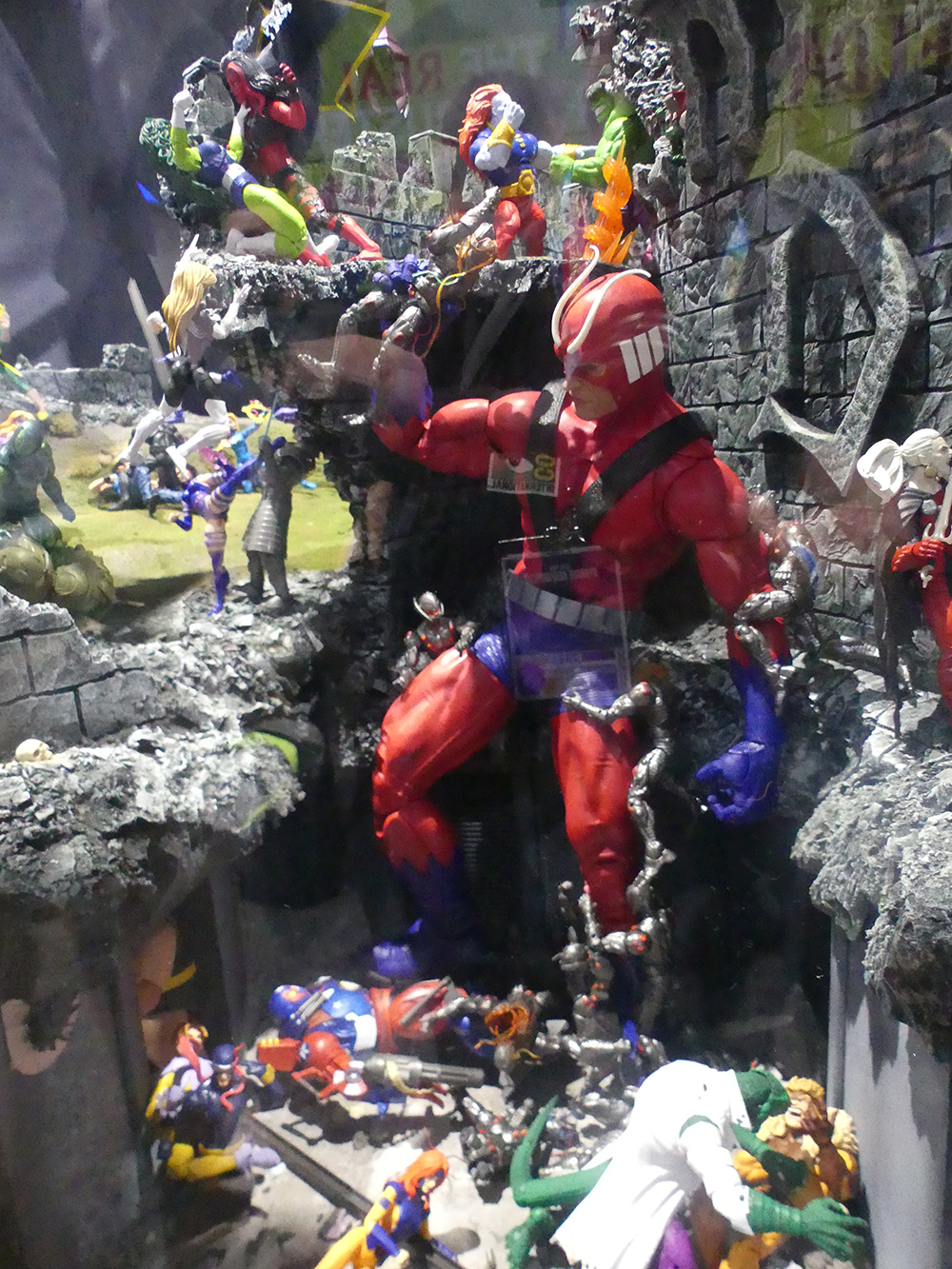
At San Diego Comic-Con 2026, Hasbro treated Marvel Legends less as a single action-figure line than as a physical map of Marvel’s many lives. Classic television animation, modern streaming, comic-book deep cuts, fighting games and the Marvel Cinematic Universe all occupied the same display. That breadth felt especially appropriate for a brand that began under Toy Biz in 2002 as a six-inch-scale offshoot of Spider-Man Classics, passed to Hasbro when its Marvel toy licence took effect in 2007, and returned to shelves in 2012 after a slowdown. The modern booth retained the line’s founding promise—recognisable characters, extensive articulation and display-minded extras—while showing how far its source material has expanded.
The presentation’s most useful insight was not simply that Marvel Legends can cover almost any period. It was that each corner received a different visual language. The 1967 cartoon figures embraced flat, bright animation colours; X-Men ’97 used retro-TV packaging; the Future Foundation releases leaned into coordinated comic uniforms; Marvel Games adopted the energy of an arcade character-select screen; and Avengers: Doomsday translated costumes from an unreleased film into plastic. The result made nostalgia and novelty feel complementary rather than competitive.

Convention exclusives turn television memories into display pieces
The first of two convention releases recreated the original 1967 Spider-Man animated series with Spider-Man, Marvel’s Lizard and Marvel’s Electro. The three-pack included 28 accessories, among them alternate heads and hands, power effects and Peter Parker’s removable Spider-Man mask. Its outer box resembled an old television caught in webbing, transforming packaging that many buyers would normally discard into part of the display. The concept also made room for the cartoon’s most durable afterlife: alternate pointing hands allowed collectors to restage the famous Spider-Man-pointing-at-Spider-Man image that became an internet meme decades after the episode aired.
The companion exclusive placed Professor Charles Xavier in his hovering chair from X-Men ’97. The six-inch-scale figure offered more than 20 points of articulation, alternate hands, a second head, a removable Cerebro helmet and a psychic effect. The chair added detailed controls, removable blast effects and a clear support that created the appearance of hovering. With one vehicle, one figure and 13 accessories, the set was more than a seated character; it solved the difficult display problem of making a floating chair look convincingly weightless on a shelf.
Both exclusives debuted at the convention before a limited Hasbro Pulse release on August 10. The Spider-Man set was listed at $84.99 and Professor Charles Xavier with Hoverchair at $49.99 in the United States. Their matching television-inspired boxes gave the pair a shared identity despite drawing on animated productions separated by almost six decades.

Symbiote Spider-Man and Magic: The Gathering widen the comic selection
The Maximum Series expanded with Symbiote Spider-Man, built on the highly articulated engineering used for the earlier red-and-blue Maximum figure and retaining toe articulation for low, dynamic poses. Numerous hands, web effects, a web-shooter backpack and an oversized sculpted web turned the release into a miniature diorama kit. The large web could suspend a separately sold Peter Parker figure, a clever example of an accessory encouraging collectors to connect releases rather than pose each one in isolation.
Another group extended Hasbro’s collaboration with Magic: The Gathering through Marvel characters associated with the card game’s Commander products. Captain America wore his Avengers: Twilight design, while Black Panther combined weapons and costume cues from different comic eras. His alternate Infinity Gauntlet evoked 2015’s Secret Wars and created an intentionally extravagant “what if” display option. Malice, the dark persona imposed on Sue Storm, used colours influenced by the 1990s Fantastic Four animated series and introduced a new double-pinless knee construction. Doctor Doom 2099 continued the futuristic branch of the line after Hulk 2099. The figures also came with alternate-art Magic cards, making the crossover tangible rather than merely thematic.

Future Foundation heroes meet Mole Man’s underground army
The Future Foundation appeared through two coordinated two-packs. Mister Fantastic and Spider-Man wore matching black-and-white uniforms; elongated arms and hands expressed Reed Richards’ powers, while wall-crawling and web-shooting hands supported Spider-Man poses. A second set joined The Thing and Invisible Woman, with translucent force-field pieces visualising Sue Storm’s abilities. Displayed together, the four figures worked as a deliberately unified team rather than unrelated releases sharing a logo.
Mole Man pushed in the opposite direction, pairing one named villain with articulated Moloids. Interchangeable heads and two distinct creature sculpts allowed buyers to vary expressions and build a small subterranean following without every minion looking identical. Digital reveals then looked beyond familiar headliners: an updated Elsa Bloodstone drew from her Nextwave design; Earth X Captain America revisited the weathered alternate-universe hero; and Acroyear reached toward the Micronauts-associated area of Marvel publishing history. Acroyear’s presence was particularly striking because it suggested that even characters with complicated toy-and-comics legacies remain possible candidates for the line.

Marvel Games revives the energy of Capcom’s fighting era
The gaming assortment now carried Marvel Games branding in place of Gamerverse and focused on the visual shorthand of Capcom fighting games. Alternate-player colours gave Wolverine and Psylocke the immediate recognisability of a character-select palette swap without reducing them to simple repaints. Their two-pack included 19 accessories, with claw effects for Wolverine and multiple psionic weapons and effects for Psylocke. A separate Iron Man versus Spiral set replaced the previously reused modular armour with a bulkier new Iron Man sculpt and added combat effects suited to an arcade confrontation.
The centrepiece was an 11-inch Sentinel inspired by Marvel vs. Capcom and by an unreleased Toy Biz prototype that had circulated in collector lore. The made-to-order Hasbro Pulse exclusive included 11 accessories, more than 20 points of articulation, opening shoulder sections, articulated toes, interchangeable hands and head parts, plus rocket and extending-punch options. Priced at $99.99, it was available to order until September 7, 2026. Turning a prototype remembered through old images into a production collectible gave the reveal unusual historical weight: this was not only a new figure, but the completion of an idea left unfinished in an earlier Marvel Legends era.

Avengers: Doomsday brings screen costumes to shelves unusually early
The booth’s largest mainstream surprise was the Marvel Legends collection for Avengers: Doomsday. The line-up crossed Avengers, X-Men and Fantastic Four teams before the film reached cinemas, offering an unusually early look at costumes, weapons and character groupings. Sam Wilson’s Captain America carried his shield and flight backpack, while Thor came with both Mjolnir and Stormbreaker. Shang-Chi included four alternate hands and two Ten Rings power effects.
The X-Men contingent gave Scott Summers’ Cyclops an alternate visor designed to accept an optic-blast effect, while Gambit received a bo staff and two kinetically charged playing-card effects. The Fantastic Four were divided across complementary releases: Invisible Woman and Human Torch shared a nine-accessory two-pack with force-field and flame effects; Mister Fantastic arrived with H.E.R.B.I.E.; and The Thing included alternate hands and a bearded head. Magneto and Doctor Doom completed the announced assortment, with Victor von Doom’s masked armour providing the display’s most direct bridge to the film’s central threat.
That advance timing matters. Movie-based figures have often reached collectors after the screen event that inspired them, but this assortment was planned for fall 2026, placing the products close to the film’s marketing cycle. It also made the booth a source of costume detail in its own right: collectors could study sculpted seams, armour shapes and accessories from multiple angles rather than rely only on trailers or publicity stills.

One booth, many entry points for collectors
The strongest achievement of Hasbro’s SDCC 2026 display was its refusal to define a single “correct” Marvel era. A viewer raised on the 1967 cartoon could stop at the web-wrapped television box; an X-Men ’97 fan could focus on Professor Charles Xavier; comic readers could assemble the Future Foundation or descend with Mole Man; fighting-game players could finally order the long-rumoured Sentinel; and MCU collectors could preview Avengers: Doomsday through a dozen film-inspired figures.
That range also explained Marvel Legends’ longevity. Since 2002, the line has survived changes of manufacturer, packaging, articulation and retail strategy because it can treat a meme, a forgotten prototype, a cult comic design and a major studio film as equally valid pieces of Marvel history. At San Diego Comic-Con 2026, those pieces did not compete for attention. Together, they made the booth feel like a compact, poseable archive—one built for collectors who increasingly expect both deep continuity and timely spectacle.
You can found our photos in our Flickr page
Photos and video 4K : Boris Colletier / Mulderville