

Scary movie
Directed by Michael Tiddes (2026)
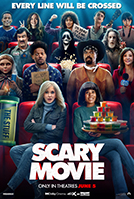
| With | Marlon Wayans, Shawn Wayans, Anna Faris, Regina Hall, Kenan Thompson, Dave Sheridan, Lochlyn Munro, Kim Wayans, Cheri Oteri, Chris Elliott, Damon Wayans Jr., Heidi Gardner, Olivia Rose Keegan, Cameron Scott Roberts, Savannah Lee Nassif, Sydney Park, Gregg Wayans, Benny Zielke, Ruby Snowber |
| Runtime | 94 minutes |
| Release | 2026-06-05 |
| Rating | 4/10 |
Twenty-six years after escaping a strangely familiar masked killer (Ghostface), the saga’s iconic heroes are once again in the murderer’s crosshairs, and no horror movie franchise is safe.
The review
By Mulder 2026-06-03
The return of Scary Movie should have been cause for celebration. More than twenty-five years after the original film helped redefine mainstream parody cinema, and thirteen years after the widely panned fifth installment seemingly buried the franchise for good, the reunion of Marlon Wayans, Shawn Wayans, Anna Faris, and Regina Hall seemed to be exactly the shot in the arm the series needed. The fact that the Wayans family had finally regained creative control of the franchise they had helped build only heightened expectations. In an era dominated by sequels to old franchises, remakes, reboots, and nostalgia-driven revivals, Scary Movie seemed perfectly positioned to satirize Hollywood’s current obsession with recycling familiar brands. Ironically, the film ends up falling victim to the very trend it attempts to mock. While seeing the original cast reunited evokes genuine affection and a few laughs, the finished product struggles to justify its own existence beyond simply reminding the audience just how much they enjoyed the previous installments.
Directed by Michael Tiddes, the film openly embraces the modern “rebooquel” formula, functioning as a sequel, a reboot, and a commentary on the endless cycle of franchise revivals. Much like the recent Scream films that inspired its framework, the story brings together seasoned survivors and a younger generation of characters facing the return of Ghostface. Yet one of the film’s main problems becomes apparent almost immediately: its overwhelming reliance on Scream. The original Scary Movie drew on Scream while ruthlessly parodying dozens of horror and pop culture phenomena from the late 1990s. Here, however, the parody often seems trapped in the shadow of a franchise that was already parodying horror conventions to begin with. The result is a strange hall-of-mirrors effect where satire layers upon satire until little remains but references acknowledging other references.
The screenplay by Marlon Wayans, Shawn Wayans, Keenen Ivory Wayans, Craig Wayans, and Rick Alvarez suffers from a recurring problem in modern comedy in recent years: confusing recognition with humor. Rather than building elaborate comedic scenarios around the absurdities of contemporary horror cinema, the film often settles for recreating moments from well-known films, hoping the audience will laugh because they get the reference. The Substance, Smile, Longlegs, Terrifier 3, M3GAN, Get Out, Weapons, Sinners, Candyman, Nosferatu, and countless other films are referenced, but all too often, these nods are little more than a simple parade of cinematic references. Many scenes resemble internet memes transposed directly onto the screen, lacking the sharp satire that once set the franchise apart. The modern horror landscape offers a wealth of material to explore, from sophisticated horror and the influence of A24 to streaming culture, social media fan communities, the obsession with true crime, and interconnected horror universes. Yet the film rarely delves beyond the surface of these trends.
That’s not to say the film is entirely devoid of humor. In fact, one of the most frustrating aspects of Scary Movie is how often it offers glimpses of genuine comic inspiration only to abandon them immediately. The opening sequence, featuring a wonderfully self-aware celebrity cameo, ranks among the best openings in the franchise’s history and instantly sets expectations that the rest of the film unfortunately struggles to meet. A recurring background gag inspired by Final Destination is genuinely clever, rewarding attentive viewers rather than demanding applause with obvious references. An inspired parody featuring Michael Jackson generates one of the film’s biggest laughs, while a handful of fourth-wall-breaking jokes about obscure horror films demonstrate a level of self-deprecation that feels refreshing and inventive. These moments prove that the Wayans still possess the instinct that made the original films a success. The problem is that they’re scattered throughout a script drowned in far less effective material.
As always, Anna Faris stands out as the film’s secret weapon. Few comedic actors possess her remarkable ability to treat utter absurdity with absolute sincerity. Like the great Leslie Nielsen before her, Faris understands that parody works best when the actors themselves never seem to be chasing the joke. Whether Cindy Campbell finds herself in yet another ridiculous horror scenario or delivers lines that would fall flat in the hands of a less talented comedian, Faris consistently raises the bar of the script through her unwavering commitment. Her return alone largely justifies the audience’s goodwill toward this project. Equally impressive is Regina Hall, whose character Brenda remains one of the franchise’s most beloved creations. Hall’s sense of timing, physical comedy, facial expressions, and seemingly inexhaustible energy are responsible for many of the film’s funniest moments. Seeing Faris and Hall share the screen again is a powerful reminder of just how much they contributed to the success of the previous installments.
Marlon Wayans and Shawn Wayans remain charismatic comedians, and their affection for these characters is evident throughout the film. Unfortunately, the script often traps them in jokes that should have been abandoned years ago. Shorty is still defined almost exclusively by references to marijuana, while Ray continues to go in circles with the same sexual humor that felt repetitive long before the franchise’s hiatus. Rather than reinventing these characters for a modern audience, the film often seems content to simply recycle their most recognizable traits. The same criticism applies to several returning supporting characters whose appearances often seem designed to evoke nostalgia rather than generate genuine comedy. Newcomers such as Olivia Rose Keegan, Sydney Park, Savannah Lee Nassif, and Gregg Wayans bring enthusiasm to their roles—Keegan is particularly impressive as a younger version of Cindy—but the script rarely gives them enough room to forge memorable comedic identities of their own.
One of the most surprising weaknesses concerns the film’s satirical approach. The original Scary Movie films may have been crude, childish, and blatantly incoherent, but they often possessed a certain reckless confidence. This new installment often seems indecisive about what it actually wants to say. It pokes fun at modern social issues, influencer culture, celebrity scandals, political controversies, identity politics, and contemporary entertainment trends, but many of these jokes feel forced rather than natural. Some attempts at provocative humor work because of their audacity, while others come across as tired provocations that confuse being offensive with being funny. Rather than seeming dangerous or unpredictable, several controversial scenes feel strangely calculated, as if the filmmakers were checking boxes on a list of topics guaranteed to elicit a reaction.
Visually, Michael Tiddes delivers a polished production that often seems far more accomplished than the franchise’s previous installments. The recreations of famous horror images are impressively precise, and the art direction successfully captures the visual language of the parodied films. However, technical skill alone is not enough to carry a comedy. The pace becomes increasingly exhausting as the film progresses, bombarding the audience with a relentless barrage of jokes, references, cameos, nods, visual gags, and celebrity appearances. Some sketches fizzle out before reaching their potential, while others drag on long after their central joke has lost its momentum. The film often feels like a patchwork of brainstorming sessions by a team of screenwriters rather than a coherent comedy with clear pacing and progression.
Perhaps the biggest missed opportunity is the film’s failure to fully engage with the extraordinary evolution horror cinema has undergone over the past decade. Since the last installment of Scary Movie, horror has undergone a remarkable renaissance, producing some of the genre’s most acclaimed, inventive, and culturally significant works. Rather than exploring what makes modern horror unique, the film often seems content to merely acknowledge its existence. For a franchise that once specialized in highlighting the absurdities of popular culture, this superficiality is particularly disappointing. We catch glimpses of the sharper, more anarchic parody that fans were hoping for, but these moments never fully coalesce into a coherent comedic vision.
Scary Movie is neither the catastrophic failure some critics have described, nor the triumphant return longtime fans imagined when the Wayans family announced their comeback. Instead, it occupies a frustrating middle ground: a film that is often entertaining, sometimes hilarious, but ultimately unable to escape the gravitational pull of its own nostalgia. The chemistry between Anna Faris, Regina Hall, Marlon Wayans, and Shawn Wayans remains undeniably appealing, and their reunion brings enough charm to keep the film watchable. Yet charm alone cannot compensate for a script that relies too often on recognition rather than invention. What should have been a bold reinvention of a beloved comedy franchise ends up feeling like a reminder of how difficult it is to recreate the magic of yesteryear. The spirit of Scary Movie is still alive, but this return rarely feels as daring, inventive, or culturally incisive as the films that first made audiences fall in love with the franchise.
Scary Movie
Directed by Michael Tiddes
Written by Marlon Wayans, Shawn Wayans, Keenen Ivory Wayans, Craig Wayans, Rick Alvarez
Based on Characters by Marlon Wayans, Shawn Wayans, Buddy Johnson, Phil Beauman, Jason Friedberg, Aaron Seltzer
Produced by Marlon Wayans, Shawn Wayans, Keenen Ivory Wayans, Craig Wayans, Rick Alvarez
Starring Marlon Wayans, Shawn Wayans, Anna Faris, Regina Hall, Kenan Thompson, Dave Sheridan, Lochlyn Munro, Kim Wayans, Cheri Oteri, Chris Elliott, Damon Wayans Jr., Heidi Gardner, Olivia Rose Keegan, Cameron Scott Roberts, Savannah Lee Nassif, Sydney Park, Gregg Wayans, Benny Zielke, Ruby Snowber
Cinematography: Terry Stacey
Edited by Jonathan Schwartz
Music by Haim Mazar
Production company: Wayans Bros. Entertainment (United States
Distributed by Paramount Pictures
Release date: June 3, 2026 (France), June 5, 2026 (United States)
Running time: 94 minutes
Viewed on June 3, 2026 at Gaumont Disney Village, Theater 9, Seat A19