

Allah Is Not Obliged : Birahima’s Journey from Page to Screen in Zaven Najjar’s Animated Adaptation
Tuesday 10 February, 6:42 AM PT
With Allah Is Not Obliged, director Zaven Najjar delivers one of the most striking animated features to emerge from the recent festival circuit, translating Ahmadou Kourouma’s landmark novel into a work that is visually stylized yet deeply anchored in historical reality, a delicate balancing act that has defined the project from its earliest conception. The film, which screened at major international events including Annecy, the Red Sea International Film Festival, and Tokyo, now prepares for its French theatrical release on March 4, 2026, carried by distributors BAC Films and Maison 4 Tiers in France and Gkids in the United States. Adapted from Kourouma’s 2000 novel, recipient of the Prix Renaudot and Prix Goncourt des Lycéens, the story follows Birahima, a young Guinean orphan attempting to reach his aunt in Liberia, only to be swallowed by the chaos of civil war and the brutal machinery that transforms children into soldiers, a trajectory that remains tragically resonant decades after the conflicts that inspired it.
What makes this adaptation particularly compelling is the unusually long maturation behind it, shaped by producer Sébastien Onomo’s personal connection to the book, first encountered during his literature studies at the Sorbonne, where he famously described the reading experience as an uppercut, struck not only by the geopolitical scope but by the linguistic audacity of Ahmadou Kourouma, whose prose fuses satire, oral storytelling, and devastating lucidity. Onomo acquired the adaptation rights as early as 2016, yet deliberately resisted rushing the project into production, waiting instead for what he considered the right artistic evidence, a phrase that would eventually crystallize in his collaboration with Zaven Najjar, whose graphic signature and sensitivity to narratives of memory, exile, and war had already left a strong impression through his artistic direction work. Their encounter during the development of La Sirène, directed by Sepideh Farsi, proved decisive, as Najjar’s visual language offered precisely the singularity Onomo believed necessary to approach a novel so intimately tied to voice and perspective.
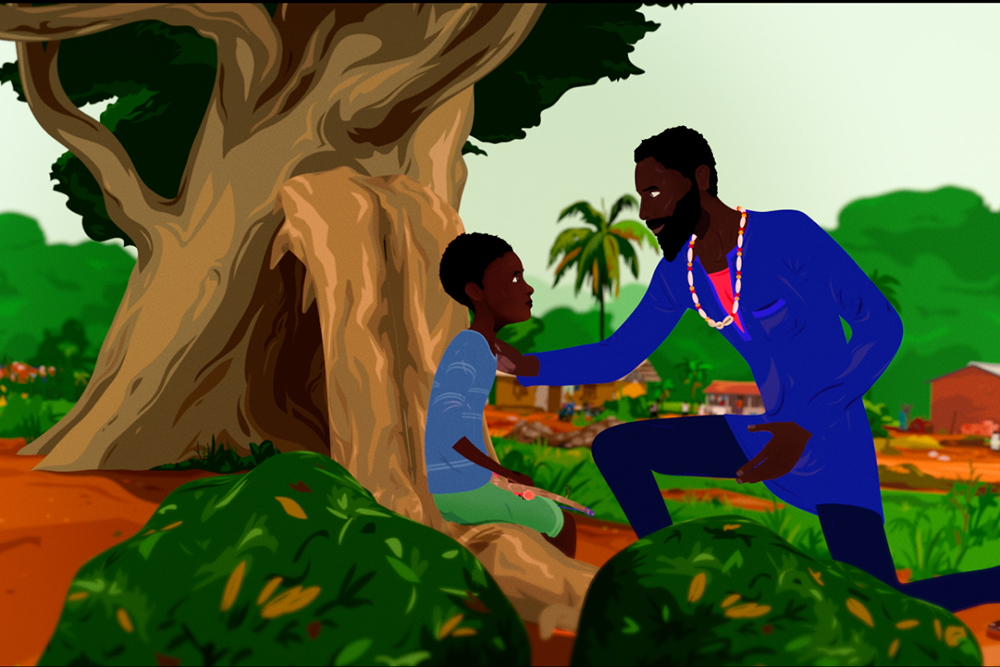
Najjar’s creative path toward Allah Is Not Obliged is inseparable from his own biography, rooted in a family history marked by the Armenian diaspora between Syria and Lebanon, experiences that exposed him early to the paradoxical way war stories can oscillate between humor and horror, anecdote and trauma. That tonal duality became central to his reading of Kourouma’s novel and later to the film’s dramaturgy, co-written with Karine Winczura, preserving the book’s constant navigation between irony and tragedy. Rather than diluting the violence or aestheticizing suffering, Najjar opted for a strategy of emotional subjectivity: Birahima is often positioned as witness rather than protagonist of brutality, while humor is channeled primarily through Birahima and Yacouba. This careful dosage, as Najjar describes it, extends even to narrative departures from the source text, including the introduction of a brief adolescent romance and a gunshot injury, elements absent from the novel but designed to intensify identification with Birahima’s fractured coming-of-age.
The film’s credibility rests heavily on Najjar’s field research in West Africa, an approach that deliberately echoes Kourouma’s own reliance on literary sources and United Nations reports when crafting the novel. Determined to pose the real as a foundation, Najjar traveled to Liberia, where he established contact with former combatants, most notably Mohamed Sparo Tarawalley, a former general of the LURD (Liberians United for Reconciliation and Democracy), whose guidance opened doors to testimonies, locations, and lived perspectives rarely accessible to filmmakers. Rather than seeking a direct real-life equivalent to Birahima, Najjar collected a mosaic of experiences, later refining the screenplay through discussions in Monrovia while simultaneously sketching environments and characters in his notebooks. Among the most visually symbolic outcomes of this process is the recurring panda keychain attached to Birahima’s weapon, a quietly devastating image functioning as an oxymoron of childhood and violence, innocence and forced militancy.
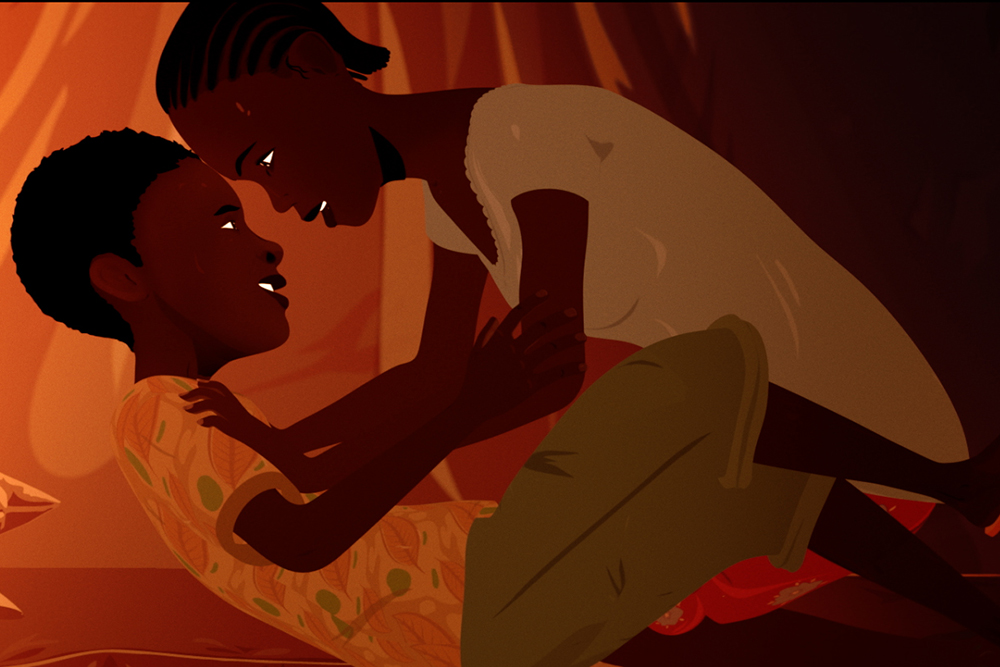
Historically, the narrative unfolds against the backdrop of the Liberian and Sierra Leone civil wars (1989–2003), conflicts fueled by internal power struggles and exacerbated by the strategic exploitation of natural resources, particularly diamonds, timber, and minerals, dynamics extensively documented by international observers. The wars resulted in approximately 300,000 deaths, millions of displaced civilians, and the forced recruitment of tens of thousands of children. Figures highlighted in the pedagogical dossier, including references to the rise and fall of Charles Taylor and the eventual restoration of peace with the election of Ahmad Tejan Kabbah in Sierra Leone, reinforce the film’s educational dimension, framing Birahima’s fictional odyssey within a rigorously defined geopolitical context . The material further underscores a grim contemporary reality: the continued use of child soldiers worldwide, a practice classified as a war crime under international law, with Amnesty International estimating more than 250,000 children still involved in armed conflicts.
Sound and performance play an equally critical role in the film’s authenticity, beginning with the voice casting led largely in Abidjan under the direction of Luis Marques, following recommendations from author Marguerite Abouet. The decision to entrust Birahima’s voice to young Ivorian rapper Hanta Christ Aboubakar Traoré, known artistically as SK07, infuses the character with raw immediacy and emotional volatility, while Thomas Ngijol’s interpretation of Yacouba navigates between cynicism, humor, and unexpected tenderness. The ensemble cast including Annabelle Lengronne, Marc Zinga, and Naky Sy Savané contributes to a vocal texture shaped by improvisations, local rhythms, and multilingual adaptations, complemented by Thibault Kientz-Agyeman’s score, itself structured around the melody of a lullaby associated with Birahima’s mother. The music traverses borders just as the narrative does, blending traditional West African sonorities with contemporary hip-hop and afrobeat influences.

Technically, Allah Is Not Obliged stands as a multinational co-production spanning France, Luxembourg, Belgium, Canada, and Saudi Arabia, supported by institutions including Eurimages, the CNC, and the Red Sea Film Fund, with animation executed across multiple studios, a necessity born from budgetary constraints but ultimately contributing to the film’s layered craftsmanship. Running 77 minutes in Scope format with 5.1 sound, the feature also benefits from an accompanying pedagogical booklet developed by the Association Française du Cinéma d’Animation, designed to contextualize the themes of war, language, and youth dispossession for educational audiences . In an era where animation increasingly engages with political memory and historical trauma, Zaven Najjar’s debut feature asserts itself not merely as an adaptation but as a continuation of Ahmadou Kourouma’s urgent interrogation: how does a child become a soldier, and how can cinema give form to that unbearable question ?
Synopsis :
Birahima, a Guinean orphan aged around ten, must leave his village to try to cross the border and find an aunt who has reportedly settled in Liberia. The young boy follows in the footsteps of Yacouba, a smooth-talking highwayman who acts as a substitute guide. But on the road, an encounter with child soldiers changes Birahima's destiny. Unwillingly recruited, what does the path of war have in store for him?
Allah Is Not Obliged
Directed by Zaven Najjar
Written by Ahmadou Kourouma, Karine Winczura
Produced by Sébastien Onomo, Paul Thiltges
Starring Marc Zinga, Chris Aboubacar, Hanta Traoré
Edited by Isabelle Manquillet
Music by Thibault Agyeman
Production companies : Creative Touch Studios, Paul Thiltges Distribution, Need Production, Lunamine, Yzanakio
Distributed by BAC Films (France), Maison 4 Tiers (France), Gkids (United States)
Release date : March 4, 2026 (France)
Running time : 77 minutes
Photos : Copyright Bac Films