

Black Box
Directed by Steven Quale (2026)
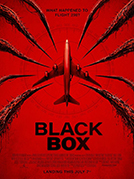
| With | Tom Brittney, Holly White, Boadicea Ricketts, Betsy-Blue English, Georgi S. Georgiev, Georgina Leonidas, Vaughn Johseph, Weronika Rosati, Cel Spellman |
| Runtime | 85 minutes |
| Release | 2026-06-17 |
| Rating | 8/10 |
Supernatural events surround Vero Airlines Flight 298 from New Orleans to Seattle.
The review
By Mulder 2026-06-28
There are countless thrillers set aboard commercial airliners, but the film Black Box manages to breathe a disconcerting freshness into this confined setting by refusing to limit itself to a single genre. What initially appears to be a tense survival drama gradually transforms into something far stranger, blending psychological horror, science fiction, and creature feature with impressive confidence. Director Steven Quale once again demonstrates that he has a keen instinct for orchestrating large-scale suspense in confined spaces, transforming the narrow aisles and pressurized cabin of Flight 298 into a veritable pressure cooker where paranoia spreads as quickly as the unexplained illness afflicting its passengers. The film wastes no time establishing an atmosphere of silent unease before spiraling into a succession of increasingly bizarre events, making each new revelation both surprising and strangely inevitable.
At the heart of the story is Jeremy, played with understated conviction by Tom Brittney, a grieving medical student whose personal tragedy subtly influences his reactions without ever overshadowing the narrative. His unexpected friendship with young Chloe, portrayed by Molly Belle Wright, provides the film with an emotional anchor that is often lacking in many genre films with ambitious concepts. Their interactions infuse genuine warmth into a story otherwise consumed by fear, suspicion, and mounting chaos. Orbiting around them is a colorful cast of passengers, ranging from brusque businessmen and conspiracy theorists to devoted flight attendants and anxious crew members, each adding another layer to the mounting tension. Even those with limited screen time leave a memorable impression, as the screenplay recognizes that, in disaster movies, personality often matters more than elaborate backstories.
The film’s first act skillfully plays with the audience’s expectations. An elderly passenger suddenly collapses after exhibiting alarming symptoms, sparking understandable fears of an in-flight epidemic. Bleeding passengers, unexplained technical malfunctions, and mounting panic create an atmosphere that feels disturbingly realistic, before the screenplay begins to draw viewers into increasingly supernatural territory. This gradual shift is handled with remarkable patience. Rather than relying on constant jump scares, Black Box lets the uncertainty itself become the greatest source of fear. The simple image of dozens of passengers simultaneously pressing their call buttons—or the eerie silence that follows violent turbulence—becomes just as unsettling as the film’s most elaborate visual effects.
Anyone familiar with classic TV series of this genre will immediately recognize affectionate echoes of Rod Serling’s The Twilight Zone, particularly the legendary “Nightmare at 20,000 Feet.” Yet Black Box never settles for simply paying homage. On the contrary, it transforms this familiar premise into something that also evokes the mystery and conspiracy atmosphere of The X-Files. As the characters struggle to make sense of the strange lights outside the plane and the increasingly implausible phenomena inside, the film invites viewers to embrace uncertainty rather than seek immediate answers. Much like a particularly unsettling lost episode of either of these series, the story constantly encourages the audience to wonder whether they are witnessing an extraterrestrial intervention, a psychological breakdown, or something that lies somewhere between these two possibilities.
Visually, the production consistently exceeds what its apparent budget would suggest. The storm systems surrounding the plane become characters in their own right, illuminated by mysterious flashes of lightning that create breathtaking imagery without sacrificing credibility. The occasional use of found-footage-style imagery and smartphone recordings enhances the realism without falling into the trap of overused artifice, making the nightmare unfolding before our eyes feel immediate and personal. Steven Quale also demonstrates excellent control of pacing, allowing quiet moments focused on the characters to breathe before unleashing bursts of frenetic action. When the film finally embraces its most obvious science-fiction elements, the transition feels earned, as the suspense has been carefully built up well in advance.
The performances further reinforce the illusion that ordinary people have been thrust into unimaginable circumstances. Tom Brittney avoids the exaggerated heroic posturing common in this genre, portraying Jeremy as an intelligent but emotionally vulnerable protagonist whose determination emerges naturally rather than through the bravado typical of action movies. Molly Belle Wright provides a captivating emotional counterbalance, while the supporting cast manages to make familiar archetypes surprisingly entertaining. Even the deliberately insufferable passengers serve a narrative purpose by amplifying the panic and mistrust that gradually seep into every corner of the cabin. Their clashing personalities become just as dangerous as the invisible threat lurking beyond the plane’s windows.
The screenplay stumbles slightly in its final act, where certain mysteries are deliberately left unresolved and some narrative twists may divide viewers seeking definitive answers. However, these ambiguities also contribute to the film’s enduring charm. Instead of neatly tying up all the loose ends of the plot, Black Box embraces the unsettling uncertainty that characterizes many of the best science-fiction horror stories. Long after the end credits roll, questions continue to swirl about what really happened aboard Flight 298, inviting discussion rather than a simple resolution. This lingering sense of mystery ultimately becomes one of the film’s greatest strengths.
Although its influences are impossible to ignore, Black Box manages to transform familiar elements into an entertaining, suspenseful, and surprisingly moving adventure. It combines the claustrophobic anxiety of airplane disaster movies with the existential unease of The Twilight Zone and the investigative paranoia that made The X-Files such an enduring cultural phenomenon. Rather than simply playing the nostalgia card, it forges its own unsettling identity, offering a suspenseful genre experience that keeps the audience on the edge of their seats until the very end. It may not reinvent sci-fi horror, but thanks to confident direction, captivating performances, and an atmosphere that rarely lets up, Black Box carves out a place for itself among the most memorable high-concept thrillers of recent years.
Black Box
Directed by Steven Quale
Written by Stephen Susco
Based on The Vessel by Clark Baker
Produced by David Haring, Christian Mercuri, Jonathan Oakes, Stephen Susco, Warren Zide
Starring Tom Brittney, Holly White, Boadicea Ricketts, Betsy-Blue English, Georgi S. Georgiev, Georgina Leonidas, Vaughn Johseph, Weronika Rosati, Cel Spellman
Cinematography: Steven Quale
Edited by Steven Quale
Music by Raffertie[
Production companies: Capstone Pictures, Hammerstone Studios, Inzide Media
Distributed by Aura Entertainment, Signature Entertainment (United States)
Release date: June 17, 2026 (United States)
Running time: 85 minutes
Viewed on June 28, 2026 (press screener)