

Lockbox
Directed by Daniel Stamm (2026)
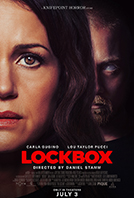
| With | Carla Gugino, Lou Taylor Pucci, Katharine Isabelle |
| Runtime | 105 minutes |
| Release | 2026-07-03 |
| Rating | 7/10 |
A woman risks her life to protect her cousin, Winthrop, who is being hunted by a powerful supernatural force.
The review
By Mulder 2026-07-03
There’s something undeniably intriguing about Lockbox even before the film begins. Adapted from an episode of the long-running podcast Knifepoint Horror, Daniel Stamm’s latest supernatural thriller promises to transform an intimate audio nightmare into a visual experience. The director has already proven he knows how to craft unsettling religious horror, and for much of the first act, he displays the same confidence here. Rather than rushing into possession clichés, the film initially presents itself as a subtle psychological mystery, centered on grief, trauma, and broken family ties. The rural setting, understated cinematography, and deliberately measured pace create an atmosphere where every strange glance and every unexplained sound seems laden with meaning. It’s the kind of opening that encourages patience, suggesting that this slow progression will ultimately reward viewers willing to invest in its mysteries.
This initial restraint is largely carried by Carla Gugino, whose performance provides the film with the emotional foundation it so desperately needs. Ellen is portrayed as someone who has spent so much of her life caring for others that she has forgotten how to rebuild her own. After her mother’s death, she takes in her troubled cousin, Winthrop, at her isolated farm with a compassion that never feels forced or sentimental. Carla Gugino makes every moment of this quiet resilience believable, transforming ordinary domestic scenes into credible expressions of empathy. Her chemistry with Lou Taylor Pucci is equally effective, lending authenticity to their tentative attempts to reconnect after decades of separation, rather than reducing them to mere functional exposition.
But if the film truly belongs to anyone, it is Lou Taylor Pucci. Winthrop is weighed down by childhood abuse, military trauma, and deep psychological wounds that make him both sympathetic and unpredictable. Much of his performance relies on silence rather than dialogue; his nervous body language and fleeting expressions convey far more than the script allows him to articulate. It becomes increasingly clear that the screenplay deliberately withholds crucial aspects of his past to preserve the central mystery, but this choice comes at a cost. Instead of gradually uncovering a multifaceted character, the audience often feels that important elements of his personality have simply been kept from them. This is a frustrating limitation, as Lou Taylor Pucci constantly hints at an emotional complexity far greater than what the narrative ultimately explores.
The film shifts in tone noticeably as soon as Katharine Isabelle enters the scene as Vahna, the eccentric neighbor. Her arrival injects a welcome element of unpredictability into the story, though it also marks the moment when Lockbox begins to abandon its realistic psychological tension in favor of a more grandiose supernatural spectacle. Katharine Isabelle fully embodies her character’s extraordinary eccentricities, delivering a performance that’s impossible to ignore, even when it occasionally borders on theatrical excess. Vahna becomes the catalyst for a series of increasingly strange events, transforming what initially resembled a crime thriller into a full-fledged possession story. It’s an ambitious shift in tone, but one that doesn’t always feel entirely natural.
Ironically, Lockbox’s most original idea comes surprisingly late. The concept behind the title itself introduces a troubling moral dilemma that sets the film apart from the countless exorcism stories released over the past decade. Rather than relying solely on familiar rituals and religious confrontations, the screenplay alludes to a mythology with fascinating implications regarding sacrifice, confinement, and hereditary darkness. Unfortunately, these ideas remain more suggestive than fully developed. Instead of delving deeper into its mythology, the narrative rushes toward a conventional conclusion, leaving viewers with the impression that an even stronger and stranger film lies hidden somewhere beneath the surface.
The second half nonetheless contains a few effective moments. Director Daniel Stamm stages several genuinely unsettling sequences that rely more on atmosphere than on loud jump scares, while the art direction lends Ellen’s dilapidated farm and the surrounding community a welcome sense of authenticity. Even when certain visual effects fail to convince, the oppressive atmosphere often makes up for this shortcoming. However, an uneven pace, abrupt narrative detours, and insufficiently explained supernatural rules prevent the tension from building as effectively as it could. Several intriguing subplots are introduced only to fade into the background without meaningful resolution, making the conclusion less satisfying than its initial premise deserves.
Lockbox is a film with considerable potential that never quite manages to fully realize its best ideas. Its cast works tirelessly to elevate a screenplay that often prioritizes mystery at the expense of character development, and Carla Gugino and Lou Taylor Pucci succeed in making viewers care about characters who are sometimes underserved by the script. Horror fans looking for something a little different from the usual possession formula will find enough unsettling imagery and compelling performances to make the journey worthwhile, even if the destination turns out to be less memorable than expected. The result is an atmospheric but uneven supernatural thriller that comes close to excellence without ever quite reaching it.
Lockbox
Directed by Daniel Stamm
Written by Justin Yoffe
Based on The Lockbox by Soren Narnia
Produced by Kearie Peak
Starring Carla Gugino, Lou Taylor Pucci, Katharine Isabelle
Cinematography: Alfonso Chin
Edited by Bridget Durnford
Music by Matthew Rogers
Production companies: Peak Pictures, Capstone Studios, Dark Castle Entertainment
Distributed by Aura Entertainment (United States)
Release date: July 3, 2026 (United States)
Running time : 105 minutes
Viewed on June 27, 2026 (press screener)