

The Toxic Avenger
Directed by Macon Blair (2025)
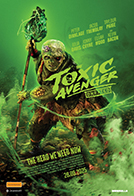
| With | Peter Dinklage, Jacob Tremblay, Taylour Paige, Julia Davis, Jonny Coyne, Elijah Wood, Kevin Bacon |
| Runtime | 103 minutes |
| Release | 2025-08-29 |
| Rating | 9/10 |
A terrible toxic accident transforms Winston Gooze, an oppressed janitor, into a new hero: Toxic Avenger.
The review
By Mulder 2025-09-30
There is a perverse tenderness that runs through Macon Blair's The Toxic Avenger, something we didn't expect in a film whose calling cards are geysers of blood and a broom that doubles as a baton. The title remains the same—industrial decay breeds a popular hero—but the script has been rewritten to reflect today's anxieties. Peter Dinklage's Winston Gooze is not the comic character of the 1984 original; he is a soft-spoken widower and janitor, trapped by a terminal diagnosis, the Kafkaesque maze of his employer's insurance, and a stepson who keeps him emotionally at arm's length. It is in the first part, played in a desperate and impassive tone, that Macon Blair asserts his intention: if this film is to be a carnival of guts, it will be a carnival with a bruised conscience. When Winston Gooze's discreet request for help is rejected by Bob Garbinger, the pharmaceutical magnate played by Kevin Bacon, and a nocturnal mishap plunges him into neon mud, the metamorphosis feels less like a fall than a brutal correction of fate, a working-class scream distilled into a green-tinged steamroller.
What follows is a film that treats its legacy as a toolbox rather than a museum piece. The nods are numerous: place names that resemble editorial cartoons, a muddy civic ecosystem, an appearance by Lloyd Kaufman, but Blair's rhythm is unique: rapid visual gags, joyful nudges at the fourth wall, and violence choreographed with mischievous glee. The jokes are plentiful, but the film rarely hides behind irony. Even when it pokes fun at our culture wars—the panic over pronouns in local newspapers, cosplay extremists hungry for viral videos—it does so with seriousness, reserving its sarcasm for corporate double-speak and the monetization of human fragility. This tonal tightrope is stabilized by the bifurcated performance at the film's center: Peter Dinklage's melancholic voice and Luisa Guerreiro's tactile work merge into a single, surprisingly vulnerable presence. The synchronization isn't always aesthetically perfect—the dubbing edits are part of the joke—but the character feels complete, and that's what matters.
As a director, Macon Blair's smartest decision is to favor tactile grime. Prosthetics crack, viscera groan, and sets look sticky enough to fail a health inspection; when digital splatters appear, they feel like an addition rather than stylistic support. The production design depicts St. Roma's Village as a live-action trash magazine: handwritten signs, purgatorial warehouses, and a color palette that suggests every light bulb is on its last leg. Within this playground, the supporting characters draw inspiration from the Looney Tunes of the silver screen. Kevin Bacon strikes the perfect balance between meeting room shark and wellness-obsessed clown, a biohacking peacock whose philanthropy is a line in an Excel spreadsheet. Opposite him, Elijah Wood transforms Fritz into an impresario halfway between Riff Raff and a garage goblin, who manages a nu-metal death squad with the exhaustion of a middle manager at closing time. Taylour Paige, as whistleblower J.J., plays it simple and realistic—an essential counterbalance—and Jacob Tremblay makes Wade's touchiness come across as heartbreak translated into teenage language. There's even a tasty turn from Julia Davis as an assistant who treats corporate malfeasance like love talk.
The action, above all, understands that in Troma land, choreography is only half the fun; the fall is the post-impact tableau. A toilet becomes a club; a parkour showboat learns the politics of gravity; a heroic line dies on the vine, and the film lets us hear its death rattle. Blair continues to invent new ways for this luminous broom to humiliate the powerful, and he also remembers the comic power of the off-screen chorus: the misplaced voice that qualifies a heroic gesture, the townspeople who can conjure up a crowd armed with torches and pitchforks as if it were an app feature. While some sequences rely on special effects that might make our inner purists salivate, the film compensates with staging that prioritizes rhythm over sheer volume. And when it references superhero lore—an underground laboratory here, a nod after the credits there—it reads as a casual acknowledgment of the genre's excesses rather than an invitation to join in.
The film's generosity in terms of subplots sometimes gets in the way; not all the digressions are worth the detour, and a father-son passage resolves itself in a more orderly fashion than it is constructed. A few monologues slow down the momentum, and the central part threatens to repeat itself: capture, escape, regrouping, encore. But even when the engine sputters, Blair's universe remains unique. The satire works not because it's original—we've all heard the sermon on profit before people—but because it's staged like a small office theater: HR scripts collide with deadly stakes, the multi-level maze of a helpline serves as an obstacle to the plot. In this vein, perhaps the funniest gag is the film's cruelest truth: bureaucracy as bodily horror.
In terms of performances, Peter Dinklage gives the minutes leading up to Winston's mutation the pain of a man who has run out of luck, and that pain darkens Toxie's ravages, turning victories into grimaces. Luisa Guerreiro's body language—hesitant, then optimistic, then slightly embarrassed by the mess she has caused—allows the rubber suit to express emotions; it's physical comedy with a bruised pulse. Kevin Bacon revels in vowels like a man betting on stock options; Elijah Wood plays with his scalp; Taylour Paige refuses to wink and, in doing so, gives the film its sincerity. Even the surprise casting—veterans of the Michael Herz/Lloyd Kaufman orbit—feels deserved rather than forced, a community call rather than a lap of honor.
Context is important in a project like this. The anti-social nature of the original belonged to an era when Reaganite veneer called for crude graffiti. The current ecosystem is different: transgression is a ready-made aesthetic, and the “provocateur” has a marketing budget. Blair sidesteps this trap by making a film about utility rather than attitude. The Toxic Avenger does not defend bad taste as a sacrament; it argues that some stories work better when they are sticky, loud, and a little ashamed of themselves. In a year when intellectual property is sterilized, a film that dares to look ugly—deliberately—seems, paradoxically, purifying.
If we want to get to the bottom of things: does it work? Yes, in terms of carnage, laughter, and the thrill of seeing a lost cause rise again. It's not the pure, mischievous flash of yesteryear, and that's okay. Macon Blair doesn't embalm Lloyd Kaufman; he converses with him, then steers the conversation toward unpaid bills, diagnoses half-heard over the noise of construction, children who freeze on stage and still need to be taken home.
As a certain cameo growls, we can feel the film's thesis crystallize: a tribute without embalming fluid, a sentiment without sweetness. The mop shines, the blood runs blue, and the anger is eternal. So yes, long live Toxie. Not as a nostalgic totem, but as a messy, muscular folk tale about a man who became a monster to get a message across, then kept on cleaning. Between farce and prayer, Macon Blair generally strikes the right tone, and when he misses, the film shrugs, wipes the lens, and keeps going. That's ultimately where the charm of this reinvention lies: it believes in cleaning up after the carnage. In this universe, that passes for hope.
The Toxic Avenger
Written and directed by Macon Blair
Based on The Toxic Avenger by Lloyd Kaufman
Produced by Mary Parent, Alex Garcia, Lloyd Kaufman, Michael Herz
Starring Peter Dinklage, Jacob Tremblay, Taylour Paige, Julia Davis, Jonny Coyne, Elijah Wood, Kevin Bacon
Cinematography: Dana Gonzales
Edited by Brett W. Bachman, James Thomas
Music by Will Blair, Brooke Blair
Production companies: Legendary Pictures, Troma Entertainment, Inc.
Distributed by Cineverse, Iconic Events Releasing
Release dates: September 21, 2023 (Fantastic Fest), August 29, 2025 (United States and United Kingdom)
Running time: 103 minutes
Seen on September 30, 2025