

Backrooms
Directed by Kane Parsons (2026)
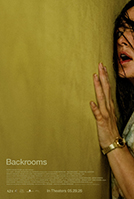
| With | Chiwetel Ejiofor, Renate Reinsve, Mark Duplass, Finn Bennett, Lukita Maxwell |
| Runtime | 110 minutes |
| Release | 2026-05-29 |
| Rating | 8/10 |
A strange door appears in the basement of a furniture store.
The review
By Mulder 2026-06-17
There are horror films that rely on monsters, blood, or jump scares, and then there are those that unsettle the audience by tackling something far more difficult to define: the feeling that reality itself is no longer reliable. Backrooms unquestionably belongs to the latter category. By expanding on the viral internet phenomenon that captivated millions with a single image of an empty yellow room, director Kane Parsons transforms a modern digital legend into one of the most memorable cinematic experiences of the year. What could easily have become a gimmicky adaptation of an online phenomenon turns out instead to be an ambitious and atmospheric descent into isolation, memory, and existential angst. Even more impressive, Kane Parsons achieves this feat at an age when most filmmakers are still dreaming of their first feature film, demonstrating a visual confidence that many established directors spend decades trying to develop.
Set in 1990, the story follows Clark, played by Chiwetel Ejiofor, a failed architect whose life has quietly fallen apart around him. Reduced to managing a struggling furniture store while sleeping among the very products he sells, Clark is already trapped in a psychological labyrinth long before he discovers the literal one hidden behind the walls of his basement. When he accidentally slips into the endless labyrinth known as the Backrooms, the film skillfully avoids treating this discovery as a mere supernatural event. Instead, this strange dimension becomes an extension of his emotional state, a place where frustration, regret, and buried trauma take on an architectural form. At his side, Renate Reinsve delivers another excellent performance as Dr. Mary Kline, a therapist whose unresolved past gradually draws her into this nightmare. Their relationship forms the emotional backbone of a film that, without it, might have gotten completely lost in abstraction.
What makes Backrooms truly remarkable is its artistic design. The endless yellow hallways, the neon lights buzzing with oppressive monotony, the furniture fused to the walls, the staircases leading nowhere, and the rooms that seem almost normal create a particularly unsettling atmosphere. It’s hard not to think back to the first time you wandered through a deserted shopping mall after closing time, an abandoned office building, or a forgotten hotel hallway that felt both familiar and foreign. Danny Vermette deserves immense credit for creating spaces that feel both mundane and deeply threatening. The Backrooms are terrifying precisely because they don’t look like hell; they look like places we’ve all seen before, distorted just enough to convince us that something is terribly wrong. The result often feels like walking through a dream pieced together from faulty memories and incomplete recollections.
The film’s technical execution is equally impressive. Kane Parsons understands that horror often works best when the audience is forced to scan the frame for danger rather than having it presented directly. His use of real locations, found-footage aesthetics, VHS textures, and carefully controlled camera movements creates a constant sense of unease. Jeremy Cox’s cinematography frequently transforms ordinary hallways into visual puzzles, while the sound design becomes a full-fledged invisible antagonist in its own right. The incessant hum of neon lights, distant impacts, distorted voices, and barely perceptible noises hidden beneath the soundtrack slowly erode the viewer’s sense of security. More than once, the film creates tension not through what is shown, but through what might well be waiting just outside the frame.
The film is not without its flaws. The mythology surrounding the Backrooms has always thrived on mystery, and translating that mystery into a feature-length narrative proves difficult. Screenwriter Will Soodik sometimes struggles to strike a balance between explanation and ambiguity. Certain psychological themes involving trauma, memory, and personal stagnation are introduced more directly than necessary, while parts of the lore seem intentionally left out to preserve future narrative possibilities. There are moments when the script seems torn between becoming a fully realized psychological drama and remaining a surreal, nightmarish experience. Some viewers may walk away frustrated by unanswered questions, particularly during the film’s enigmatic final act. Yet, curiously, this unfinished quality may also be part of its appeal. The Backrooms were never intended to provide reassuring answers. They constitute a modern myth founded on uncertainty itself.
The actors’ performances help ground the most abstract elements. Chiwetel Ejiofor is remarkable, portraying Clark as a man consumed by disappointment without ever reducing him to a stereotype. His growing obsession with the Backrooms feels credible because it mirrors the behavior of someone desperately seeking meaning in a life that no longer satisfies him. Renate Reinsve brings intelligence and emotional restraint to Mary, avoiding the over-the-top reactions common in horror films. Even the supporting appearances, notably that of Mark Duplass, help create the impression that greater forces are at work behind the scenes, whether supernatural, psychological, or something in between. The actors play their roles with sincerity, allowing the strange world around them to generate horror rather than resorting to melodrama.
Perhaps the most fascinating aspect of Backrooms is what it represents culturally. Every generation develops its own nightmares. Gothic castles defined one era, suburban homes another, and abandoned forests yet another. For a generation that grew up in digital spaces, endless online exploration, and the strange loneliness of modern connectivity, the Backrooms seem strangely fitting. They embody the fear of being trapped in familiar environments devoid of human warmth and meaning. The film captures that unsettling sensation many have experienced during periods of isolation, when ordinary places suddenly seemed strange and disconnected from reality. In this sense, Backrooms functions not only as a horror film, but also as a snapshot of contemporary anxiety translated into architecture and atmosphere.
Even if not all narrative choices are perfectly executed, Backrooms succeeds where it matters most: it creates images and sensations that linger long after the credits roll. Few horror films manage to make something as mundane as fluorescent lighting, cheap furniture, and empty hallways truly terrifying. Rarely does a new cinematic voice emerge with such confidence. Whether audiences embrace its mysteries or find them frustrating, there’s no denying that Kane Parsons has delivered one of the most visually distinctive and intellectually intriguing horror films of recent years. It’s a nightmare built from everyday banality, and it may be the most unsettling nightmare of all.
Backrooms
Directed by Kane Parsons
Written by Will Soodik
Based on Backrooms by Kane Parsons
Produced by James Wan, Michael Clear, Roberto Patino, Shawn Levy, Dan Cohen, Dan Levine, Osgood Perkins, Chris Ferguson, Peter Chernin, Jenno Topping, Kori Adelson
Starring Chiwetel Ejiofor, Renate Reinsve, Mark Duplass, Finn Bennett, Lukita Maxwell
Cinematography: Jeremy Cox
Edited by Greg Ng
Music by Edo Van Breemen, Kane Parsons
Production companies: North Road Films, 21 Laps Entertainment, Atomic Monster, Phobos
Distributed by A24 (United States), Metropolitan FilmExport (France)
Release dates: May 7, 2026 (Aero Theatre), May 29, 2026 (United States), June 17, 2026 (France)
Running time: 110 minutes
Viewed on June 17, 2026, at the Gaumont Disney Village, Theater 9, Seat C19