

Think Good
Directed by Géraldine Nakache
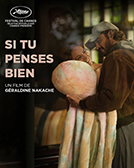
| With | Monia Chokri, Niels Schneider, Clémentine Célarié, Christian Benedetti, Mina Kavani, Oussama Kheddam, Daniel Cohen, Salomé Dewaels, Laurent Capelluto, Thaïs Garfinkiel |
| Runtime | 94 minutes |
| Release | Release date unknown |
| Original title | Si tu penses bien |
| Rating | 7/10 |
In Dubai, Gil meets Jacques. Their love at first sight leads to a hasty marriage that quickly reveals a deep rift: Gil does not share her husband’s all-consuming faith. Jacques tries to force her to conform to his worldview with a mantra that sounds like a threat.
The review
By Mulder 2026-05-25
There are films that immediately impose themselves with force and grandiloquence, determined to make their intentions clear from the very first frame. And then there are films like Think Good, which slowly tighten their grip on the audience like an invisible knot before revealing the suffocating embrace hidden beneath their tranquil exterior. With her latest feature film, Géraldine Nakache makes a radical and unexpected shift from the world many viewers associate with her previous works. Rather than offering warmth and lighthearted observations, she ventures into deeply uncomfortable territory and delivers a psychological drama centered on control, manipulation, and emotional violence. Premiered at Cannes Première, Think Good is the kind of film that catches the audience off guard, not because of sensational moments, but because it highlights something disturbingly ordinary: the gradual disappearance of a person from their own life.
The film follows Gil, played by Monia Chokri, a woman working in the film industry whose life is turned upside down after meeting Jacques, played by Niels Schneider, during a trip to Dubai. Their romance unfolds with the speed and intensity of a dream. There is that irresistible attraction, the certainty that it is fate, marriage that seems almost as natural as breathing, and the promise of a bright future together. Yet what makes Think Good so unsettling is that Géraldine Nakache understands that toxic relationships rarely come with obvious warning signs. At first, Jacques doesn’t seem like a monster. He is charming, attentive, protective, almost excessively loving. In hindsight, the warning signs seem painfully obvious, but the film captures the tragedy of real life: people rarely experience their lives with the benefit of hindsight. Gil isn’t sinking into darkness; she believes she is walking toward happiness.
What emerges as the story unfolds is not physical violence in its conventional cinematic form, but a far more insidious brutality. Jacques rewrites conversations, questions memories, imposes guilt, and gradually reshapes reality to suit his own needs. There is something deeply unsettling about the way Niels Schneider portrays him. He avoids theatrical outbursts or exaggerated cruelty. On the contrary, he turns his calmness into a weapon. He speaks softly, often with a smile that almost suggests concern, and this is perhaps the film’s greatest source of unease. The scariest people aren’t always the ones who scream. Sometimes, they’re the ones who gently convince you that every problem is your fault. Watching Jacques manipulate situations becomes almost infuriating, as the audience sees the trap closing long before Gil fully realizes it herself.
Monia Chokri delivers a perfectly controlled performance that rejects easy victimization. Gil is never reduced to a symbol or a case study. She remains a woman in her own right, with her desires, ambitions, flaws, and moments of resistance. What makes this performance so moving is its subtlety. Her deterioration unfolds through tiny changes. Her voice grows weaker. Her smiles grow fewer. Her confidence gradually fades from the scenes until the audience begins to realize that the vibrant person introduced earlier in the story is slowly disappearing. There are moments when Monia Chokri conveys more through a brief hesitation or an exhausted expression than pages of dialogue ever could. Watching this slow erosion becomes truly heartbreaking, as it feels painfully familiar.
One of the most fascinating elements of the film is the way religion fits into the story. Géraldine Nakache, drawing on her own cultural heritage, avoids any simplistic commentary or criticism of faith itself. Instead, she examines how belief systems and rituals can be distorted by individuals seeking to exert power over others. Jacques uses religious expectations almost like additional walls in the prison he builds around Gil. Rituals become charged with tension, transforming moments meant for spirituality into mechanisms of control. The film never takes a stand against religion; rather, it observes how manipulation can hide behind sacred language. This nuance gives Think Good a complexity that sets it apart from many dramas dealing with domestic violence.
Visually, the film also finds compelling ways to reinforce its emotional themes. There is a striking contrast between environments that appear luxurious and the emotional imprisonment they conceal. Dubai initially appears radiant and full of possibilities, while the couple’s spacious home eventually comes to resemble a beautifully designed cage. One of the particularly effective aspects of Géraldine Nakache’s direction lies in her use of close-ups. Faces dominate the frame, leaving little room to breathe. The camera often lingers a little too long, forcing the audience into Gil’s emotional space. Rather than providing relief, the cinematography often creates the sensation of sitting right beside him, trapped in conversations where every sentence harbors a hidden danger. The unease becomes cumulative rather than explosive.
At times, the structure risks becoming repetitive, as Jacques’s manipulative patterns echo one another. Some viewers might also wish for a deeper exploration of Gil’s inner world outside of his relationship, or a more thorough examination of Jacques himself. The film sometimes gives the impression of deliberately stopping short of emotional devastation, favoring restraint over total exposure. Yet, one could also argue that this very restraint serves the subject matter. Psychological abuse in real life often lacks dramatic crescendos. It repeats itself, goes in circles, and slowly wears people down. Think Good understands that exhaustion can sometimes be more devastating than shock.
What ultimately stays with you after the credits roll isn’t a specific scene, but a feeling. It’s the lingering unease of recognizing just how easily love can turn into confusion, and how manipulation often hides behind tenderness. Géraldine Nakache has created a film that eschews easy villains and obvious answers in favor of something far more unsettling: the possibility that emotional imprisonment can emerge through ordinary conversations, family routines, and promises of protection. Think Good may not reinvent the psychological drama, but it approaches its subject with intelligence, sensitivity, and an emotional honesty that quietly follows you out of the theater and refuses to let you go.
Think Good
Directed by Géraldine Nakache
Produced by Philippe Godeau, Philippe Logie, Patrick Quinet
Written by Géraldine Nakache, David Lambert
Starring Monia Chokri, Niels Schneider, Clémentine Célarié, Christian Benedetti, Mina Kavani, Oussama Kheddam, Daniel Cohen, Salomé Dewaels, Laurent Capelluto, Thaïs Garfinkiel
Cinematography ; Sylvestre Vannoorenberghe
Edited by Juliette Welfling
Production companies : Liaison cinématographique, Pan Cinéma, Artémis Productions, Les Productions du Ch'timi
Distributed by Pan Distribution (France)
Release date : May 15 2026 (festival de Cannes) ; September 16 2026 (France)
Running time : 94 minutes
Vu le 22 mai 2025 à Paris Pathe Palace, salle 01 siège B16