

Anemone
Directed by Ronan Day-Lewis (2025)
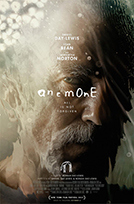
| With | Daniel Day-Lewis, Sean Bean, Samantha Morton |
| Runtime | 126 minutes |
| Release | 2025-10-03 |
| Rating | 7/10 |
It has been 10 years since Ray Stroker exiled himself to a remote forest in England, cut off from the world and his family. But when his family decides to reconnect with him, everyone's traumas resurface. After a decade of silence, the time has come for Ray to face his secrets.
The review
By Mulder 2026-02-24
There is a particular kind of cinematic electricity that only occurs when a film knows it has a force of nature at its center, and Anemone draws on this truth with almost disarming candor. The film understands exactly what Daniel Day-Lewis's return to the camera after years of absence means: every silence becomes a challenge, every glance a paragraph, every movement in this cramped forest cabin a piece of the character's story. Directed by Ronan Day-Lewis (and co-written by Ronan Day-Lewis and Daniel Day-Lewis), the film presents this return not as a victory lap, but as an exhumation: a man named Ray Stoker, a former soldier, exiled for decades, living in a solitary cabin built with his own hands somewhere in the north of England, with only the radio, the stove, and the stubborn ritual of survival to keep the days from blending into one another. The premise is almost theatrically minimalist: Ray's brother, Jem Stoker, arrives as an emissary from the world of the living, and yet the film dresses this simplicity with a pictorial instinct for composition, timing, texture, and symbolic intrusion, as if nature itself were constantly trying to translate human trauma into something visible.
The first part plays on restrained language, which is both the film's boldest choice and the most divisive. Sean Bean makes Jem Stoker a man of restraint and duty, religious, cautious, trying to do what is right without reviving bad memories, while Daniel Day-Lewis makes Ray an animalistic human being, tense and suspicious, almost offended by the presence of another beating heart in his environment. Their first exchanges are almost silent: brushing teeth, eating meals, chopping wood, murmuring prayers, glances that refuse to soften. It's captivating, like a locked room when you're sure something inside is about to break, but it also risks giving the impression of a film that maintains tension through atmosphere alone. Ben Fordesman films the forest with unsettling patience, while Bobby Krlic imposes a heavy, monotonous musical pressure that may be hypnotic at first, but gradually begins to underscore the film's tendency to go around in circles rather than move forward. When the film returns to the family Ray abandoned, the contrast is striking: the cabin feels authentic and alive, while the domestic part often seems sketchy, functional, there to justify the return trip rather than to exist on its own emotionally.
When Ray finally speaks, the film, for better or worse, becomes a vehicle for monologues. The first long story Ray tells (about revenge against an abusive priest) is staged as a challenge to the audience, but it is also the clearest evidence of what Daniel Day-Lewis can do when given powerful language: he turns the grotesque into a narrative weapon, black humor into self-loathing, performance into confession, while leaving you uncertain as to whether the confession is entirely “true” or emotionally true. It's the kind of scene that people will recount afterwards with a look that says I can't believe they went that far, and which feels like a perverse anecdote that you didn't ask to hear but can't forget, partly because the performance is so controlled that it becomes hypnotic. Later, when the film tackles Ray's military past and the lingering trauma of the Troubles that shaped these men, the tone shifts from disgusting bravado to raw revelation, and again, the film is at its best when it simply steps aside and lets the actor work. In these passages, Anemone suddenly takes on the air of the intimate, sober drama it wants to be: two brothers trying to coexist with what destroyed them, one clinging to faith, the other allergic to it, both trapped in a cycle where violence begets violence and silence becomes a legacy.
But the frustrating truth is that Anemone keeps interrupting its best version. Ronan Day-Lewis clearly has an eye, but the film's expressionistic flourishes don't always reinforce the meaning; rather, they muddle it. There are surreal images and mystical intrusions (a strange creature, hallucinatory touches, a quasi-biblical hailstorm) that aim to create a strange effect, but they often appear as imported symbolism rather than emotional inevitability, and the film's final act relies so heavily on this register that it risks breaking the naturalistic backbone it has taken so long to build. Structurally, the editing can seem uneven and strangely unbalanced, and the imbalance of the story becomes difficult to ignore: Ray is given explosive lines, while Jem and Nessa are too often there to prompt, react, worry, and wait. Even when Samantha Morton is given a moment of vocal power, we sense how much richer the film could have been if her inner life and Sean Bean's sacrifices had been used to add complexity to Ray rather than simply frame him, and if the character of Brian, played by Samuel Bottomley, had been written as something more than a wounded symbol of the rage of the next generation.
In the end, we leave the film with the impression that it is both a remarkable but uneven debut that contains moments of true cinematic grace, but which too often confuses weight and depth. Ronan Day-Lewis shows great promise, particularly in the way he films silent faces and threatening landscapes; we can glimpse the contours of a future filmmaker with a distinctive visual signature, even if the narrative is not yet rigorous enough to match the images. Yet the experience is hard to forget, largely because Daniel Day-Lewis remains what he has always been: an actor capable of reducing a room with his presence, turning a pause into an accusation, transforming a simple speech into a human story worthy of an entire film. Anemone doesn't entirely deserve its storms, symbols, or grand statements, but it offers something rarer than coherence: the feeling of seeing a family collaboration achieve something intimate, ugly, and real, and sometimes, in moments, actually touch it.
Anemone
Directed by Ronan Day-Lewis
Written by Ronan Day-Lewis, Daniel Day-Lewis
Produced by Dede Gardner, Jeremy Kleiner
Starring Daniel Day-Lewis, Sean Bean, Samantha Morton
Cinematography: Ben Fordesman
Edited by Nathan Nugent
Music by Bobby Krlic
Production company: Plan B Entertainment
Distributed by Focus Features (United States), Universal Pictures (International), Condor distribution (France)
Release dates: September 28, 2025 (NYFF), October 3, 2025 (United States), March 25, 2026 (France)
Running time: 126 minutes
Seen on February 23, 2026 at Pathe Palace, theater 1