

Words of Love
Directed by Rudi Rosenberg
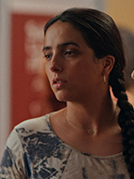
| With | Hafsia Herzi, Nour Salam, Ella Bedoucha, Aïdan Djouadi, Mateo Danila, Charlie Lugassy, Eden Sarfati, Paulette Chetrit, Jacques Sebban, Stephan Chargebœuf, Jean-Pierre Lahmi |
| Runtime | 97 minutes |
| Release | Release date unknown |
| Original title | Quelques mots d'amour |
| Rating | 8/10 |
Sarcelles, 1995. Erika is raising her two children on her own. Her daughter Abigaëlle is convinced that her father, whom she has never met, loves her silently from somewhere. When Abigaëlle decides to find him, Erika feels compelled to help her, while also trying to protect her. As she grows up, Abigaëlle’s quest turns into an obsession, drawing in her mother, her best friend, and everyone who matters to her.
The review
By Mulder 2026-05-23
There is something quietly moving about the way Words of Love unfolds, as if director Rudi Rosenberg deliberately avoids the grand emotional outbursts usually associated with stories of abandonment and broken families. Instead, he builds his film from fragments of everyday life: crowded apartments, interrupted conversations, children loitering in hallways, exhausted mothers smoking alone on their balconies, and teenagers constructing fantasies powerful enough to survive reality itself. Set in Sarcelles in the mid-1990s, the film immediately plunges viewers into a deeply tactile world where answering machines still seem revolutionary, where the streets are alive with the noise and hubbub of voices, and where family identity is defined not by traditional structures but by those who remain present when life gets tough. In many ways, the film seems less interested in revealing dramatic secrets than in observing the emotional wounds caused by absence, particularly the kind that becomes mythologized in the mind of a child desperate to fill an emotional void.
At the heart of the story is Abigaëlle, portrayed with remarkable intensity by the film’s young female breakout star, Nour Salam, whose performance exudes an emotional authenticity that never feels artificial. Abigaëlle grew up without ever knowing her biological father, and the idea that he exists gradually turns into an obsession that shapes her adolescence. What makes the film compelling is that Rudi Rosenberg never reduces her quest to a simple rebellion against her mother. On the contrary, it becomes a portrait of a young girl trying to understand her own identity through the fantasy of paternal recognition. Some of the film’s most moving scenes are also its quietest, particularly when Abigaëlle watches other families from afar with a mix of jealousy and nostalgia. One of the first family gatherings involving her little brother’s paternal relatives speaks volumes about emotional exclusion in a way that pages of dialogue never could. We watch her practically construct an imaginary version of family life in real time, desperately trying to fit into a picture where she feels she doesn’t belong.
The emotional backbone of the film, however, is undeniably Hafsia Herzi, who delivers one of the most striking performances of her career as Erika, this exhausted yet resilient mother trying to hold her fractured household together. What makes her performance so extraordinary here is everything she communicates without speaking. Hafsia Herzi understands that Erika is a woman who can no longer afford the luxury of an emotional breakdown. She is constantly on the move, constantly worried, constantly working, and yet always trying to protect her children from the disappointments she herself accepted years ago. An incredible sadness lies beneath her composed exterior, particularly because she understands long before Abigaëlle that some men are incapable of becoming fathers simply because biology dictates it. The film constantly contrasts Abigaëlle’s idealized fantasy of paternal love with Erika’s much more down-to-earth view of reality, creating a painful emotional tension that becomes increasingly difficult to escape as the story progresses.
One of the most fascinating aspects of Words of Love is how deeply rooted it seems in its social setting. Like many recent French films exploring life in the suburbs, Rudi Rosenberg completely avoids melodrama and caricature. Sarcelles isn’t portrayed as a place of violence or cinematic despair, but as a vibrant community, filled with eccentric characters, chaotic humor, and everyday struggles. Most of the supporting roles are played by non-professional actors, and this choice lends the film immense authenticity. Conversations overlap naturally, the scenes give an impression of disorder in the best sense of the word, and the energy that emanates from them often recalls semi-documentary cinema. At times, the film even evokes the rhythm of classic American comedies, filtered through French social realism, particularly during a wonderfully chaotic phone sequence where several characters interrupt each other, lie, and misunderstand one another simultaneously. The scene is genuinely funny, but beneath the comedy lies the tragedy of people unable to communicate honestly about their emotional pain.
It is in this tonal balance that the film becomes particularly interesting. Rudi Rosenberg constantly oscillates between humor and melancholy, sometimes within the same scene. Certain moments, such as those involving a lost dog or neighborhood interactions, flirt dangerously with sentimentality, and it must be acknowledged that the film sometimes tries a little too hard to emphasize its emotional themes. Certain narrative coincidences also require viewers to fully surrender to the story’s emotional logic rather than its realism. Yet even when the script borders on excessive sentimentality, the sincerity underlying it remains hard to resist. The film’s emotional transparency ultimately becomes one of its strengths, as it never feels manipulative in a cynical sense. On the contrary, one gets the impression of witnessing the work of a filmmaker who is sincerely trying to understand the emotional architecture of unconventional families.
Visually, the film succeeds through restraint rather than stylistic excess. The 1990s setting is recreated with impressive subtlety, avoiding any nostalgic exaggeration while immersing viewers in that era through music, clothing, urban textures, and social customs. There are no flashy reenactments of that decade, nor calculated references intended solely to evoke nostalgia. On the contrary, this era integrates naturally into the narrative. This understated approach significantly enhances the realism and underscores the idea that these characters are not experiencing cinematic moments, but simply surviving day-to-day life. This atmosphere rooted in reality makes the emotional revelations all the more impactful, as the film never strays from recognizable human behavior.
What ultimately stays with you after the credits roll is the film’s quietly radical argument about what defines a family. Words of Love dismantles the romantic notion that biological ties automatically create emotional legitimacy. Through Abigaëlle’s painful journey toward disillusionment, the film suggests that love is measured less by blood than by consistency, sacrifice, and presence. The true emotional revelation is not discovering who her father is, but recognizing who has actually been there from the beginning. In this regard, the final moments when Erika finds herself alone on her balcony are deeply moving precisely because of their simplicity. There is no dramatic speech, no triumphant reconciliation, only the exhausted calm of a woman who has survived yet another emotional storm and who will continue to carry her family into the future starting tomorrow morning.
Despite a few lapses into overt sentimentality, Words of Love remains a deeply moving and surprisingly mature family drama, carried by the exceptional performances of Hafsia Herzi and Nour Salam. More importantly, it captures something emotionally universal in children who construct fantasies to compensate for emotional absences, and in parents who silently endure sacrifices that their children may not understand until years later. Rudi Rosenberg may occasionally overdo the tenderness, but the film’s humanity is undeniable, and by the end, it becomes impossible to shake off its emotional sincerity.
Words of Love
Directed by Rudi Rosenberg
Produced by Hugo Sélignac
Written by Rudi Rosenberg, Bruno Tracq
Starring Hafsia Herzi, Nour Salam, Ella Bedoucha, Aïdan Djouadi, Mateo Danila, Charlie Lugassy, Eden Sarfati, Paulette Chetrit, Jacques Sebban, Stephan Chargebœuf, Jean-Pierre Lahmi
Music by Yom and Chapelier Fou
Cinematography: Éric Dumont
Edited by Delphine Genest and Bruno Tracq
Production companies: Chi-Fou-Mi Productions, Chapter 2, TF1 Films Production
Distributed by Ad Vitam Distribution (France)
Release date: May 14, 2026 (Cannes Film Festival), October 28, 2026 (France)
Running time: 97 minutes
Viewed on May 22, 2026, at the Pathe Palace in Paris, Theater 01, Seat B16