

SDCC 2026: Inside Stuart’s Multiverse Experience
Sunday 26 July, 6:00 PM PT San Diego,,Sparks Gallery, 530 Sixth Avenue 2026-07-26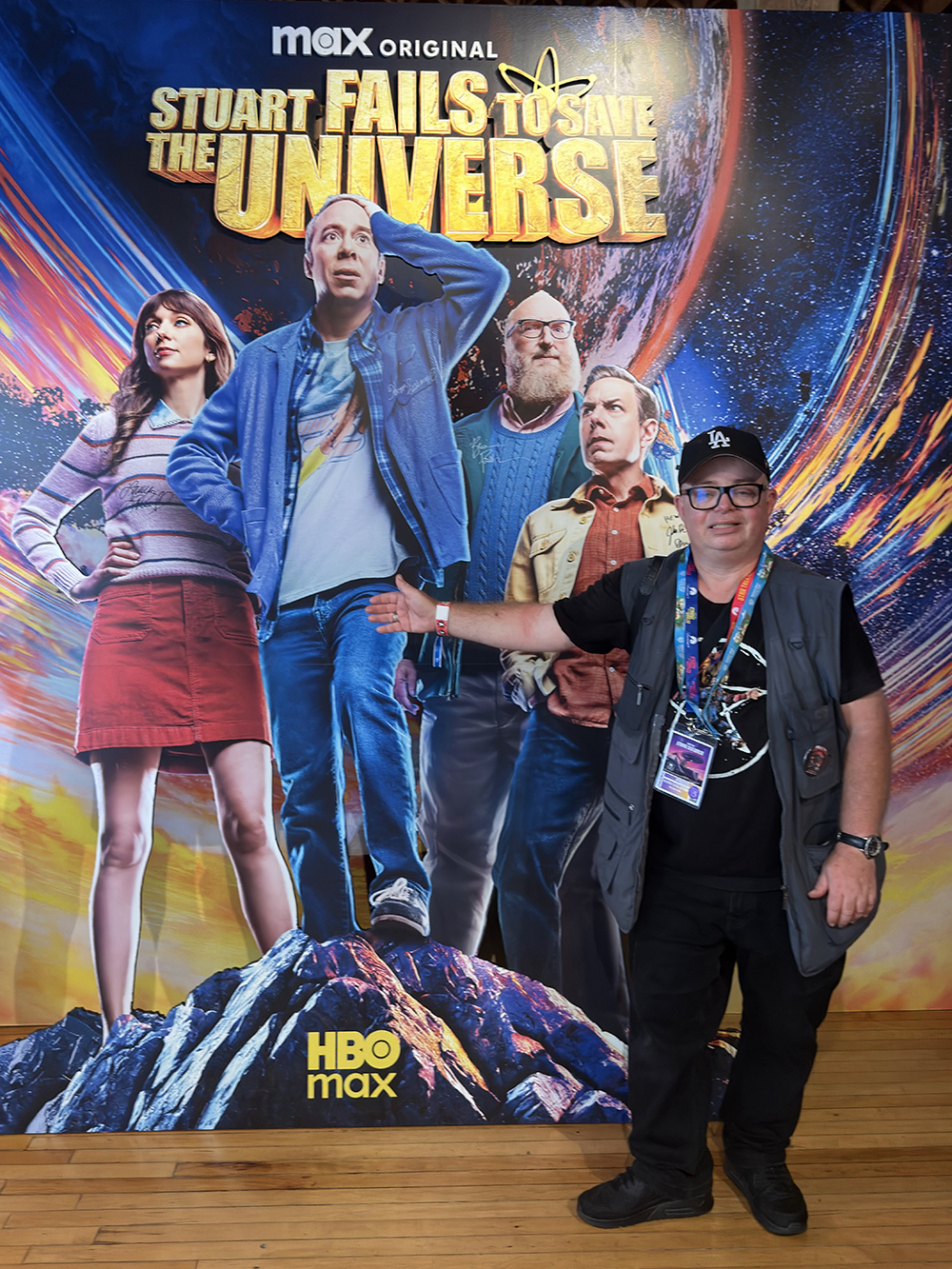
The Comic Center of Pasadena Comes to SDCC 2026
During San Diego Comic-Con 2026, HBO Max invited visitors to leave the crowded convention floor and enter a much less stable version of Pasadena. Installed inside Sparks Gallery in San Diego’s Gaslamp Quarter, The Comic Center of Pasadena transformed the comic-book shop familiar from The Big Bang Theory into an immersive experience inspired by the Max Original comedy Stuart Fails to Save the Universe. The activation ran from Thursday, July 23, through Sunday, July 26, matching Comic-Con’s principal dates and opening on the same day as the series’ HBO Max premiere.
Located at 530 Sixth Avenue, only a few minutes’ walk from the San Diego Convention Center, the free off-site attraction welcomed visitors from 11:00 a.m. to 7:00 p.m. on Thursday, Friday and Saturday, before closing at 3:00 p.m. on Sunday. No advance reservation system was used, although the attraction’s popularity resulted in substantial lines throughout the convention.
HBO Max designed more than a static set recreation or promotional exhibition. Visitors were placed inside a complete story combining a carefully decorated comic shop, performers playing store employees, recorded appearances by Kevin Sussman as Stuart Bloom, interactive missions, alternate realities and personalized collectibles. The attraction’s central joke reflected the title of the series: participants were recruited to save the universe, but failure was always the expected outcome.

Entering Stuart Bloom’s Comic-Book Shop
The experience began with a recreation of The Comic Center of Pasadena, the store operated by Stuart Bloom throughout The Big Bang Theory. Shelves and display cases were crowded with comics, statues, action figures, posters and other memorabilia. Back-issue bins and numerous DC-themed displays gave the room the atmosphere of a genuine neighborhood comic shop rather than a temporary four-day installation.
References to DC characters and other Warner Bros. properties encouraged guests to examine the surroundings before beginning their mission. Performers posing as Comic Center employees welcomed each group, explained that Stuart Bloom had stepped away and distributed membership cards that would become essential to the interactive part of the adventure.
The choice of setting carried considerable nostalgic value. In The Big Bang Theory, the store was a regular meeting place for Sheldon Cooper, Leonard Hofstadter, Howard Wolowitz and Raj Koothrappali. It was also Stuart Bloom’s struggling business and one of the sitcom’s most recognizable recurring locations. Reconstructing it at Comic-Con created an immediate connection between the original series and its more ambitious science-fiction spin-off.
That reassuring environment did not remain stable for long. A recorded message from Stuart Bloom, played once again by Kevin Sussman, informed the visitors that a mysterious device had disappeared and reality was in danger. The machine had been built by Sheldon Cooper and Leonard Hofstadter, but Stuart Bloom’s involvement had helped create a multiversal catastrophe. His awkward request for assistance provided the transition from familiar sitcom territory into an unpredictable science-fiction adventure.

Three Missions Across an Unstable Multiverse
After passing through a portal, visitors entered the principal interactive area. Lighting, sound, screens and science-fiction effects marked the shift from the warm, cluttered comic shop to a series of unstable alternate realities. The Comic Center membership card distributed at the entrance now became the key to the experience.
Guests used the card to unlock choose-your-own-adventure challenges positioned around the room. Although several possible realities were available, every participant could complete three missions. Each scenario asked visitors to make decisions that might locate the missing device, repair a damaged timeline or prevent another universe from collapsing.
The challenges were based on humor, instinct and personality rather than detailed knowledge of The Big Bang Theory. As a result, the attraction remained accessible to newcomers while including enough familiar references and characters to satisfy longtime fans. The availability of several stations also allowed participants to follow different paths instead of moving through one fixed sequence.
Each decision was recorded on the membership card and later used to determine a personalized “hero archetype.” The card therefore connected the different stages of the attraction: it introduced visitors as members of the Comic Center, unlocked their three missions and preserved their choices until the final reveal.

Successfully Failing to Save the Universe
No matter how carefully participants considered their options, every mission ended with another damaged reality. This repeated failure was not an unsatisfying conclusion but the experience’s most effective running joke. Visitors could make questionable decisions, produce ridiculous consequences and still complete the adventure exactly as intended.
Traditional superhero attractions usually reward bravery, strength or perfect judgment. Stuart Fails to Save the Universe reversed that formula by congratulating guests for having “successfully failed” to protect the multiverse. Defeat became both a punchline and a shared achievement.
The concept was particularly appropriate for Stuart Bloom, a character defined by persistence despite repeated disappointment. He has never resembled a conventional action hero, and the attraction did not attempt to turn him into one. Instead, it used his anxiety, bad luck and resilience as the basis of the adventure. Participants became part of his world by failing alongside him.
After completing three missions, each group entered a final story room containing the missing multiverse device. The illuminated machine, surrounded by controls and oversized science-fiction components, served as the physical climax of the experience and its principal photo opportunity. A final video message from Stuart Bloom acknowledged the visitors’ efforts before directing them toward the reward area.

Personalized Cards and Exclusive SDCC Collectibles
At the final station, visitors scanned their membership cards one last time. Their recorded decisions were used to match them with a character from Stuart Fails to Save the Universe. Instead of presenting the result only on a screen, HBO Max turned it into a collectible character card sealed inside a rigid plastic case resembling a professionally graded trading card.
The detail was perfectly matched to Comic-Con’s collecting culture. A disposable personality-test result would have had little value after the event, while a mock-graded card looked like an object that could genuinely be displayed or sold in Stuart Bloom’s shop. Because the assigned character depended on the participant’s choices, not every visitor necessarily received the same card.
Guests also left with a “Comic Books Are My Superpower” T-shirt, a comic connected to the series and a pack of Red Vines. The merchandise was placed inside a brown paper bag bearing The Comic Center of Pasadena branding, making the giveaways resemble purchases from the fictional store instead of unrelated promotional products.
The rewards were generous, but they also completed the attraction’s story. The membership card introduced the mission, the three realities recorded the participant’s decisions and the final collectible transformed those choices into a physical souvenir. Every major element therefore contributed to a journey with a clear beginning, progression and conclusion.

An Unlikely Hero Leads The Big Bang Theory Spin-Off
Stuart Fails to Save the Universe stars Kevin Sussman as Stuart Bloom, with Lauren Lapkus returning as Denise, Brian Posehn as geologist Bert Kibbler and John Ross Bowie as physicist Barry Kripke. The series was created by Chuck Lorre, Zak Penn and Bill Prady and produced by Chuck Lorre Productions and Warner Bros. Television.
The premise takes several supporting characters from The Big Bang Theory and places them inside a science-fiction action-adventure involving wormholes, alternate worlds and multiple versions of familiar figures. After accidentally helping to create a new multiverse, Stuart Bloom must locate a quantum-interference device before the resulting crisis destroys reality.
Building the series around Stuart Bloom gives the project an appealingly self-aware identity. The perpetually unlucky comic-shop owner was never the franchise’s most obvious candidate to become a multiversal hero. That mismatch is precisely what makes the concept work: reality needs a savior, but the person answering the call is someone whose plans rarely unfold as intended.
The Sparks Gallery activation communicated this creative evolution effectively. It began inside a recognizable piece of The Big Bang Theory history, then gradually destabilized that familiar environment. Nostalgia provided the entrance, while the portals, interactive decisions and quantum device introduced the larger scale of the spin-off.

Why HBO Max’s SDCC 2026 Activation Worked
The attraction succeeded because it balanced nostalgia with discovery. Longtime viewers could recognize the comic shop and reconnect with supporting characters from The Big Bang Theory. New visitors could understand the premise within minutes: Stuart Bloom had helped break the multiverse, a dangerous device was missing and everyone had three opportunities to make the situation worse.
For four days in San Diego, a character who had spent years at the edge of The Big Bang Theory finally occupied the center of his own chaotic universe. The Comic Center of Pasadena turned failure into entertainment, transformed interactive choices into collectibles and demonstrated that an unlikely hero could support one of SDCC 2026’s most memorable off-site experiences.

The Comic Center of Pasadena Experience
Where: Sparks Gallery, 530 Sixth Avenue, San Diego, California.
When: Thursday, July 23, through Saturday, July 25, 2026, from 11:00 a.m. to 7:00 p.m.; Sunday, July 26, 2026, from 11:00 a.m. to 3:00 p.m.
What: A free, story-driven HBO Max activation recreating Stuart Bloom’s comic shop and sending visitors through three interactive multiverse missions. The experience included recorded appearances by Kevin Sussman, a replica quantum device, a personalized hero-archetype card, a themed T-shirt, an exclusive comic and Red Vines.
You can found our photos in our Flickr page
Photos and video 4K : Boris Colletier / Mulderville