

Comic Con France 2026 : Battlestar Galactica brought Edward James Olmos and Mary McDonnell back to command
Sunday 19 April, 2:55 PM PT Villepinte, Parc des Expositions 2026-04-19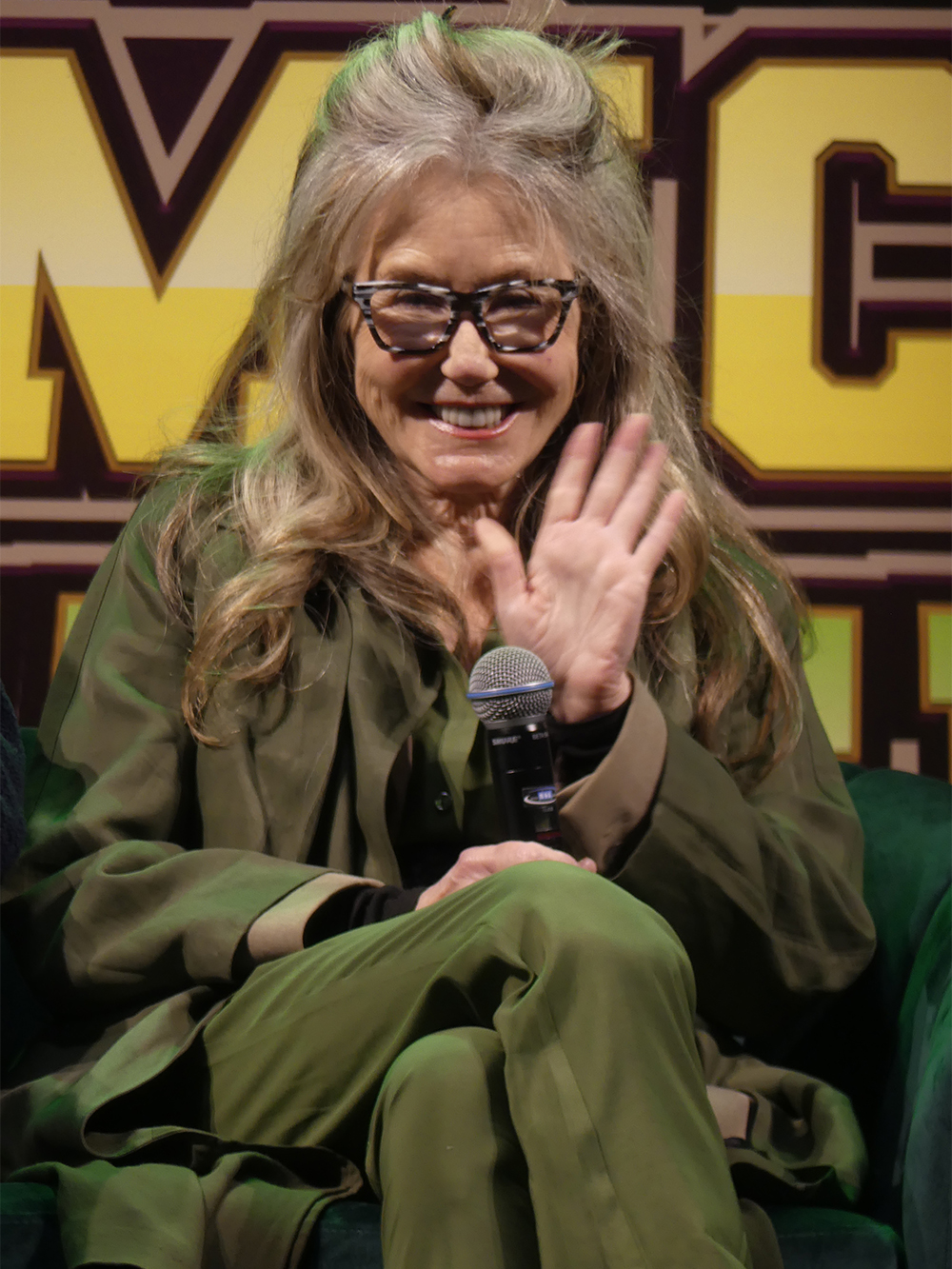
At Comic Con France 2026, held at the Parc des Expositions Paris-Nord Villepinte, the Sunday, April 19 panel dedicated to Battlestar Galactica carried a very special emotional weight, because it brought together two of the modern series’ most essential figures: Edward James Olmos, unforgettable as Commander and later Admiral William Adama, and Mary McDonnell, whose President Laura Roslin remains one of the strongest political and human figures ever written for science-fiction television. For the audience gathered in Villepinte, this was not simply another nostalgia panel attached to a cult show; it was a rare opportunity to see two performers whose shared screen presence helped turn a space opera reboot into one of the defining television dramas of the 2000s. Comic Con France had officially announced both guests for the 2026 edition, presenting Mary McDonnell as the actress behind Laura Roslin, Stands With A Fist, Rose Darko, Marilyn Whitmore, Sharon Raydor, and Madeline Usher, while Edward James Olmos was introduced as a rare guest associated with Admiral William Adama, Gaff, Lieutenant Martin Castillo, and several other landmark roles.
The strength of this reunion was immediately obvious because Battlestar Galactica has always lived less through its machinery than through its people. Developed by Ronald D. Moore and executive produced with David Eick, the reimagined series began with the 2003 miniseries before becoming a four-season drama that ran until March 20, 2009, following the last human survivors of the Twelve Colonies after a devastating Cylon attack. At its center stood the fragile balance between military command and civilian democracy, embodied by Edward James Olmos and Mary McDonnell with a gravity that still feels unusually modern. The Peabody Awards described the series as an intense drama asking provocative questions about religion, politics, sex, and what it means to be human, while also emphasizing that fewer than 50,000 survivors were left wandering through space in a fleet led by the Galactica. That description remains perhaps the clearest explanation of why the panel felt so powerful in 2026: the series was never only about survival in space, but about what a society keeps, abandons, invents, and betrays when everything else has collapsed.

Seeing Edward James Olmos and Mary McDonnell side by side at Comic Con France also reminded fans how beautifully the series built its emotional architecture around contrast. William Adama was the soldier, the father figure, the old warrior forced to protect a fleet with discipline, scars, instinct, and stubborn faith in his crew. Laura Roslin was the reluctant president, a former education secretary suddenly placed at the center of history, carrying illness, authority, doubt, and moral conviction in the same breath. Their relationship, one of the great slow-burn emotional bonds of modern television, never needed easy sentimentality to become unforgettable; it grew from argument, responsibility, respect, grief, and the simple fact that two exhausted people kept choosing humanity in a universe designed to erase it. That is why this Villepinte panel worked so naturally: fans were not only applauding two beloved actors, but also honoring the memory of a fictional partnership that helped redefine how science fiction could speak about power, democracy, faith, war, and love.
For Mary McDonnell, Battlestar Galactica became one more major chapter in a career already marked by remarkable performances across film, television, and theatre. Born in Wilkes-Barre, Pennsylvania, Mary McDonnell earned two Academy Award nominations, first for Stands With A Fist in Kevin Costner’s Dances With Wolves, then for May-Alice Culhane in John Sayles’ Passion Fish. She also appeared in Independence Day, Donnie Darko, Sneakers, Grand Canyon, Scream 4, The Closer, Major Crimes, and, more recently, Mike Flanagan’s The Fall of the House of Usher. The Television Academy notes her reputation for transforming both period and contemporary roles into dynamic character portraits and highlights the acclaim she received for Laura Roslin in the Peabody Award-winning Battlestar Galactica.

For Edward James Olmos, the Villepinte appearance carried the aura of a career that has moved constantly between performance, direction, representation, and activism. Born in East Los Angeles, Edward James Olmos became widely known through roles such as Detective Gaff in Ridley Scott’s Blade Runner, Lieutenant Martin Castillo in Miami Vice, Jaime Escalante in Stand and Deliver, Montoya Santana in American Me, Abraham Quintanilla in Selena, Felipe Reyes in Mayans M.C., and William Adama in Battlestar Galactica. His work on Miami Vice earned him a Primetime Emmy Award and a Golden Globe Award, while Stand and Deliver brought him an Academy Award nomination for Best Actor. What made his presence at Comic Con France especially meaningful is that Edward James Olmos has never treated genre as a lesser space: whether in cyberpunk, crime drama, political allegory, animation, or science fiction, he has consistently brought moral density to characters who could easily have been reduced to icons.
The panel also offered a reminder of how far Battlestar Galactica traveled beyond the usual limits of television fandom. In March 2009, the series was the subject of a United Nations event attended by Mary McDonnell, Edward James Olmos, Ronald D. Moore, and David Eick, with Whoopi Goldberg moderating a discussion connected to human rights, terrorism, children and armed conflict, and reconciliation. Few genre series earn that kind of institutional afterlife, and fewer still deserve it so naturally. Battlestar Galactica became a post-9/11 drama without reducing itself to a single allegory; it could evoke terrorism, occupation, religious extremism, torture, civil liberties, militarized fear, and political compromise while still remaining, first and foremost, a character-driven survival story. That was the brilliance of the show and the reason the Villepinte audience could respond so warmly nearly two decades after its finale: the questions it raised have not aged out of relevance.

The importance of the series was also inseparable from its formal ambition. Battlestar Galactica avoided much of the glossy distance often associated with space opera, choosing handheld urgency, military realism, political claustrophobia, and a musical identity shaped by Bear McCreary, whose score rejected the usual symphonic clichés of science fiction in favor of percussion, voices, global instrumentation, and recurring emotional motifs. That creative seriousness gave Edward James Olmos and Mary McDonnell the ideal dramatic ground: they were not performing around spectacle, but inside a world that treated exhaustion, fear, devotion, and leadership as physical states. The Peabody Awards credited the show with pushing the limits of science fiction while making it accessible to a broad audience, and that remains one of the best ways to understand its lasting prestige.
At Comic Con France 2026, the presence of Edward James Olmos and Mary McDonnell therefore felt like much more than a guest booking. It was a living bridge to a series that proved science fiction could be philosophical without becoming cold, political without becoming didactic, and spectacular without losing sight of intimate human pain. In Villepinte, among photoshoots, autographs, fan memories, and the particular electricity that conventions create when generations of viewers share the same room, Battlestar Galactica once again became what it had always been at its best: a story about survival, leadership, sacrifice, and the terrifying possibility that history repeats itself only when human beings stop learning from it. And with Edward James Olmos and Mary McDonnell on stage, the words every fan knows seemed to hover naturally over the room: so say we all.
You can discover our photos in our Flickr page
Photos and video 4K : Boris Colletier / Mulderville