

The Odyssey
Directed by Christopher Nolan (2026)
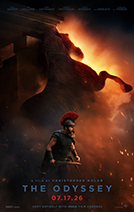
| With | Matt Damon, Tom Holland, Anne Hathaway, Robert Pattinson, Lupita Nyong’o, Samantha Morton, Zendaya, Charlize Theron |
| Runtime | 173 minutes |
| Release | 2026-07-17 |
| Rating | 10/10 |
The Odyssey is a mythical epic filmed around the world that follows Odysseus’s return to Ithaca. For the first time, Homer’s seminal saga is brought to the screen in spectacular fashion using the latest IMAX technology.
The review
By Mulder 2026-07-15
Some filmmakers adapt classics, while others reinvent them through the lens of their own cinematic language. With The Odyssey, director and screenwriter Christopher Nolan achieves something even rarer. Rather than simply transposing Homer’s immortal epic to the screen, he transforms one of humanity’s oldest stories into a moving, technically breathtaking, and intellectually ambitious blockbuster that feels both ancient and surprisingly modern. Following the monumental success of Oppenheimer, expectations surrounding Christopher Nolan’s return could hardly have been higher, but the director handles this pressure with remarkable confidence. Filmed entirely with IMAX cameras in six countries, the production itself has been described by his longtime production partner, Emma Thomas, as feeling like making seven ambitious films at once, and this extraordinary scale shines through in virtually every shot.
Rather than crafting a simple mythological adventure, Christopher Nolan approaches Odysseus’s journey as an exploration of memory, regret, identity, and survival. His screenplay mirrors the fragmented structure of Homer’s poem, interweaving multiple timelines without sacrificing clarity. The result undeniably bears Nolan’s mark while remaining deeply respectful of the original work. The flashbacks to Troy, the long journey home, and the political tensions brewing in Ithaca constantly enrich one another, allowing emotional revelations to emerge naturally rather than through exposition. Perhaps the film’s greatest surprise lies in its humanity. Christopher Nolan has often been praised for his concepts rather than his emotions, but here, the emotional core is impossible to ignore. Every monster, every battle, and every supernatural encounter ultimately serves a central idea: the unbearable longing to return home after being transformed by war and by one’s own mistakes. The mythical creatures become less obstacles and more manifestations of guilt, temptation, and fear, giving the journey a deeply personal resonance.
Matt Damon delivers what is arguably the best performance of his career here. Rather than portraying Odysseus as an untouchable mythological hero, he embodies an exhausted man bearing the invisible scars of conflict. His physical commitment is undeniable, but it is the moments of calm that leave the deepest impression. A glance out to sea, a hesitation before making yet another impossible decision, or the exhaustion visible beneath his determination reveal a king who understands that the greatest battle awaiting him is not against monsters, but against himself. Matt Damon immediately accepted the project even before reading the synopsis, simply because Christopher Nolan was directing it, and he later described the role of Ulysses as the role of a lifetime. This level of commitment shines through in his performance, especially given the notoriously difficult shoot, which took the cast from remote islands to the icy black-sand beaches of Iceland, in unforgiving weather conditions. These hardships ultimately contribute to the film’s authenticity, lending each sequence an undeniable sense of physical reality.
The supporting cast consistently elevates the quality of the film. Anne Hathaway imbues Penelope with extraordinary emotional complexity, transforming what could have been merely a passive, waiting character into one of the most memorable figures in the story. Her intelligence, restraint, and resilience make every scene in Ithaca captivating, while her chemistry with Matt Damon lends genuine emotional weight to the entire narrative. Tom Holland brings surprising maturity to the character of Telemachus, whose journey into adulthood subtly yet significantly echoes his father’s odyssey. Robert Pattinson portrays a perfectly menacing Antinous, while Charlize Theron, Zendaya, Samantha Morton, Lupita Nyong’o, and John Leguizamo each leave a memorable impression despite relatively limited screen time. Among them, Samantha Morton’s spellbinding performance as Circe is particularly captivating, creating one of the film’s most unsettling and unforgettable sequences. John Leguizamo also provides one of the film’s warmest emotional anchors, lending remarkable dignity and sincerity to the character of Eumaeus.
From a technical standpoint, The Odyssey is memorable. The decision to shoot the entire production with IMAX cameras could easily have become nothing more than a marketing gimmick, but Christopher Nolan ensures that this format serves the storytelling. The vast coastlines, dizzying cliffs, endless oceans, and colossal mythological creatures take on an overwhelming sense of scale that truly justifies the big-screen experience. Hoyte van Hoytema’s cinematography constantly strikes a balance between intimacy and grandeur, while the real-life filming locations, massive physical sets, and meticulously crafted visual effects prevent the fantasy from feeling artificial. The sound design is equally extraordinary. Every crashing wave, every distant clap of thunder, every whispered prayer, every monstrous roar, and every spellbinding melody of the sirens contributes to a soundscape that often carries as much narrative weight as the images themselves. Ludwig Göransson wisely avoids overwhelming the film with constant musical grandeur, preferring to let silence and ambient sounds build tension before unleashing powerful orchestral moments at the most emotionally charged points.
What makes The Odyssey particularly fascinating is its willingness to embrace mythology without sacrificing realism. Christopher Nolan does not treat the Cyclops, Charybdis, Circe, or the sirens as mere showcases for special effects. On the contrary, each encounter carries genuine dramatic weight, reinforcing Odysseus’s psychological journey. The film constantly navigates the fine line between historical authenticity and mythical fantasy, without ever letting one approach completely dominate the other. This balance also extends to Nolan’s recurring fascination with time, perception, and subjective reality. Viewers familiar with Memento, Inception, Interstellar, or Oppenheimer will immediately recognize thematic echoes, though these never feel repetitive. On the contrary, The Odyssey stands as the culmination of ideas that Nolan has continually refined throughout his career.
The film is not entirely without flaws. At nearly three hours long, certain passages inevitably lose momentum, and a few large-scale battle sequences suffer from editing that at times prioritizes chaos at the expense of spatial clarity. Some viewers might also find the deliberately subdued color palette darker than expected for a Greek epic, while Nolan’s characteristic preference for dense dialogue remains evident throughout the film. Yet these minor reservations never seriously detract from the experience, as the emotional payoff proves so deeply rewarding. The final act, in particular, offers one of the director’s most moving conclusions, reminding the audience that behind all this spectacle lies a deeply personal story about family, forgiveness, and the price of survival.
The Odyssey thus stands as one of the defining cinematic achievements of the decade. It is an epic in the truest sense of the word—not only because of its scale or budget, but also because it manages to capture the timeless emotional power that has allowed Homer’s story to endure for nearly three millennia. By combining revolutionary cinematic techniques, exceptional performances, breathtaking craftsmanship, and an emotional depth that is unexpectedly profound, Christopher Nolan has created far more than just a prestigious blockbuster. He has crafted a modern myth that is just waiting to be discovered on the biggest screen possible and once again confirms why he remains one of the most ambitious storytellers in contemporary cinema. The Odyssey is not merely a spectacle: it is an unforgettable, fascinating cinematic journey, worthy of the legend that inspired it.
The Odyssey
Written and directed by Christopher Nolan
Based on Homer’s Odyssey
Produced by Emma Thomas, Christopher Nolan
Starring Matt Damon, Tom Holland, Anne Hathaway, Robert Pattinson, Lupita Nyong’o, Samantha Morton, Zendaya, Charlize Theron
Cinematography: Hoyte van Hoytema
Edited by Jennifer Lame
Music by Ludwig Göransson
Production companies: Universal Pictures, Syncopy
Distributed by Universal Pictures
Release dates: July 6, 2026 (Empire Leicester Square), July 15, 2026 (France), July 17, 2026 (United States)
Running time: 173 minutes
Viewed on July 9, 2026, at the Pathé Palace, Theater 1