

Moana
Directed by Thomas Kail (2026)
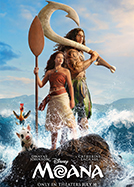
| With | Catherine Laga'aia, Dwayne Johnson, Rena Owen, John Tui, Frankie Adams, Jemaine Clement |
| Runtime | 115 minutes |
| Release | 2026-07-10 |
| Rating | 5/10 |
Answering the call of the ocean, Vaiana ventures beyond the reef of her island, Motunui, for the first time. Accompanied by the famous demigod Maui, she embarks on an unforgettable journey destined to restore prosperity to her people…
The review
By Mulder 2026-07-08
The Walt Disney Company’s live-action film, Moana, arrives with the daunting task of following not only one of the studio’s most beloved modern animated classics but also a franchise that has become a true global phenomenon. With Thomas Kail behind the camera and Dwayne Johnson reprising the role of Maui, the film initially seems like a sure bet: visually ambitious, culturally respectful, and driven by songs that have already proven their timeless appeal. Yet, despite the craftsmanship it displays and the obvious affection everyone involved has for the original work, this remake is constantly confronted with a question to which it never provides a convincing answer: why does it exist? It is by no means a bad film, but it rarely justifies the reinterpretation of a story that remains remarkably relevant, barely a decade after its initial release.
What strikes one immediately is the production’s remarkable commitment to Polynesian authenticity. The Walt Disney Company invested heavily in a collaboration with artisans, historians, choreographers, and cultural advisors from the Pacific, thereby creating costumes, villages, and ceremonial details rooted in authentic traditions rather than generic exoticism. The fact that more than 2,000 costumes were handcrafted, that ancient rope-making techniques replaced modern construction methods in the village sets, and that a cultural committee oversaw the production throughout its development adds an undeniable dimension of sincerity to the project. Even when the film sometimes seems overwhelmed by CGI, these concrete elements provide an impressive, tangible foundation that deserves to be commended, and one senses that respect for the cultures depicted was never treated as a mere marketing slogan, but as an essential creative priority.
The casting proves equally successful, particularly newcomer Catherine Lagaʻaia, who shoulders an enormous responsibility with admirable confidence. Rather than trying to imitate the animated heroine, she brings a more understated determination that fits the film’s live-action approach, while performing each musical number with sincere conviction. Her chemistry with Dwayne Johnson works particularly well when the script allows the duo to interact naturally, rather than recreating familiar scenes shot for shot. Johnson clearly relishes physically embodying Maui after lending his voice to the character for years, and his enthusiasm remains infectious; however, transforming an animated demigod with exaggerated features into a flesh-and-blood character inevitably limits the extraordinary energy that once defined him. His performance remains entertaining, even if the constraints of makeup, prosthetics, and realism sometimes give Maui a surprisingly subdued air.
Ironically, the film’s biggest obstacle is neither its casting nor its technical execution, but its blind loyalty to the original animated film. Scene after scene, the plot unfolds with such precision that longtime fans can often anticipate every line of dialogue, every emotional moment, and every musical number before they even happen. While a few small additions—including the new original song “Along The Way”—offer welcome moments of freshness, they are simply too modest to transform the experience into something truly new. Instead of using the live-action adaptation to deepen the characters, expand the mythology, or reinterpret familiar relationships, the screenplay functions primarily as an expensive exercise in preservation, treating the original almost like an untouchable sacred text.
Visually, the results are mixed. The Polynesian landscapes remain breathtaking, and the ocean continues to be arguably the film’s most captivating character, combining beauty with an almost spiritual presence. Real-life locations blend with large-scale visual effects to create spectacular panoramas, but not all digital environments achieve the same level of believability. Some sequences possess true cinematic grandeur, while others seem dominated by artificial sets and CGI that diminish the emotional impact rather than enhancing it. This imbalance becomes particularly noticeable during action scenes, where the freedom of expression found in animated films often proves more effective than realism.
The musical aspect, fortunately, loses virtually none of its magic. The familiar songs retain their emotional power, and hearing them performed by a new cast brings enough freshness to justify their return. Catherine Lagaʻaia impresses vocally throughout the film, while Dwayne Johnson once again embodies Maui’s theatrical personality with obvious delight. The soundtrack continues to evoke the vastness of the Pacific, and Lin-Manuel Miranda, alongside his longtime collaborators, successfully preserves the musical identity that helped elevate the original to the status of a modern Disney classic. The music remains the emotional engine that unfailingly carries this remake whenever the narrative becomes too predictable.
Perhaps the most frustrating aspect of Moana is that its greatest strengths ultimately only serve to reinforce the excellence of the 2016 animated film rather than surpass it. Undeniable care has been taken at every level, from art direction to choreography, and the filmmakers never approach the subject with cynicism. Yet technical refinement alone cannot replace the sense of discovery that defined the original adventure. Animation allowed for impossible movements, expressive exaggeration, and whimsical visual invention that the live-action film can only partially recreate. The result is an adaptation that is consistently enjoyable, often magnificent, and sometimes moving, but rarely surprising.
Moana succeeds as a polished family film but falls short as a meaningful reinterpretation. Viewers experiencing the story for the first time will undoubtedly find it a captivating adventure, filled with memorable songs, charismatic performances, and breathtaking images of the Pacific. Those returning after having seen the animated classic, on the other hand, may leave admiring the effort more than the necessity. It is a polished production that honors its legacy, celebrates Polynesian culture with admirable sincerity, and introduces a promising new lead actress, but it never quite shakes the impression of being an exceptionally expensive echo of a film that had already captured the same magic with greater imagination.
Moana
Directed by Thomas Kail
Written by Jared Bush, Dana Ledoux Miller
Based on Disney’s Moana by Jared Bush
Produced by Dwayne Johnson, Beau Flynn, Dany Garcia, Hiram Garcia, Lin-Manuel Miranda
Starring Catherine Laga'aia, Dwayne Johnson, Rena Owen, John Tui, Frankie Adams, Jemaine Clement
Cinematography: Óscar Faura
Edited by Melanie Ann Oliver
Music by Mark Mancina
Production companies: Walt Disney Pictures, Seven Bucks Productions, Flynn Picture Co., 5000 Broadway Productions
Distributed by Walt Disney Studios Motion Pictures (United States)
Release date: July 8, 2026 (France), July 10, 2026 (United States)
Running time: 115 minutes
Viewed on July 8, 2026, at Gaumont Disney Village, IMAX Theater, Seat E20