

Evil Dead Burn
Directed by Sébastien Vaniček (2026)
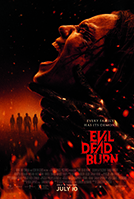
| With | Souheila Yacoub, Hunter Doohan, Luciane Buchanan, Tandi Wright, Erroll Shand, Maude Davey |
| Runtime | 109 minutes |
| Release | 2026-07-10 |
| Rating | 9/10 |
After her husband’s funeral, Alice goes to her in-laws’ secluded house to share a final meal in his memory. But the family gathering turns into a nightmare when her loved ones begin transforming, one by one, into demonic creatures. Faced with this hellish ordeal, Alice discovers that the vows she once made continue to bind her to her husband… far beyond death.
The review
By Mulder 2026-07-03
More than four decades after Sam Raimi forever revolutionized horror cinema with a low-budget nightmare set in a secluded cabin, Evil Dead Burn proves that the franchise remains one of the few in the genre capable of constantly reinventing itself without betraying its identity. Directed by French filmmaker Sébastien Vaniček—whose remarkable Vermines immediately established him as one of the most promising figures in European horror—this latest installment abandons nostalgia in favor of a fiercely personal vision. Rather than attempting to imitate Sam Raimi’s kinetic madness or Fede Álvarez’s uncompromising brutality, Sébastien Vaniček confidently forges his own path, transforming the familiar mythology into an intimate, emotionally charged chamber of horrors where grief, domestic violence, guilt, and familial denial become as terrifying as the Deadites themselves. It’s a bold creative gamble that pays off spectacularly, confirming why the franchise’s producers granted him total creative freedom to reinterpret this universe.
The screenplay, co-written by Sébastien Vaniček and Florent Bernard, skillfully shifts the emotional center of the saga. After her husband’s funeral, Alice returns to her in-laws’ isolated home for what was supposed to be a final tribute, but she discovers that death has no intention of respecting this turning point. As family members succumb one by one to demonic possession, the story gradually reveals that the true curse did not begin with forbidden rituals, but with years of hidden emotional and physical abuse. Supernatural horror serves less as the main attraction than as an amplifier of wounds that already existed. This thematic focus gives Evil Dead Burn a dramatic narrative of unexpected maturity, allowing the film to examine cycles of violence, toxic family dynamics, and manipulation without ever sacrificing the relentless pace expected of an installment in the Evil Dead series. The mythology serves the story rather than overwhelming it, lending the emotional stakes an authenticity that’s unusual for a franchise traditionally driven by escalating carnage.
What immediately sets the film apart is Sébastien Vaniček’s astonishing mastery of visual storytelling. Every camera movement seems driven by anxiety rather than mere spectacle. Long takes, sudden shifts in perspective, carefully orchestrated background movements, and the remarkable use of confined spaces constantly undermine the audience’s sense of security. The isolated family home becomes a living organism, with every hallway, staircase, and room gradually transforming into a battlefield where danger lurks behind every door. Even moments that might have been mere conventional “jump scares” in less skilled hands are transformed into exercises in mounting tension through composition and choreography. Vaniček demonstrates an impressive understanding of physical space, allowing viewers to mentally map out the environment before methodically turning that familiarity against them. Several extended sequences display remarkable technical precision, particularly an elaborate long take that was already partially revealed in promotional material, but whose full execution within the film remains truly exhilarating.
While producer Rob Tapert described Evil Dead Burn as perhaps the least gory episode of the modern series—but the most brutal—this claim proves surprisingly accurate. The violence here focuses less on the sheer quantity of blood than on physical suffering and psychological cruelty. The practical effects remain exceptional, the bodily horror is inventive, and every everyday object becomes a potential instrument of unimaginable pain, in the purest Evil Dead tradition. Yet what lingers in the memory after the film is not simply the mutilations or grotesque transformations, but the deeply unsettling emotional context surrounding them. The Deadites remain delightfully sadistic, mocking, manipulative, and darkly humorous, thus preserving one of the franchise’s defining characteristics, but the cruelty now carries an emotional weight that goes far beyond mere shock value. Sébastien Vaniček understands that horror resonates longer when viewers fear not only what they see, but also what it represents.
The film relies almost entirely on Souheila Yacoub, whose remarkable performance elevates every scene in which she appears. Rather than portraying Alice as yet another invincible “final girl,” Yacoub crafts a protagonist defined by her vulnerability, exhaustion, and emotional resilience. She spends much of the film terrified, wounded, and emotionally shattered, yet never loses her credibility or humanity. Her performance relies less on heroic lines than on subtle physicality, conveying fear through posture, breathing, and hesitation rather than through exaggerated theatrical flourishes. The emotional realism she brings allows the audience to connect with Alice as a woman in her own right rather than merely as a horror-movie survivor. Her chemistry with Tandi Wright, particularly during their emotionally charged confrontations, provides some of the film’s most powerful dramatic moments. If there is a breakout star of the year in the horror genre, Souheila Yacoub undoubtedly deserves that distinction.
The screenplay isn’t without its flaws. Some secondary characters remain somewhat underdeveloped, making certain deaths less impactful than they could have been, while a handful of flashbacks occasionally explain emotions that the performances had already conveyed perfectly. The final act also adopts more traditional elements of the franchise after spending much of the film carefully building a more subtle psychological atmosphere. Nevertheless, these flaws never seriously detract from the experience, as the direction itself remains consistently inventive and because Alice’s emotional journey continues to ground even the most outlandish supernatural twists. Sébastien Vaniček consistently prioritizes sincerity over hollow spectacle, allowing the characters to coexist with outrageous horror rather than forcing one to replace the other.
Perhaps the film’s greatest achievement lies in the way it naturally integrates a distinctly French sensibility into an iconic American horror franchise. Without ever feeling forced, Evil Dead Burn incorporates European emotional restraint, social commentary, and understated humor while fully embracing the franchise’s joyful madness. The balance is surprisingly harmonious. Fans will still find playful nods to the saga’s legacy through familiar visual motifs, weapon choices, and the behavior of the Deadites, but these references function as affectionate homages rather than nostalgic crutches. It is neither an imitation of Sam Raimi’s classic films nor an attempt to outdo Fede Álvarez or Lee Cronin on their own turf. On the contrary, it confidently broadens the horizons of what an Evil Dead story can be while remaining undeniably faithful to its chaotic spirit.
Evil Dead Burn ultimately stands out as one of the franchise’s most memorable entries precisely because it refuses to repeat tired formulas. Sébastien Vaniček displays remarkable confidence for what is only his second feature film, delivering a technically accomplished, moving, and uncompromisingly brutal film. It honors its legendary legacy while fearlessly forging its own identity, proving that the Evil Dead universe still holds immense creative potential when entrusted to filmmakers with a true vision rather than mere veneration. Much more than just a sequel, Evil Dead Burn promises to be the beginning of a fascinating new era for the franchise—an era where horror is measured not solely by the amount of blood spilled, but by the emotional scars left behind.
Evil Dead Burn
Directed by Sébastien Vaniček
Written by Sébastien Vaniček, Florent Bernard
Based on The Evil Dead by Sam Raimi
Produced by Rob Tapert, Sam Raimi
Starring Souheila Yacoub, Hunter Doohan, Luciane Buchanan, Tandi Wright, Erroll Shand, Maude Davey
Cinematography: Philip Lozano
Edited by Maxime Caro
Music by Double Danger
Production companies: New Line Cinema, Screen Gems, Ghost House Pictures
Distributed by Warner Bros. Pictures (United States), Metropolitan FilmExport (France)
Release date: July 8, 2026 (France), July 10, 2026 (United States)
Running time: 109 minutes
Viewed on June 11, 2026, in Paris at the Le Grand Rex Cinema
Reviewed on July 3, 2026, in Paris at the Le Grand Rex Cinema
We will not be thanking certain french public relations agencies, which are clearly more concerned with influencers than with media outlets that have been established for over 23 years and have accumulated more than 50 million views on YouTube (videos) and Flickr (photos).