

Lydia and the Mist Rider
Directed by Émilie Rosas, Philippe Arseneau Bussières, Nancy Florence Savard
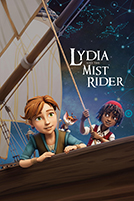
| With | Sophie Nélisse, Anthony Kavanagh, Lyndz Dantiste, Éveline Gélinas, Alexandre Bacon, Kevin Houle, Guy Nadon, Gildor Roy, Dorothée Berryman, Philomène Bilodeau |
| Runtime | 85 minutes |
| Release | Release date unknown |
| Rating | 7/10 |
When her older brother Thaddeus is mysteriously kidnapped by the Enchanter, 11-year-old Lydia sets out to find him in the Sea of Mist. Taken in by the crew of the Dauphin, a flying ship, she becomes the apprentice of the astromagician Ambrosia. Ambrosia is searching for other missing children, including her own son. Determined to solve this mystery, Lydia must learn astromagic and confront the Enchanter.
The review
By Mulder 2026-07-05
There is something undeniably refreshing about seeing an original fantasy universe emerge from the Canadian independent animation scene, especially when it is driven more by emotion than by spectacle. Nancy Florence Savard, Émilie Rosas, and Philippe Arseneau Bussières have clearly made it their mission to create an adventure that celebrates the wonder of childhood while exploring themes of grief, courage, and family. Adapted from the novels by Yves Meynard, Lydia and the Mist Rider follows a classic coming-of-age journey, but its emotional sincerity allows it to rise above many of the conventions that define the genre. Although its ambitions sometimes exceed its technical capabilities, the film remains a captivating and genuinely heartfelt journey that never loses sight of the emotional struggles driving its young heroine.
The story centers on Lydia, an eleven-year-old girl whose peaceful life is turned upside down when her older brother, Thaddeus, is kidnapped by the mysterious Spellbinder. Unwilling to accept this loss, she ventures into the dangerous Misty Sea, where fate leads her aboard the flying ship Dolphin and under the tutelage of the enigmatic astromancer Ambrosia. The story unfolds gradually as the two women discover that their personal tragedies are linked to a much larger mystery involving missing children. Rather than relying solely on action, the screenplay wisely focuses its emotional momentum on Lydia’s determination to reunite her broken family, creating an adventure that remains intimate despite its fantastical setting. The relationship between Lydia and Ambrosia becomes the true heart of the film, evolving naturally into a touching surrogate mother-daughter dynamic that adds welcome emotional depth to every stage of their quest.
One of the production’s greatest strengths lies in its voice performances. Sophie Nélisse delivers an impressive and nuanced portrayal of Lydia, striking a balance between youthful innocence and a growing determination as the character gradually takes on responsibilities far beyond her years. It’s worth noting that, during production, she recorded many of her scenes alongside other cast members rather than alone in a recording booth—an unusual approach in the world of animation that helped create a spontaneous chemistry rarely heard in animated feature films. This authenticity shines through throughout the film, particularly during the moving exchanges between Lydia, Thaddeus, and Lucas. Sarah Booth imbues Ambrosia with a subtle melancholy that perfectly complements the character’s hidden pain, while Anthony Kavanagh infuses Captain Chadio with warmth and humor without detracting from the more serious moments. Even the performances of the supporting cast—played by Hasani Freeman, Nico DeCastris, and Anna Hopkins—help give this fantastical world the feel of being populated by believable, emotionally grounded characters.
Visually, Lydia and the Mist Rider reflects both the strengths and limitations of an independently funded Canadian production. The world itself is brimming with imaginative concepts: floating ships sailing through endless clouds of mist, celestial navigation powered by astromagic, mysterious coastlines, and magical creatures that add charm without overshadowing the story. Certain sequences—particularly those focusing on Lydia’s magical training and the Dolphin’s voyage—demonstrate true artistic creativity. The production also deserves praise for the remarkable effort behind it, with more than 200 Quebec artists contributing over two years to bring this entirely local universe to life. While the animation sometimes lacks the polish and attention to detail associated with major Hollywood studios, its artisanal quality gives the film an identity all its own, rather than merely imitating big-budget productions.
That said, the film is not without its flaws. Its relatively short runtime often forces the character development and world-building to move at a faster pace. Lydia’s evolution as an astromancer feels rushed, while several captivating subplots involving the Spellbinder and the mythology of the Misty Sea would have deserved further exploration. Similarly, the final showdown arrives sooner than expected, resolving emotional and narrative conflicts at a pace that slightly diminishes the impact built up throughout the adventure. These issues never ruin the experience, but they leave the impression that the filmmakers had envisioned a broader story than the final runtime could comfortably accommodate.
Even when the screenplay occasionally relies on familiar fantasy conventions, the emotional honesty at the heart of the work constantly propels the film forward. The themes of resilience, healing, hope, and chosen family are handled with sincerity rather than sentimentality, ensuring that Lydia’s personal growth resonates beyond the film’s young target audience. Jean-François Racine’s score further enhances the atmosphere, blending gentle orchestral passages with bolder compositions that perfectly complement the film’s magical worlds. Combined with expressive vocal performances, the music often compensates for moments when the animation fails to fully convey the scope of its ambitious universe.
Rather than competing directly with big-budget, spectacle-driven animated blockbusters, Lydia and the Mist Rider succeeds by taking a more intimate approach to fantasy storytelling. It may not reinvent the genre or offer groundbreaking visual effects, but it delivers an emotionally enriching adventure, imbued with compassion, imagination, and optimism. Its imperfections are evident, as is the passion of the artists who created it. For families looking for a magical tale rooted in genuine emotional warmth rather than nonstop spectacle, Lydia’s journey across the Misty Sea proves to be an adventure well worth the detour.
Lydia and the Mist Rider
Directed by Émilie Rosas, Philippe Arseneau Bussières, Nancy Florence Savard
Written by Émilie Rosas
A free adaptation of the novels The Ship of Storm and The Prince of Ice by author Yves Meynard.
Produced by Nancy Florence Savard
Starring Sophie Nélisse, Anthony Kavanagh, Lyndz Dantiste, Éveline Gélinas, Alexandre Bacon, Kevin Houle, Guy Nadon, Gildor Roy, Dorothée Berryman, Philomène Bilodeau
Edited by René Caron
Music by Jean-François Racine
Production companies: 10e Ave Productions
Distributed by Eurozoom (France)
Release dates: February 20, 2026 (Canada), August 12, 2026 (France)
Running time: 85 minutes
Viewed on July 5, 2026