

Cocktail
Directed by Roger Donaldson (1988)
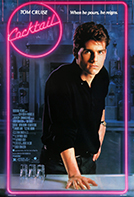
| With | Tom Cruise, Bryan Brown, Elisabeth Shue |
| Runtime | 103 minutes |
| Release | 1988-07-29 |
| Rating | 7/10 |
After leaving the army, Brian Flanagan tries to find a job in New York, but he has no qualifications. He decides to go back to school while working as a bartender. An easy solution, he thinks. But the job isn’t as simple as he believes. The owner, Douglas Koglan, decides to teach him all the tricks of the trade: how to serve drinks, customers’ drinking habits, and so on. Very quickly, Brian becomes very popular.
The review
By Mulder 2026-07-02
More than three decades after its theatrical release, Roger Donaldson’s film Cocktail remains a fascinating time capsule of late-1980s Hollywood. Often panned by critics upon its release but acclaimed by audiences, the film occupies an intriguing crossroads between a star-studded blockbuster, a romantic drama, a coming-of-age story, and an ambitious fantasy. Relying almost entirely on Tom Cruise’s irresistible charisma, the film captures the era’s obsession with ambition, material success, and style, transforming the seemingly ordinary job of a bartender into a spectacle worthy of a rock concert. While its screenplay struggles to reconcile its many narrative ambitions, its infectious energy and undeniable entertainment value have ensured that it remains etched in memory as one of the actor’s most iconic performances.
Fresh out of the army, Brian Flanagan dreams of financial success, but quickly discovers that ambition alone isn’t enough to climb the corporate ladder in the New York business world. Fate then leads him behind the bar, where the seasoned bartender Doug Coughlin played with remarkable confidence by Bryan Brown teaches him that selling drinks is often less about the art of mixology than it is about showmanship. The film’s most memorable sequences remain the elaborate flair bartending routines a mix of bottle juggling, synchronized choreography, lightning-fast mixology, and a theatrical flair that turned bartenders into celebrities long before such competitions became mainstream. These scenes are undeniably entertaining and infuse the film with a contagious energy, bolstered by a soundtrack that perfectly embodies the carefree optimism of that decade. Rather than aiming for realism, Cocktail embraces the fantastical, presenting nightlife as a glamorous playground where charisma seems capable of opening any door.
As Brian’s journey unfolds, however, the film gradually shifts away from this high-octane work atmosphere toward a romantic melodrama. His relationship with Jordan Mooney, portrayed with warmth and sincerity by Elisabeth Shue, introduces genuine emotional stakes, but the screenplay often struggles to strike a balance between romance, friendship, greed, redemption, and personal growth within a relatively linear narrative. Several dramatic twists feel abrupt, while some of the characters’ decisions seem driven more by the needs of the plot than by genuine emotional growth. The result is a second half that at times loses the natural momentum established during an exhilarating first act, leaving the audience wishing that the fascinating mentor-protégé dynamic between Brian and Doug had remained the true emotional heart of the story.
Much of the film’s enduring appeal, however, lies with Tom Cruise himself. At this point in his career, following hits like Top Gun and The Color of Money, Tom Cruise had become Hollywood’s embodiment of youthful confidence and relentless ambition. Brian Flanagan fits this profile perfectly: charming, energetic, reckless, self-centered, yet impossible to completely dislike. Tom Cruise throws himself heart and soul into every aspect of the role, bringing an athletic flair to the bartending stunts while effortlessly carrying scenes that, without him, might collapse under the weight of dialogue that is at times uneven. Even when Brian’s moral compass becomes questionable, Cruise’s natural screen presence keeps the audience captivated by his ultimate redemption.
The supporting cast further elevates the film. Bryan Brown delivers arguably the film’s richest performance, portraying Doug as both a charismatic mentor and a tragic cautionary tale. Behind his cynical advice and carefree attitude lies a deeply lonely man whose quest for wealth ultimately ruined him emotionally. His narrative arc provides Cocktail with its darkest and most moving moments, adding unexpected dramatic depth beneath the smooth, glossy surface. For her part, Elisabeth Shue brings authenticity and emotional credibility to the character of Jordan, making her relationship with Brian far more believable than the script sometimes warrants. Even in scenes that rely heavily on romantic clichés, her grounded performance provides an effective counterbalance to the film’s over-the-top fantasy.
Viewed today, Cocktail inevitably reflects many attitudes deeply rooted in its era. Its portrayal of relationships, gender dynamics, materialism, and the pursuit of wealth often seems simplistic from a modern perspective, while several of the characters’ motivations deserve more in-depth examination than the audience may have given them in 1988. Yet these elements also contribute to the film’s historical charm, offering a snapshot of an optimistic decade obsessed with success, image, and excess. Thanks to dazzling art direction, elegant cinematography, and a soundtrack composed of instantly recognizable hits, the film succeeds in transporting viewers to a very specific cultural moment.
Cocktail is far from being Roger Donaldson’s best film as a director, and its screenplay never fully develops the profound themes it briefly touches on, such as ambition, friendship, or personal fulfillment. Nevertheless, its infectious charm, memorable musical selections, entertaining bartending sequences, and magnetic performances ensure that it remains surprisingly enjoyable to watch decades later. It may lack the dramatic sophistication of Tom Cruise’s best work, but as a slice of 1980s glamour cinema that’s effortlessly enjoyable to watch, it continues to blend style, romance, and escapism into a cocktail that’s always a delight to savor.
Cocktail
Directed by Roger Donaldson
Screenplay by Heywood Gould
Based on the novel Cocktail by Heywood Gould
Produced by Ted Field, Robert W. Cort
Starring Tom Cruise, Bryan Brown, Elisabeth Shue
Cinematography: Dean Semler
Editing: Neil Travis
Music: J. Peter Robinson
Production companies: Touchstone Pictures, Silver Screen Partners III, Interscope Communications
Distributed by Buena Vista Pictures Distribution
Release date: July 29, 1988 (United States), February 8, 1989 (France)
Runtime: 103 minutes
Re-watched on July 2, 2026, on Blu-ray