

The Rivals of Amziah King
Directed by Andrew Patterson (2026)
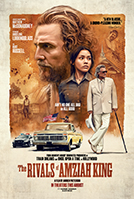
| With | Matthew McConaughey, Angelina LookingGlass, Jake Horowitz, Scott Shepherd, Rob Morgan, Tony Revolori, Kurt Russell |
| Runtime | 131 minutes |
| Release | 2026-08-14 |
| Rating | 10/10 |
Deep in the remote heart of rural Oklahoma, Amziah King, a charismatic figure with extraordinary musical talent, looks after a group of bluegrass-loving misfits while overseeing the region’s largest beekeeping operation. When his adopted daughter, from whom he had been estranged for years, suddenly reappears, Amziah sees it as an opportunity to reconnect with her and build a family business together. But the world of honey is ruthless, and Amziah’s rivals threaten to destroy everything he has built.
The review
By Mulder 2026-06-30
Some films entertain, others impress, and then there are those rare works that seem to invent their own cinematic language. The Rivals of Amziah King, directed by Andrew Patterson, unquestionably belongs to this last category. Refusing to confine itself to a recognizable formula, the film shifts effortlessly between folk musical, crime thriller, Southern fable, family drama, Western, revenge story, and portrait of everyday life, without ever feeling like a patchwork of disjointed ideas. On the contrary, it unfolds organically, much like the rural Oklahoma community it celebrates, where music, storytelling, and shared traditions are an integral part of daily life. Following the remarkable promise hinted at in The Vast of Night, Andrew Patterson establishes himself as one of the most exciting American directors working today, delivering a film that feels deeply personal, deeply human, and refreshingly unpredictable.
Matthew McConaughey’s return after a long absence from the big screen could have been the film’s main draw, but, remarkably, it is just one of its many strengths. In the role of Amziah King, a beekeeper, musician, and pillar of the community, Matthew McConaughey delivers one of the best performances of his career, creating a character whose natural charisma never veers into caricature. His familiar drawling Southern accent, infectious smile, and innate sense of humor immediately make Amziah someone the audience instinctively wants to spend time with. Whether he’s hosting impromptu bluegrass concerts outside roadside restaurants, explaining the intricacies of honey production, or casually dispensing life lessons disguised as humorous anecdotes, he commands every shot without ever coming across as attention-seeking. His performance radiates generosity, making Amziah less a traditional protagonist than the emotional heart of an entire community.
One of the film’s greatest pleasures lies in its celebration of ordinary lives elevated by extraordinary storytelling. Andrew Patterson transforms seemingly modest subjects—shared meals at church, swarms of bees, barrels of honey, local restaurants, and jam sessions in gardens—into moments filled with wonder, humor, and genuine emotional depth. The film understands that memorable cinema doesn’t always require spectacular events; sometimes, the most captivating sequences feature people simply sharing a meal, making music, or exchanging stories whose veracity matters far less than the feelings they evoke. This quintessentially Southern narrative approach gives the film its irresistible charm, allowing each conversation to reveal a new facet of history, folklore, or personal connections. Even the world of commercial beekeeping which at first glance seems almost absurd as the subject of a feature film, gradually becomes the fertile ground for a surprisingly rich exploration of loyalty, identity, and resilience.
As captivating as Matthew McConaughey is, the film ultimately holds an even greater surprise in store thanks to Angelina LookingGlass, whose stunning screen debut transforms what initially seemed to be Amziah’s story into something far more ambitious. Portrayed with understated restraint, Kateri evolves slowly, transforming from a hesitant young woman reconnecting with her former foster father into a determined force capable of carrying the film’s increasingly dark narrative. Angelina LookingGlass handles this demanding progression with remarkable confidence, demonstrating a maturity and emotional precision rarely seen in a debut film performance. The transition never feels forced, as Andrew Patterson carefully sets up each shift, allowing Kateri’s newly acquired strength to emerge naturally from the compassion, trust, and sense of belonging that Amziah has rebuilt around her.
What truly sets The Rivals of Amziah King apart is its fearless refusal to confine itself to a single emotional register. The first hour unfolds with an almost euphoric energy, blending deadpan humor, musical performances, and eccentric interactions between the characters to paint a portrait of communal happiness that is more reminiscent of classic American folk tales than contemporary cinema. Then, almost imperceptibly, the atmosphere darkens. Crime, betrayal, revenge, and moral ambiguity begin to reshape the narrative without ever erasing the warmth that prevailed before. Rather than creating a jarring shift in tone, Andrew Patterson demonstrates remarkable confidence by allowing these contrasting moods to coexist. Life itself rarely conforms to well-defined genre boundaries, and the film embraces this unpredictability with extraordinary conviction.
Visually, the film is just as unique as its narrative. Andrew Patterson uses still images, rhythmic editing, slow motion, and vibrant musical interludes not as stylistic devices, but as extensions of memory and emotion. The Oklahoma countryside is filmed with extraordinary affection, capturing the golden fields, the buzzing beehives, and the modest gathering places with the grandeur usually reserved for epic landscapes. The bluegrass soundtrack becomes a narrative voice in its own right, blending seamlessly into the story rather than interrupting it. Each performance seems rooted in the character rather than in showmanship, lending the music an authenticity that reinforces the film’s emotional core while underscoring its celebration of friendship, tradition, and shared experience.
If there is one criticism to be made, it is only that the film’s ambition sometimes requires the audience to surrender completely to its unique pace. Its episodic structure and willingness to venture down unexpected narrative paths may disorient viewers expecting a conventional thriller or a straightforward drama. Yet it is precisely these qualities that ultimately constitute its greatest strengths. Patterson trusts his audience to prioritize curiosity over predictability, allowing scenes to breathe, characters to surprise us, and seemingly insignificant moments to resonate long after they have passed. In an era when so many productions follow familiar formulas, The Rivals of Amziah King feels thrillingly alive precisely because it refuses to be easily categorized.
As it nears its conclusion, The Rivals of Amziah King has become something increasingly rare in modern cinema: a truly original work that leaves audiences feeling as though they’ve discovered a whole world rather than simply watched a story. Driven by Matthew McConaughey’s career-best performance, Angelina LookingGlass’s standout breakthrough, and Andrew Patterson’s unique artistic vision, the film celebrates community, music, memory, and resilience with extraordinary warmth and imagination. It is bold without being self-indulgent, sincere without lapsing into sentimentality, and boundlessly inventive without sacrificing emotional truth. In short, it is one of this year’s most beautiful cinematic discoveries, a film destined to remain etched in viewers’ memories long after the final note has faded. A true masterpiece—the kind we’d love to see more often in theaters.
The Rivals of Amziah King
Written and directed by Andrew Patterson
Produced by David Heyman, Teddy Schwarzman, Jeffrey Clifford, Michael Heimler, Andrew Patterson, Will Greenfield
Starring Matthew McConaughey, Angelina LookingGlass, Jake Horowitz, Scott Shepherd, Rob Morgan, Tony Revolori, Kurt Russell
Cinematography: Miguel I. Littin-Menz
Edited by Patrick J. Smith
Music by Erick Alexander, Jared Bulmer, Ben Hardesty
Production companies: Black Bear Pictures, Heyday Films, G.E.D. Media
Distributed by Black Bear Pictures (United States), Metropolitan Filmexport (France)
Release dates: March 10, 2025 (SXSW), August 14, 2026 (United States), August 19, 2026 (France)
Running time: 131 minutes
Viewed on June 30, 2026, at the Club de l’Etoile