

Fjord
Directed by Cristian Mungiu (2026)
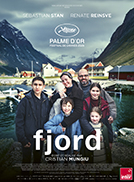
| With | Sebastian Stan |
| Runtime | 146 minutes |
| Release | 2026-10-09 |
| Rating | 9/10 |
The Gheorghius, a deeply religious Romanian-Norwegian couple, settle in a village at the end of a fjord, where they quickly become friends with their neighbors, the Halbergs. The children from both families become very close, despite their different upbringings. When the school staff discovers bruises on the body of Elia, the eldest of the Gheorghiu children, the community wonders whether the traditional upbringing the Gheorghiu children receive from their parents could be the cause.
The review
By Mulder 2026-07-02
Few contemporary filmmakers demonstrate as much audacity as Cristian Mungiu when it comes to exploring those uncomfortable zones where ideology, morality, and human vulnerability collide. With Fjord, the Romanian director once again rejects the reassuring comfort of easy answers, offering a film that is as intellectually rigorous as it is emotionally stirring. Set against the backdrop of the majestic yet unforgiving landscapes of rural Norway, this gripping drama follows Mihai and Lisbet Gheorghiu, a deeply religious couple who leave Romania with their five children in hopes of leading a more peaceful life. Instead, they find themselves at the center of an escalating legal and cultural battle after bruises discovered on their eldest daughter trigger an investigation by child protective services. What initially appears to be a simple social drama gradually transforms into a unsettling reflection on faith, justice, cultural identity, and the fine line between protection and persecution.
One of the film’s greatest achievements lies in its remarkable refusal to manipulate the audience. From the very first scenes, Christian Mungiu sows doubt like a seed that never stops sprouting. We witness a strict household governed by conservative evangelical principles, where discipline is unquestioned, modern distractions are rejected, and religious devotion shapes every aspect of daily life. Yet the director never portrays Mihai and Lisbet as caricatures of religious extremism. Nor does he depict the Norwegian authorities as heartless, villainous bureaucrats. Every time the narrative seems poised to validate a particular viewpoint, another detail complicates the picture. Did abuse actually occur? Are cultural misunderstandings being mistaken for criminal behavior? Has ideological suspicion clouded objective judgment? Rather than crafting a conventional legal thriller, director Cristian Mungiu transforms uncertainty itself into the central dramatic force, forcing viewers to constantly reevaluate their own preconceptions.
The film’s emotional weight rests almost entirely on the remarkable performances of Sebastian Stan and Renate Reinsve, who reunite after A Different Man with astonishing chemistry. Sebastian Stan delivers arguably the best performance of his career, portraying Mihai as a man whose apparent calm barely conceals volcanic frustration. His controlled physical presence becomes almost frightening, suggesting both tenderness and menace without ever allowing the audience absolute certainty about either. Renate Reinsve is equally remarkable, shedding all traces of the vibrant characters she has often portrayed to embody a woman whose grief is expressed through silence rather than tears. The moments following the infant’s removal from the family are particularly heart-wrenching, as Lisbet’s maternal suffering is conveyed with devastating subtlety rather than through melodrama. Together, they bring to life two deeply complex characters whose humanity remains undeniable, regardless of how much sympathy one ultimately feels for them.
As the investigation turns into an increasingly public legal battle, Fjord extends far beyond the scope of a single family’s story. Cristian Mungiu uses this case to dissect the ideological divides running through contemporary Western democracies. The screenplay explores religious freedom, multiculturalism, parental authority, state intervention, institutional responsibility, the pressure of social media, and the limits of liberal tolerance, without ever reducing these themes to simplistic political statements. The way in which the two opposing worldviews gradually reveal their own contradictions is particularly fascinating. The family’s uncompromising religious convictions expose deeply troubling attitudes toward corporal punishment and sexuality, while the supposedly tolerant institutions around them become increasingly rigid and dogmatic in their own quest for moral certainty. Christian Mungiu’s greatest strength lies in his ability to show how absolutism can emerge from all corners of the political spectrum.
Visually, the film possesses a serene magnificence that constantly reinforces its thematic concerns. The vast Norwegian fjords, the imposing glaciers, and the ever-present threat of avalanches become much more than picturesque backdrops. They function as powerful metaphors for the emotional and ideological forces building up beneath seemingly peaceful surfaces. Director of photography Tudor Vladimir Panduru captures these icy landscapes with extraordinary precision, creating compositions in which human beings appear minuscule in the face of nature—just as individual lives find themselves overwhelmed by legal systems, cultural expectations, and political conflicts. Even the film’s understated visual palette contributes to its emotional impact, replacing conventional dramatic effects with an atmosphere of persistent unease that lingers throughout its nearly two-and-a-half-hour runtime.
This ambition, however, comes at a price. At 146 minutes, Fjord sometimes feels as though it drags on, particularly during certain courtroom exchanges where philosophical debate threatens to overshadow the emotional momentum. There are also moments when Cristian Mungiu’s commitment to ambiguity borders on excessive restraint, withholding information to such an extent that some viewers might find the experience frustrating rather than stimulating. Yet even these reservations seem almost inseparable from the film’s broader ambitions. This is not cinema that seeks to provide satisfaction through resolution. It deliberately leaves uncomfortable spaces where certainty refuses to exist.
What ultimately sets Fjord apart is its respect for its audience. Rather than imposing conclusions, Cristian Mungiu demands active participation. Every conversation, every testimony to the audience, and every silent glance becomes another piece of an ethical puzzle that never quite comes together. The film poses profoundly difficult questions about parenthood, immigration, religion, democracy, and justice, without claiming that any single ideology holds all the answers. At a time when cinema often rushes to reassure audiences about their existing beliefs, Fjord accomplishes something far rarer: it challenges viewers to consider the possibility that their own convictions might be incomplete.
By the time the final images fade, Fjord has become much more than a courtroom drama or a social critique. It is a unsettling reflection on the burden of judgment itself, reminding us that the truth is often obscured by fear, prejudice, culture, and ideology long before a legal verdict is handed down. Demanding, moving, and intellectually exhilarating, Cristian Mungiu has created one of the most provocative works of the year—a film that continues to haunt the mind long after the end credits roll. It may not offer comfort, but its willingness to tackle complexity with such honesty makes it an unforgettable cinematic experience.
Fjord
Written and directed by Cristian Mungiu
Produced by Cristian Mungiu, Tudor Reu, Andrea Berentsen Ottmar, Dyveke Bjøkly Graver
Starring Sebastian Stan, Renate Reinsve
Cinematography: Tudor Vladimir Panduru
Edited by Mircea Olteanu
Music by Kaspar Kaae
Production companies: Mobra Films, Why Not Productions, Eye Eye Pictures, Snowglobe Film, Aamu Film Company, Filmgate Films
Distributed by Le Pacte (France), NEON (United States)
Release dates: May 18, 2026 (Cannes), August 19, 2026 (France), October 9, 2026 (United States)
Running time: 146 minutes
Viewed on July 2, 2026, at the Forum des images as part of the Allociné club