

The Battle of Gaulle - Part 2: I Write Your Name
Directed by Antonin Baudry
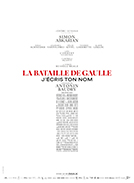
| With | Simon Abkarian, Niels Schneider, Thierry Lhermitte, Karim Leklou |
| Runtime | 160 minutes |
| Release | Release date unknown |
| Original title | La Bataille de Gaulle - Partie 2 : J’écris ton nom |
| Rating | 10/10 |
June 1940. France collapses and signs the armistice. Amid the chaos, one man refuses to give in. Alone against all odds, this unknown general flees to London to save what remains of a dream: freedom. Without an army, without support, without hope. But with a fierce conviction: France—his France—has not laid down its arms. He makes one last gamble: to convince the world that the Battle of France is neither over nor lost. Reality is relentless, and proves him wrong. But little by little, resistance fighters operating in the shadows, rebellious high school students, and determined soldiers rise up around him in England, France, and Africa. Their faith, their audacity, and their thirst for freedom defy a history that seemed, nevertheless, to have been written in advance.
The review
By Mulder 2026-06-23
With De Gaulle: Part Two – Liberté director Antonin Baudry delivers a remarkable conclusion to one of the most ambitious French historical productions of recent years. While the first installment, Résistance, focused on the improbable birth of Free France and the solitary resistance of a general who had almost fallen into oblivion, this second installment broadens its scope while, paradoxically, becoming more intimate. Covering the crucial years of 1943 and 1944, the film moves away from the battlefield to delve directly into the political trenches where another war was being waged: the struggle for legitimacy, sovereignty, and France’s future identity. Inspired by the work of historian Julian T. Jackson, the film explores how Charles de Gaulle evolved from a military dissident into a statesman capable of standing up to world leaders, even though he had virtually no real power. The result is a surprisingly modern historical drama that examines tensions among allies, the dangers of political dependence, and the difficult balance between pragmatism and conviction.
What immediately sets this second installment apart is its confidence. Rather than attempting to rival Hollywood war blockbusters with endless combat sequences, director Antonin Baudry understands that the most decisive battles often take place around negotiating tables rather than on battlefields. The film’s most captivating moments arise from diplomatic confrontations, strategic negotiations, and ideological clashes between major historical figures. Watching Charles de Gaulle challenge Franklin D. Roosevelt, resist the influence of Henri Giraud, and maintain a tense relationship with Winston Churchill becomes just as thrilling as any military engagement. A fascinating irony lies at the heart of the film: the man who would eventually come to embody France spends much of the story as the weakest person in every room he enters. The screenplay repeatedly emphasizes this power imbalance, transforming political conversations into duels where every word carries the weight of a nation’s future. This approach gives the film a unique identity among dramas set during World War II and reinforces its central thesis that history is shaped as much by determination and rhetoric as by armies and weapons.
At the heart of this monumental production lies Simon Abkarian’s remarkable performance, which continues to prove that he was the ideal choice for this role. Rather than merely imitating a famous figure, he paints a deeply human portrait of a man often trapped by his own legend. Through carefully controlled gestures, an imposing physical presence, and subtle moments of vulnerability, Simon Abkarian reveals the loneliness, stubbornness, and unshakable conviction that characterized Charles de Gaulle. What makes this performance particularly captivating is the way it captures the contradictions: here is a man capable of immense pride, yet forced to swallow humiliation; a leader who inspires millions while spending most of his time in isolation; a visionary who seems irrational in the eyes of many of his contemporaries. Several scenes subtly reveal the emotional burden borne by the future leader of liberated France, allowing the audience to see not only the historical figure, but also the flesh-and-blood individual struggling against insurmountable obstacles.
The supporting cast is equally superb and contributes significantly to the film’s dramatic richness. Simon Russell Beale is impressive as Winston Churchill, creating a character who oscillates between mentor, ally, rival, and reluctant friend. The chemistry between him and Simon Abkarian often offers unexpected moments of humor and humanity amid geopolitical tensions. Campbell Scott brings complexity and ambiguity to the character of Franklin D. Roosevelt, avoiding caricature while highlighting the profound differences between American pragmatism and Gaullist idealism. Furthermore, Félix Kysyl delivers one of the film’s most moving performances as Jean Moulin, embodying both courage and fragility as the architect of a unified Resistance. Niels Schneider brings charisma and military determination to the character of Philippe Leclerc, while Anamaria Vartolomei, Karim Leklou, and Thierry Lhermitte ensure that even the supporting characters leave a lasting impression. The entire cast succeeds in bringing these historical figures to life, rather than leaving them trapped within the pages of history textbooks.
One of the film’s most interesting creative choices is its refusal to make Nazi Germany the primary antagonist on screen. Adolf Hitler remains largely absent, German forces often appear in the background, and the horrors of the occupation are frequently implied rather than shown directly. Instead, the real conflict revolves around competing visions of France’s future and the struggle for political recognition. This approach may surprise viewers expecting a conventional war film, but it ultimately strengthens the narrative. By emphasizing alliances, rivalries, and internal divisions, director Antonin Baudry reminds the audience that the victory of 1945 was not merely a military feat, but also the result of countless political battles fought behind closed doors. The suffering of that era is never forgotten—particularly through the subplot featuring Jean Moulin—but the film is primarily concerned with how history is negotiated and written.
Visually, the production often impresses with its scale, its recreation of the era, and its attention to historical detail. The film’s substantial budget is evident in its authentic filming locations, costumes, military equipment, and meticulously recreated wartime sets. While some battle scenes lack the kinetic energy or visual innovation found in films such as Saving Private Ryan or Dunkirk, they are not the main draw here. The real spectacle lies in the recreation of a world in the midst of upheaval, where decisions made in offices, embassies, and command centers would determine the face of postwar Europe. At times, the direction relies a bit too heavily on bombastic music and dramatic reaction shots, and some emotional moments seem slightly overplayed. Yet these minor excesses rarely detract from the overall impact of the film’s narrative ambition.
Perhaps the most fascinating aspect of Liberté is its resolutely contemporary nature. Although set against the backdrop of the events of 1943 and 1944, the film continually raises questions about national independence, international alliances, political influence, and cultural identity. Without ever veering into didacticism, Antonin Baudry invites viewers to reflect on how nations preserve their sovereignty while relying on more powerful partners. The title itself, borrowed from Paul Éluard’s famous poem “Liberté,” serves as a reminder that freedom is never guaranteed and must constantly be defended, redefined, and reaffirmed. This thematic resonance gives the film a relevance that goes far beyond a simple historical reenactment, transforming it into a reflection on the challenges facing modern democracies.
As the conclusion to the two-part series, De Gaulle: Part Two—Liberté largely succeeds in living up to its immense ambitions. It is an intelligent, moving, and politically sophisticated historical drama that rejects easy answers while celebrating the power of conviction and perseverance. More than just a biopic, it becomes a meditation on leadership, sacrifice, and the fragile process through which nations define themselves. While some viewers might wish for more dynamic action sequences or a lighter touch in certain directorial flourishes, the film’s strengths far outweigh its flaws. Driven by Simon Abkarian’s exceptional performance and Antonin Baudry’s ambitious vision, it stands out as one of the most memorable French historical productions of recent years and powerfully reminds us that history is not merely about what happened, but also about those who had the courage to imagine a different future.
De Gaulle: Part Two – Liberté
Directed by Antonin Baudry
Screenplay: Antonin Baudry, Bérénice Vila
Based on “A Certain Idea of France: The Life of Charles De Gaulle” by Julian Jackson
Produced by Axelle Boucaï, Ardavan Safaee, Jérôme Seydoux
Starring Simon Abkarian, Niels Schneider, Thierry Lhermitte, Karim Leklou,
Cinematography: Pierre Cottereau
Editing: Rehman Nizar Ali
Music: Théo Cascio
Production Company: Pathé
Distribution: Pathé
Release Dates: June 26, 2026 (France)
Runtime: 160 minutes
Viewed on June 22, 2026, in Paris at the Pathé BNP Paribas