

Pressure
Directed by Anthony Maras (2026)
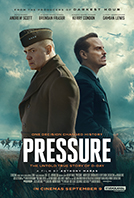
| With | Andrew Scott, Brendan Fraser, Kerry Condon, Chris Messina, Damian Lewis |
| Runtime | 100 minutes |
| Release | 2026-05-29 |
| Rating | 9/10 |
Three days before D-Day, a single decision could change the course of history. As the Allies prepare to launch the largest amphibious landing ever organized, a violent storm threatens to derail the operation. General Eisenhower and Captain James Stagg, a meteorologist, are faced with an impossible choice: attack despite the uncertainty… or risk losing the war. Pressure, the true story of a high-tension countdown.
The review
By Mulder 2026-06-18
There is something fascinating about a movie that manages to create intense suspense from an event whose outcome is already known. We all know that D-Day finally took place on June 6, 1944, and we know that the Allied landings in Normandy became one of the defining moments of the 20th century. Yet the film Pressure, directed by Anthony Maras, manages to transform these well-known historical facts into a captivating and nerve-wracking thriller by shifting the focus from the beaches to the rooms where the decisions were made. Adapted from David Haig’s acclaimed play, the film explores a little-known chapter of history: the meteorological battle that determined when the largest seaborne invasion ever attempted could begin. It’s an inspired angle that proves history is often shaped not only by soldiers and generals, but also by scientists willing to tell those in power what they don’t want to hear.
At the heart of the story is actor Andrew Scott, who delivers one of the best performances of his career as meteorologist James Stagg. Summoned by Winston Churchill to advise Allied Supreme Commander Dwight D. Eisenhower, Stagg arrives at Southwick House just seventy-two hours before the planned invasion. He leaves behind a pregnant wife and immediately finds himself trapped in a pressure cooker where rival egos, military urgency, and impossible expectations collide. What makes Andrew Scott’s performance so captivating is his refusal to make Stagg likable in the conventional sense. He is stubborn, socially awkward, often brusque, and absolutely resistant to the idea of compromising scientific integrity for the sake of political considerations. Yet Andrew Scott imbues him with such conviction and quiet humanity that every scene becomes magnetic. His Stagg understands the terrifying consequences of a mistake, but he also grasps the even greater danger of feigning certainty where none exists. In a film populated by powerful figures, he becomes the moral and intellectual anchor.
The film’s central conflict is surprisingly contemporary. Stagg’s data-driven predictions stand in direct opposition to the methods of American meteorologist Irving P. Krick, portrayed with swaggering confidence by Chris Messina. Krick relies heavily on historical weather trends and past analogies, while Stagg insists on interpreting current atmospheric conditions. This disagreement takes on a scope far greater than a mere scientific debate. It turns into a battle between evidence and hypotheses, between humility and certainty, between uncomfortable truth and reassuring comfort. Watching these two men present opposing visions of the future to military leaders eager for definitive answers is just as gripping as many of the combat sequences. The irony is delightful: while thousands of ships, planes, and soldiers stand ready for war, the greatest obstacle turns out to be the clouds forming over the Atlantic.
The pressure weighing on Dwight D. Eisenhower is portrayed with remarkable intensity by Brendan Fraser. His portrayal may not perfectly match the historical Eisenhower—both physically and in terms of temperament—but Brendan Fraser effectively conveys the crushing burden resting on the general’s shoulders. Haunted by the disastrous rehearsal of Exercise Tiger, which claimed the lives of hundreds of people, Dwight D. Eisenhower is portrayed as a man painfully aware that a single wrong decision could lead to a catastrophe of unimaginable proportions. Brendan Fraser embodies both the authority of command and the vulnerability of a leader facing uncertainty. Some moments veer toward the theatrical, but they are in keeping with the film’s origins as an adaptation of a play, and the emotional weight he brings to the role prevents the character from becoming a distant historical figure.
One of the film’s greatest strengths lies in its refusal to reduce its characters to heroes and villains. No one here is malicious. Bernard Montgomery, played with such confidence that he steals the show—thanks to Damian Lewis—is not wrong to fear that any delay could compromise the secret. Krick is not a outright impostor, but simply a man whose confidence exceeds the reliability of his methods. Dwight D. Eisenhower is not stubborn out of pride; he is responsible for the lives of hundreds of thousands of people. Even as tempers flare and accusations fly, Pressure constantly reminds us that every participant is trying to solve an unsolvable problem with incomplete information. This nuanced approach elevates the subject far beyond a conventional historical drama and transforms it into a fascinating study of leadership under extreme conditions.
Equally impressive is the way Anthony Maras creates extraordinary tension in confined spaces. Much of the film takes place inside offices, conference rooms, and weather stations, yet it rarely feels static. The countdown structure, reinforced by Volker Bertelmann’s urgent score, creates a constant sense of impending disaster. Jamie Ramsay’s cinematography also deserves special praise. Rather than adopting the washed-out gray palette often associated with war dramas, the film uses rich colors and atmospheric lighting that lend every cloud formation, every weather map, and every storm front an almost cinematic grandeur. The result is a film in which discussions about wave heights, cloud cover, and barometric pressure become strangely exhilarating.
The emotional depth of the story is greatly enhanced by Kerry Condon in the role of Kay Summersby, Dwight D. Eisenhower’s trusted assistant. In a world dominated by military strategists and scientific rivalries, Summersby brings a much-needed touch of humanity. Condon infuses this character with intelligence, warmth, and quiet strength, often serving as a bridge between clashing personalities. Her scenes with Brendan Fraser and Andrew Scott are among the film’s most moving. Similarly, the subplot featuring Stagg’s wife adds an extra layer of emotional vulnerability to a man who spends most of the film suppressing his personal fears in the service of a greater mission. These touches prevent the story from becoming an overly intellectual exercise and remind us of the human cost behind every strategic decision.
intellectual honesty. It is a film about the courage it takes to admit uncertainty, the integrity required to stand by the facts in the face of pressure, and the responsibility of leadership when there are no absolute answers. While countless films about World War II have depicted the heroism of soldiers storming the beaches, Pressure highlights the more understated heroism of those who must make impossible decisions even before the first shot is fired. It may not have the visceral spectacle of Saving Private Ryan or the epic scope of The Longest Day, but it more than makes up for it with its intelligence, suspense, and superb performances. In doing so, it establishes itself as one of the most original and rewarding World War II dramas of recent years, proving that sometimes, the most important battle in history was not fought with bullets, but with data, judgment, and the courage to remain true to the truth.
Pressure
Directed by Anthony Maras
Written by David Haig, Anthony Maras
Based on Pressure by David Haig
Produced by Tim Bevan, Eric Fellner, Cass Marks, Lucas Webb
Starring Andrew Scott, Brendan Fraser, Kerry Condon, Chris Messina, Damian Lewis
Cinematography : Jamie D. Ramsay
Edited by Anthony Maras
Music by Volker Bertelmann
Production company : Working Title Films
Distributed by Focus Features (United States), StudioCanal (France)
Release dates 29 May 2026 (United States), September 9, 2026 (France)
Running time : 100 minutes
Viewed on June 18, 2026 (VOD)