

The Furious
Directed by Kenji Tanigaki (2026)
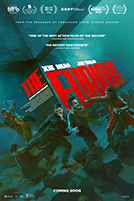
| With | Xie Miao, Joe Taslim, Yang Enyou, Jeeja Yanin, Brian Le, Joey Iwanaga, Yayan Ruhian |
| Runtime | 113 minutes |
| Release | 2026-06-12 |
| Original title | 火遮眼 |
| Rating | 10/10 |
After his daughter is kidnapped by a criminal network and faced with the police’s inaction, Wang Wei embarks on a relentless hunt to find her. His only ally, Navin, is a tenacious journalist whose wife has mysteriously disappeared. United by a shared desire for revenge, these two men who are polar opposites confront the kidnappers in an explosive showdown blending martial arts and merciless justice.
The review
By Mulder 2026-06-10
There are action movies, there are martial arts movies, and then there are those rare occasions when a film comes out and completely redefines what audiences expect from action cinema. Kenji Tanigaki’s *The Furious* firmly belongs to the latter category. Built around a premise of deceptive simplicity (a father searching for his kidnapped daughter), it quickly evolves into something far more remarkable: a relentless, almost lyrical celebration of movement, pain, endurance, and pure cinematic craftsmanship. While the story itself falls within the familiar realm of the revenge thriller, the direction transforms what could have been a classic rescue mission into one of the most exhilarating action experiences of recent years. From the very first minutes, the film establishes a sense of urgency and emotional desperation that never truly lets up, drawing viewers into nearly two hours of escalating violence, breathtaking choreography, and emotional intensity.
At the heart of the story is Wang Wei, played by Xie Miao, a mute handyman whose daughter Rainy, portrayed by Yang Enyou, is kidnapped by a ruthless child-trafficking ring operating somewhere in Southeast Asia. When the authorities prove ineffective and corruption seems pervasive within the system, Wang Wei embarks on a desperate quest that eventually brings him into contact with Navin, played by Joe Taslim, a man searching for answers regarding the disappearance of his journalist wife, portrayed by JeeJa Yanin. The plot may seem familiar, echoing classics like Taken or countless Hong Kong revenge dramas, but The Furious captures something many modern action films have forgotten: simplicity is not a weakness when every other element functions at an extraordinary level. The emotional motivations are crystal clear, allowing the audience to focus entirely on the escalating nightmare facing the protagonists without ever losing sight of the human stakes that fuel every punch, every kick, and every broken bone.
What truly sets The Furious apart from the vast majority of contemporary action cinema is its understanding that action itself can be a form of storytelling. Alongside legendary action film director Kensuke Sonomura, Kenji Tanigaki crafts sequences that don’t merely interrupt the narrative—they are the narrative. The characters reveal themselves through combat. Relationships evolve through violence. Personalities clash through fighting styles. Wang Wei’s grounded, fluid, almost animalistic movements speak volumes about his resilience and determination—far more than pages of dialogue ever could—while Navin’s more direct and explosive approach reflects his own personality and emotional state. Watching the two men gradually learn to fight side by side becomes a fascinating form of character development, conveyed almost entirely through movement and choreography rather than explanation. It is visual storytelling in its purest form.
The choreography itself borders on the miraculous. Every time the audience thinks the film has reached its climax, a new sequence proves otherwise. A fight in an octagon against waves of attackers, a brutal confrontation inside industrial facilities, breathtaking battles in hallways, improvised fights using whatever is at hand—from ladders to bicycles—and a series of increasingly extravagant confrontations all lead to a finale that feels less like an action sequence and more like a symphony of destruction. Unlike many modern productions that rely on frenetic editing to create artificial intensity, The Furious prioritizes clarity. Long takes, carefully composed camera movements, and exceptional spatial awareness allow viewers to appreciate every move, every counterattack, and every desperate attempt at survival. Cinematographer Meteor Cheung deserves praise for ensuring that even the most chaotic sequences remain visually coherent while maintaining incredible momentum.
The cast assembled here reads like an all-star team of international martial arts cinema. Joe Taslim delivers exactly the kind of charismatic physical performance audiences have come to expect from him since *The Raid* and *The Night Comes for Us*, while Xie Miao proves once again why he deserves to be recognized as one of the most compelling action stars of the moment. Their chemistry becomes the emotional backbone of the film. Meanwhile, the supporting cast elevates every scene in which they appear. Yayan Ruhian is, as expected, magnetic in the role of a fearsome henchman whose use of unconventional weapons creates some of the film’s most memorable moments, while Brian Le nearly steals the show throughout the film thanks to his sheer physical presence, transforming what could have been a classic muscleman role into something truly unforgettable. Equally impressive, Joey Iwanaga embodies a deceptively elegant villain who gradually reveals himself as one of the film’s most dangerous and fascinating adversaries.
What makes The Furious particularly unforgettable is that beneath all this brutality lies a genuine heart. The relationship between Wang Wei and Rainy provides an emotional anchor that prevents the film from sinking into meaningless spectacle. Moments of tenderness lie hidden beneath the carnage, reminding us that every fight is ultimately driven by love, grief, loyalty, and loss. Even when the film ventures into extravagant territory, it never loses its emotional center. This balance between sincerity and excess recalls the finest traditions of classic Hong Kong action cinema, where audiences could cheer on impossible feats while deeply connecting with the characters who performed them.
There are certainly some minor flaws. The dialogue sometimes feels more functional than memorable, certain secondary characters remain underdeveloped, and the conspiracy itself serves mainly as a framework to move the protagonists from one confrontation to the next. Certain aspects of this international production occasionally create moments of linguistic awkwardness, and viewers seeking a complex plot might find the narrative too simplistic. Yet, criticizing The Furious for these elements seems somewhat beside the point. It is a film that knows exactly what it wants to be and executes that vision with extraordinary confidence. It does not aspire to be a political thriller or a complex character study. It aims to be one of the greatest action films of its era, and, remarkably, it succeeds.
At a time when so many action films seem increasingly reliant on digital effects, artificial spectacle, and chaos overcome by editing, The Furious arrives as a thrilling reminder of what can be achieved through real stunts, physical performances, and creative choreography. Kenji Tanigaki and Kensuke Sonomura have delivered a film that feels like both a love letter to the golden age of Hong Kong action cinema and a bold statement about its future. It is brutal, inventive, moving, sometimes absurd, and always astonishing. Most importantly, it leaves audiences with the rare feeling of having witnessed something truly special. The Furious is not only one of the best action films of 2026; it is one of the most impressive displays of martial arts of the past decade and a future benchmark against which many action films will inevitably be measured.
The Furious (火遮眼)
Directed by Kenji Tanigaki
Written by Mak Tin-shu, Lei Zhilong, Shum Kwan-sin, Frank Hui
Produced by Bill Kong, Frank Hui, Shan Tam
Starring Xie Miao, Joe Taslim, Yang Enyou, Jeeja Yanin, Brian Le, Joey Iwanaga, Yayan Ruhian
Cinematography: Meteor Cheung
Edited by Chris Tonick
Music by Elliot Leung, Olivia Xiaolin, Flying Lotus
Production companies: Edko Films, Zhejiang Hengdian Film, XYZ Films
Distributed by Edko Films (Hong Kong), Lionsgate Films (United States), Metropolitan Filmexport (France)
Release dates: September 6, 2025 (TIFF), June 10, 2026 (France), June 12, 2026 (United States)
Running time: 113 minutes
Viewed on June 10, 2026 at Gaumont Disney Village, Theater 7, Seat A19