

Disclosure day
Directed by Steven Spielberg (2026)
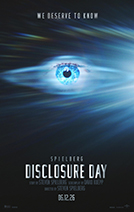
| With | Emily Blunt, Josh O'Connor, Colin Firth, Eve Hewson, Colman Domingo |
| Runtime | 145 minutes |
| Release | 2026-06-12 |
| Rating | 10/10 |
What if you discovered that we are not alone? What if we showed you, if we provided proof, would that frighten you? People have a right to the truth. It belongs to seven billion people. Every second brings us closer to the inevitable… Disclosure Day.
The review
By Mulder 2026-06-09
There are movies that entertain, movies that impress, and movies that remind audiences why they fell in love with cinema in the first place. Disclosure Day undoubtedly falls into the latter category. With what may be his most moving science-fiction film since E.T. the Extra-Terrestrial and his most ambitious exploration of extraterrestrial life since Close Encounters of the Third Kind, Steven Spielberg offers us a breathtaking cinematic experience that is both intimate and monumental. More than a blockbuster, more than a conspiracy thriller, and more than a first-contact story, Disclosure Day is a deeply human film about empathy, faith, communication, and the fragile hope that humanity can still unite in the face of truths that transcend it. At nearly eighty years old, Steven Spielberg proves once again that he remains one of the greatest storytellers in the history of cinema, directing a film that is at once thrilling, moving, visually spectacular, and intellectually stimulating.
From the very first minutes, the film plunges the audience into a mystery already in motion. Josh O’Connor plays Daniel Kellner, a cybersecurity expert turned whistleblower who has uncovered evidence that could change humanity forever. Pursued by the powerful and secretive Wardex organization, led by the menacing Colin Firth as Noah Scanlon, Daniel finds himself in possession of information that many believe could either save civilization or destroy it. Meanwhile, Kansas City meteorologist Margaret Fairchild, played by an extraordinary Emily Blunt, is confronted with a series of inexplicable phenomena that begin to shake her perception of reality. What initially appears to be two separate stories gradually converges into a sprawling yet remarkably personal journey that addresses issues such as extraterrestrial contact, state secrets, religion, and the future of humanity. Screenwriter David Koepp, reuniting with Spielberg, crafts a narrative that constantly takes surprising turns while maintaining relentless momentum.
The emotional heart of the film belongs entirely to Emily Blunt, who delivers what is undoubtedly one of the finest performances of her already remarkable career. Margaret could easily have become a passive observer swept up in extraordinary events, but Blunt transforms her into the beating heart of the story. Through subtle gestures, vulnerable expressions, and moments of astonishing emotional intensity, she gives each revelation a deeply personal dimension. Whether she is experiencing wonder, fear, confusion, or enlightenment, Blunt never loses sight of Margaret’s humanity. Spielberg wisely trusts his actress, often letting close-ups convey entire pages of emotional explanation. The result is a performance that anchors the film’s grand ideas in something tangible and familiar. By the final act, Margaret becomes not only the emotional center of the narrative but also a reflection of the audience’s hopes, fears, and curiosity about what might exist beyond our understanding.
The supporting cast is equally impressive. Josh O’Connor brings warmth, intelligence, and vulnerability to Daniel Kellner, creating a protagonist who feels undeniably human despite the extraordinary circumstances surrounding him. Eve Hewson is exceptional as Jane Blankenship, a former novice whose crisis of faith becomes one of the film’s most compelling thematic threads. Her struggle to reconcile her religious beliefs with evidence of extraterrestrial life adds surprising depth to the narrative and elevates the film beyond the confines of traditional science fiction. Colman Domingo radiates wisdom and compassion as Hugo Wakefield, a former insider determined to reveal the truth, while Colin Firth delivers one of his most compelling performances as an antagonist in years. Rather than playing a simple villain, Firth creates a man sincerely convinced that secrecy is necessary for humanity’s survival, making each confrontation morally complex rather than merely adversarial.
Visually, Disclosure Day is a true masterclass in filmmaking on the scale of modern blockbusters. In collaboration with legendary cinematographer Janusz Kamiński, Spielberg creates images that inspire wonder without ever sacrificing emotional intimacy. The film shifts fluidly between breathless chase sequences, breathtaking moments of cosmic mystery, and deeply personal interactions between the characters. Every frame seems to serve a specific purpose. The camera glides effortlessly through action scenes while lingering just long enough on the quieter moments to let the emotions resonate. Spielberg demonstrates once again that spectacle is most effective when it serves the characters and the story rather than overwhelming them. Several sequences rank among the most memorable of his career, not because they rely solely on visual effects, but because they evoke a genuine sense of wonder. In an era when audiences have grown accustomed to seeing entire galaxies rendered on screen, Spielberg finds a way to restore the magic to the mystery of the unknown.
What ultimately elevates Disclosure Day from the status of a great science fiction film to that of a truly exceptional work is its thematic ambition. The extraterrestrial elements are fascinating, but they are merely the vehicle through which Spielberg explores broader questions about humanity itself. The film asks whether the truth should ever be hidden, whether faith and science can coexist, and whether empathy remains our greatest strength in an increasingly divided world. Rather than offering easy answers, Spielberg invites the audience to reflect on these ideas through the experiences of his characters. The result is a film that feels both timely and timeless. In many ways, Disclosure Day serves as the culmination of the themes Spielberg has explored throughout his career. The wonder of Close Encounters of the Third Kind, the emotional intimacy of E.T. the Extra-Terrestrial, the urgency of War of the Worlds, and the humanism of The Fabelmans all seem to converge here into a singular artistic statement.
Another magnificent score by John Williams—whose collaboration with Steven Spielberg remains one of the greatest partnerships in film history—adds even more emotional weight. The music shifts effortlessly from suspense to melancholy, from fear to triumph, underscoring every major emotional moment without ever becoming intrusive. There are moments when the image and the music blend so perfectly that words become almost superfluous. Few filmmakers understand the relationship between sound and image as instinctively as Spielberg, and Disclosure Day contains several sequences that demonstrate this mastery at its highest level.
Perhaps the film’s greatest achievement is that it remains deeply optimistic without seeming naive. At a time when many science fiction stories focus on collapse, cynicism, or destruction, Spielberg dares to suggest that humanity is capable of growth, understanding, and compassion. He presents empathy not as a weakness, but as the very foundation of civilization. This sincerity may seem old-fashioned to some viewers, but it is precisely what makes Disclosure Day so powerful. The film believes in human beings. More importantly, it encourages the audience to believe in one another. This message resonates long after the credits roll and transforms what could have been spectacular entertainment into something truly meaningful.
Disclosure Day is not simply a return to familiar territory for Steven Spielberg. It is the work of a master filmmaker reflecting on a lifetime of questions about communication, belief, wonder, and human connection. It combines the excitement of a blockbuster with emotional depth, philosophical ambition with sincere storytelling, and brilliant technique with extraordinary performances. Above all, it reminds us that the greatest mysteries of the universe may not be the stars above our heads, but the capacity for understanding and empathy that exists within us. It is one of the best films of 2026, one of Steven Spielberg’s greatest achievements of the modern era, and a science fiction masterpiece that deserves to stand alongside the finest works of his extraordinary career.
Disclosure Day
Directed by Steven Spielberg
Written by David Koepp
Story by Steven Spielberg
Produced by Kristie Macosko Krieger, Steven Spielberg
Starring Emily Blunt, Josh O'Connor, Colin Firth, Eve Hewson, Colman Domingo
Cinematography: Janusz Kamiński
Edited by Sarah Broshar
Music by John Williams
Production company: Amblin Entertainment
Distributed by Universal Pictures
Release date: June 10, 2026 (France), June 12, 2026 (United States)
Running time: 145 minutes
Viewed on June 2, 2026, at Le Grand Rex cinema
With our sincere thanks to Club Allociné