

Masters of the Universe
Directed by Gary Goddard (1987)
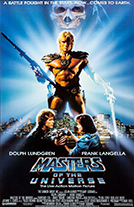
| With | Dolph Lundgren, Frank Langella, Courteney Cox, James Tolkan, Christina Pickles, Meg Foster |
| Runtime | 106 minutes |
| Release | 1987-08-07 |
| Rating | 6/10 |
On the planet Eternia, Skeletor, leading an army, has seized the Castle of Shadows and dreams of conquering the entire universe. He-Man, a warrior whose strength is matched only by his courage, uses a cosmic key to travel to Earth with his daughter Teela and Gwildor, the master of arms. But along the way, they lose the precious object, which is found by Julie Winston and her boyfriend Kevin Corrigan. While trying to figure out how it works, they send a signal to Skeletor’s minions, who come to retrieve the artifact. Starting as a toy line and then a cartoon, Masters of the Universe also saw a film adaptation that has become a cult classic over the years.
The review
By Mulder 2026-05-30
Released at the height of the He-Man phenomenon, Masters of the Universe hit theaters, carrying the hopes of an entire generation of children who had spent countless afternoons watching the animated adventures and staging their own battles with Mattel action figures. Directed by Gary Goddard, the film undertook the ambitious task of transforming the colorful mythology of Eternia into a live-action blockbuster, at a time when fantasy cinema enjoyed immense popularity thanks to films such as Star Wars, Conan the Barbarian, and Flash Gordon. Nearly four decades later, the film remains one of the most fascinating examples of 1980s franchise cinema: an undeniably flawed production that both disappoints and entertains, often within the same scene.
What strikes you immediately is the film’s striking visual ambition despite its limited resources. The opening scenes set at Grayskull Castle hint at a universe far vaster than what the production could actually afford to show. The imposing throne room, the elaborate costumes, and the impressive prosthetic work used to bring characters like Skeletor, Evil-Lyn, Beast Man, and Gwildor to life still possess a certain charm. There is a seriousness to the artistic design that deserves recognition. Rather than presenting a cheap imitation of the animated series, Gary Goddard sincerely attempts to create a cinematic fantasy world. Unfortunately, budget constraints quickly forced the story to leave Eternia and take place in a small American town—a decision that defines the film’s identity while limiting its potential. What could have been a vast cosmic adventure becomes a fish-out-of-water story centered on suburban streets, shopping malls, and record stores.
The film’s greatest strength is undoubtedly Frank Langella in the role of Skeletor. Hidden beneath layers of makeup and prosthetics, the seasoned actor delivers a performance that far surpasses the script. While many actors would have approached such a role with irony or embarrassment, Frank Langella throws himself into it body and soul. Every speech, every threat, and every dramatic gesture is delivered with Shakespearean conviction. His Skeletor is dangerous, theatrical, and strangely charismatic. In many ways, he carries the entire film on his own. Even viewers who struggle with the film itself often have fond memories of Skeletor, because Frank Langella understands that memorable villains must believe in every word they utter. His scenes possess an energy and grandeur that elevate the script surrounding them.
The casting of Dolph Lundgren as He-Man is more complex. Physically, he is nearly perfect. His imposing stature, blond hair, and commanding presence make him look like the animated character brought directly to life. Yet acting requires more than just looks, and that’s where his performance becomes uneven. Dolph Lundgren often struggles with the dialogue, and He-Man rarely comes across as the moving hero the story needs. The script doesn’t help, frequently relegating the character to the background to focus instead on the Earth teens Julie and Kevin, played by Courteney Cox and Robert Duncan McNeill. Ironically, these original characters receive more development than many of the iconic heroes of Eternia that audiences came to see. This creates a curious imbalance where the franchise’s supposed star sometimes feels like a supporting character in his own film.
One of the most interesting aspects of Masters of the Universe lies in the way it unabashedly draws inspiration from the science fiction and fantasy films that dominated the era. Echoes of Star Wars appear throughout the production, from armored soldiers and laser weapons to the mystical battle between good and evil. Elements of Back to the Future, Conan the Barbarian, and even The Terminator are woven into the story’s structure. Rather than feeling like a direct adaptation of the animated series, the film often resembles a cinematic collage of all the major genre hits from the previous decade. While this lack of originality hurts the film artistically, it also makes it a fascinating time capsule of 1980s blockbuster cinema, at a time when studios were desperately searching for the next phenomenal franchise.
The screenplay remains the film’s weak link. Viewers unfamiliar with the mythology are plunged into an ongoing conflict with little explanation, and the narrative often feels as though entire chapters are missing. Relationships are underdeveloped, characters’ motivations are often reduced to simplistic exposition, and the stakes never seem as urgent as they should. There are moments when the film seems to forget that it’s adapting one of the most imaginative toy lines ever created. Instead of exploring the rich mythology of Eternia, the story spends much of its time following the characters through parking lots, high schools, and suburban streets. For longtime fans, this can be frustrating, as glimpses of a far more grandiose film are constantly visible just beyond the frame.
Yet, despite all these shortcomings, there is something undeniably enjoyable about Masters of the Universe. The practical special effects, the elaborate makeup, the synth-soaked atmosphere, and the production’s sheer sincerity create a form of entertainment that is often missing from modern franchise films. The film never feels cynical, even when it’s clearly designed to sell toys. There’s a genuine desire to inspire wonder. The final showdown between He-Man and Skeletor, though less spectacular than one might hope, offers enough fantastical spectacle to remind viewers why this franchise originally captured imaginations. Combined with Bill Conti’s energetic score and the film’s unapologetic embrace of 1980s excess, the result becomes strangely endearing.
Today, Masters of the Universe occupies a unique place in the history of pop culture. It is neither the disaster some critics claimed it to be, nor the forgotten masterpiece that nostalgia sometimes suggests. On the contrary, it stands out as an entertaining curiosity, a film brimming with untapped potential, memorable imagery, and a truly exceptional performance by Frank Langella as the villain. For fans of 1980s fantasy cinema, it’s worth revisiting—not because it’s a total success, but because its ambition constantly exceeds its limits. Like many cult classics, its imperfections are now part of its charm, transforming it into a fascinating relic of an era when studios believed that a toy line could become the next Star Wars.
Masters of the Universe
Directed by Gary Goddard
Written by David Odell
Based on Masters of the Universe by Mattel
Produced by Yoram Globus, Menahem Golan
Starring Dolph Lundgren, Frank Langella, Courteney Cox, James Tolkan, Christina Pickles, Meg Foster
Cinematography : Hanania Baer
Edited by Anne V. Coates
Music by Bill Conti
Production company : The Cannon Group, Inc.
Distributed by The Cannon Group, Inc. (United States)
Release date : August 7, 1987 (United States), December 9, 1987 (France)
Running time 106 minutes
revu le 30 mai 2026