

Propeller One-Way Night Coach
Directed by John Travolta (2026)
| With | Clark Shotwell, Kelly Eviston-Quinnett, Ella Bleu Travolta, Olga Hoffmann |
| Runtime | 61 minutes |
| Release | 2026-05-29 |
| Rating | 4/10 |
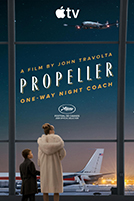
In the golden age of aviation, Jeff, a young boy with a passion for flying, takes off alongside his mother on a one-way trip to Hollywood, crossing the United States. What could have been just an ordinary flight turns into the adventure of a lifetime. Between the meals served on board, the attentive service of the flight attendants, the unexpected layovers, the colorful passengers, and a memorable visit to first class, the adventure holds moments as magical as they are surprising, which will forever shape the young boy’s destiny.
The review
By Mulder 2026-05-29
Passion projects undeniably have a certain fascination. They often reveal more about their creators than any carefully orchestrated studio production, and Propeller One-Way Night Coach is undoubtedly one of the most striking examples of this phenomenon in recent years. Written, directed, and narrated by John Travolta, based on one of his books, this unconventional 61-minute feature film feels less like a conventional movie and more like an album of cinematic memories pieced together from cherished childhood recollections. Set in 1962, the story follows young Jeff, played by Clark Shotwell, as he embarks on his first transcontinental flight alongside his mother Helen, portrayed by Kelly Eviston-Quinnett, who dreams of making it in Hollywood. What unfolds is not really a narrative in the traditional sense, but rather a collection of observations, encounters, and nostalgic memories centered on the golden age of American air travel. The problem is that while John Travolta clearly remembers every detail of this journey with affection, he struggles to explain why the audience should feel the same emotional attachment.
From the very first minutes, the film demonstrates an impressive commitment to recreating that era. The art direction captures the optimistic glamour of early 1960s aviation remarkably well, from elegant airport terminals and vintage uniforms to chic passengers and luxurious airplane interiors. Here we find a museum-worthy attention to detail that aviation enthusiasts will undoubtedly appreciate. Every in-flight meal, every airline logo, every layover hotel seems to have been carefully selected to evoke an era when flying was still considered an event rather than a necessity. The visual recreation of a vanished America sometimes becomes the film’s greatest asset, transporting viewers to a world that has largely disappeared from modern life. Unfortunately, this commitment to authenticity often seems more important to the filmmaker than the story itself.
The biggest obstacle facing Propeller One-Way Night Coach is John Travolta’s incessant narration. Rarely has a film shown so little confidence in its own images. Virtually every thought, observation, memory, and emotional reaction is explained to the audience in minute detail by the older Jeff. Rather than allowing viewers to experience the wonder of flight through a child’s eyes, the film constantly tells us what we’re supposed to feel. Moments that could have been magical become strangely lifeless, as the narration intervenes before the image has had a chance to breathe. It often feels as though John Travolta is reading his book aloud while the images serve merely as illustrations. The result is a film that rarely explores cinematic language and instead functions like an audiobook accompanied by moving pictures.
What makes this particularly frustrating is that we catch glimpses of genuinely interesting stories lurking beneath the obsession with aviation. Helen emerges as a far more intriguing character than the film seems willing to admit. Her uncertain pursuit of Hollywood dreams, her complicated relationships with men, and her determination to reinvent her life suggest a richer emotional drama just waiting to be explored. Similarly, the friendship she forms with flight attendant Liz, played by Olga Hoffmann, holds emotional potential that remains largely untapped. Even young Jeff’s interactions with his fellow travelers hint at stories blending loneliness, ambition, trauma, and loss. Yet, every time the narrative touches on an emotionally significant subject, it quickly returns to discussions about airplanes, flight schedules, seat arrangements, or the novelty of the meals served on board.
The performances suffer from the script’s narrow vision. Clark Shotwell possesses a sincere screen presence and manages to capture the excitement of a child discovering something extraordinary for the first time. However, he is rarely allowed to express this excitement naturally, as the narration constantly speaks for him. Kelly Eviston-Quinnett brings warmth and vulnerability to the character of Helen, managing to suggest nuances that the screenplay never fully develops. For her part, Ella Bleu Travolta, in the role of flight attendant Doris, delivers a pleasant performance despite a character who functions more as an idealized memory than as a real person. Throughout the film, numerous supporting characters are introduced in intriguing situations, only to disappear without leaving a lasting impression.
The film’s tone is perhaps its most disconcerting quality. Marketed as a tale of childlike wonder and family nostalgia, it repeatedly touches on adult themes that clash with its innocent perspective. Conversations about sexuality, marital infidelity, alcoholism, Holocaust survival, and psychological distress pop up briefly throughout the journey, but none are explored in depth. They merely float through the narrative like fragments of memory. In another film, these moments might have contributed to a deeper reflection on the innocence of childhood and the complexity of adulthood. Here, they seem disconnected, creating a strangely uneven viewing experience where sentimentality and unsettling realism frequently clash for no apparent reason.
What emerges is a film that feels intensely personal yet surprisingly inaccessible. One can admire the sincerity that drives this project. There is no cynicism here, no attempt to follow trends or emotionally manipulate the viewer. John Travolta sincerely loves aviation, sincerely cherishes these memories, and sincerely wanted to preserve them on screen. Yet sincerity alone is not enough to carry a feature film. The most powerful scenes are those where young Jeff simply gazes out the window, marveling at the clouds beneath his feet, for these moments briefly convey something universal about the wonder of childhood. Unfortunately, these scenes are drowned out by endless exposition and a narrative structure that confuses memory with storytelling.
Propeller One-Way Night Coach feels like an old family photo album coming to life. It holds deep meaning for the person who put it together, filled with cherished memories and personal significance, but it is much harder for outsiders to connect with it emotionally. While its recreation of a bygone era and its obvious affection for aviation occasionally exude a certain charm, the film never manages to transform nostalgia into compelling cinema. As a curiosity and a revealing glimpse into John Travolta’s lifelong passions, it holds some interest. As a dramatic feature film, however, it struggles to take off, offering an experience more admirable for its sincerity than memorable for its storytelling.
Propeller One-Way Night Coach
Written and directed by John Travolta
Based on Propeller One-Way Night Coach by John Travolta
Produced by John Travolta, Jason Berger, Amy Laslett
Starring Clark Shotwell, Kelly Eviston-Quinnett, Ella Bleu Travolta, Olga Hoffmann
Narrated by John Travolta
Cinematography: Paul de Lumen
Edited by Mark J Marraccini, Adam Varney
Music by Tim Aarons, Alec Puro, Eric Meyers
Production companies: JTP Productions, Kids at Play
Distributed by Apple TV
Release dates: May 15, 2026 (Cannes), May 29, 2026 (United States)
Running time: 61 minutes
Duration: 61 minutes
Viewed on May 29, 2026