 English
All of a Sudden
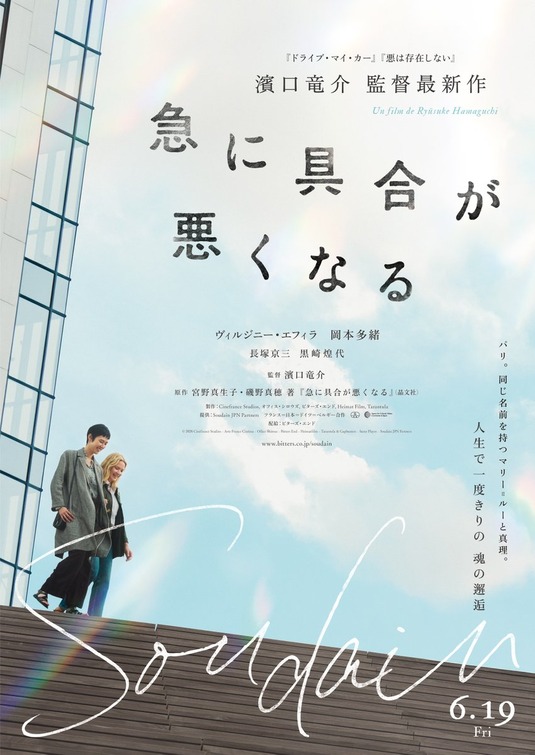
| Original title: | Soudain |
| Director: | Ryusuke Hamaguchi |
| Release: | Vod |
| Running time: | 196 minutes |
| Release date: | Not communicated |
| Rating: |
Mulder's Review
Japanese filmmaker Ryusuke Hamaguchi has always approached cinema as a living conversation, but with All of a Sudden, he reaches a level of emotional and philosophical maturity whose sincerity is almost disarming. Following the success of Drive My Car and the spellbinding austerity of Evil Does Not Exist, the director now leaves Japan for a distinctly French setting, without ever abandoning the humanistic dimension that characterizes his work. Set primarily in a Parisian care facility called Garden of Freedom, the film initially appears to be a quiet workplace drama about burnout, elder care, and the impossible logistics of compassion within systems governed by efficiency and profit. Yet, over the course of its monumental runtime, All of a Sudden gradually transforms into something far more ambitious: a meditation on mortality, capitalism, friendship, art, touch, and the terrifying fragility of human bonds. The miracle is not simply that the film sustains these themes for over three hours, but that it somehow manages to make them feel intimate rather than intellectualized. Ryusuke Hamaguchi doesn’t so much direct the scenes as he allows the characters to exist within them, giving every silence, every glance, and every hesitant confession enough space to breathe until they become emotionally overwhelming.
At the heart of the film lies Virginie Efira’s remarkable performance, delivering what may well be the greatest performance of her career as Marie-Lou, the exhausted director of the care facility who attempts to implement the care philosophy known as Humanitude. In the hands of another filmmaker, these opening sequences might have devolved into dry social realism, but Ryusuke Hamaguchi films them with an almost documentary-like tenderness. The residents are never reduced to symbols of decline or tragedy; they remain people, stubbornly alive even as memory fails them. Marie-Lou insists that we look patients in the eyes, speak to them gently, touch them with dignity, and encourage them to get up and walk instead of treating them like objects to be managed. It seems simple, but the film brilliantly demonstrates how basic empathy becomes radical within a society obsessed with productivity. Ryusuke Hamaguchi’s camera lingers on the tiniest interactions—a hand held, a resident smiling after being recognized, a nurse quietly losing patience during an exhausting shift—and these moments accumulate with devastating emotional force. The resistance Marie-Lou faces from an overworked staff never becomes caricaturally antagonistic either. Even the skeptical nurse Sophie, magnificently portrayed by Marie Bunel, comes across as someone trapped by years of institutional fatigue rather than by cruelty. The film understands that systems crush people long before people start crushing one another.
Everything changes when Marie-Lou meets Mari, played by the fascinating Tao Okamoto, a Japanese theater director staging an experimental play in Paris about the dismantling of psychiatric institutions, inspired by the work of Italian psychiatrist Franco Basaglia. Their first encounter is marked by a serendipitous intimacy that has all but disappeared from modern cinema. Ryusuke Hamaguchi films their conversations the way other directors film action scenes: with momentum, rhythm, unpredictability, and a growing emotional intensity. What begins as curiosity gradually becomes one of the most profound cinematic friendships of recent years. The two women wander through Paris speaking both Japanese and French, discussing philosophy, illness, anthropology, theater, aging, capitalism, and fear with a candor that feels almost shockingly vulnerable. There is no forced romance, no manipulative melodrama, no artificial plot twists aimed at “spicing up” the relationship. On the contrary, Ryusuke Hamaguchi builds intimacy through listening. The result is extraordinary, as the audience begins to feel like a participant in their conversations rather than a mere observer. Few films in recent years have captured that rare experience of meeting someone who seems to alter your inner rhythm almost instantly, someone whose presence suddenly reorganizes the emotional architecture of your life.
One of the film’s boldest choices is its refusal to separate intellectual discussion from emotional experience. A less talented filmmaker would reduce conversations about capitalism or demographic collapse to pretentious monologues, but Ryusuke Hamaguchi somehow manages to transform these exchanges into revelations about the characters’ personalities. There is a sequence where Mari draws diagrams on a whiteboard to explain how capitalism is gradually eroding humanity; it could have been unbearably pretentious, but it becomes hypnotic because of the emotional urgency behind it. Mari isn’t lecturing; she’s trying to understand why societies built on efficiency inevitably abandon the most vulnerable. This question quietly permeates every layer of the film. The elderly residents forgotten by society, the overworked caregivers who collapse under the weight of impossible expectations, the autistic teenager Tomoki who approaches the world differently from everyone around him, and even Mari herself, facing a terminal illness—all become reflections of modern systems’ difficulty in accounting for fragility. Ryusuke Hamaguchi never offers simplistic solutions, but he proposes something just as radical: perhaps authentic human presence is in itself a form of resistance.
The film’s emotional power also stems from its tactile quality. It is one of the few contemporary dramas that truly understands bodies not as symbols, but as living vessels of emotion. When Mari eventually spends time at the nursing home, introducing exercises focused on touch, movement, massage, and breathing, the film reaches a level of vulnerability that becomes almost unbearable. There is a scene where the residents gently massage each other’s feet on the grass, which might seem absurd on paper, but Ryusuke Hamaguchi films it with such purity that it becomes deeply moving. The film suggests repeatedly that language alone is not enough, that emotional truth often emerges through physical presence rather than through explanation. This idea is present throughout Ryusuke Hamaguchi’s filmography, but never so clearly. Here, touch becomes communication, and the slightest gestures are imbued with overwhelming emotion. Watching residents who struggle to articulate words reconnect through movement and touch becomes one of the most quietly heartbreaking scenes the director has ever filmed.
Visually, All of a Sudden possesses a luminous softness that perfectly reflects its themes. Director of photography Alan Guichaoua bathes Paris and Kyoto in a warm, natural light, creating images that seem suspended between realism and memory. Ryusuke Hamaguchi has always had an extraordinary understanding of duration, but here, time itself is an integral part of the emotional experience. At nearly three hours and twenty minutes long, the film demands patience, but that patience becomes essential as the gradual accumulation of routine, repetition, and conversation allows the audience to truly immerse themselves in the lives of these characters. There are walks that seem endless, conversations that drift naturally from one topic to another, sunsets that linger longer than expected, and scenes where absolutely nothing “important” happens narratively while everything changes emotionally. Some viewers will undoubtedly find the pace difficult to follow, but shortening the film would destroy its very essence. Ryusuke Hamaguchi wants us to feel time passing, to understand how intimacy is formed not through dramatic declarations, but through shared duration.
What ultimately makes All of a Sudden unforgettable is the way it confronts death without succumbing to despair. Mari’s cancer diagnosis hangs over the entire film like a storm on the horizon, but Ryusuke Hamaguchi rejects all the easy emotional shortcuts associated with stories about terminal illness. There are no manipulative speeches, no sentimental outbursts orchestrated to elicit applause. On the contrary, the film emphasizes the possibility that knowing life is finite can sharpen our ability to form genuine connections. In the final act, the emotional upheaval comes not because the film surprises us, but because it has led us to become so deeply attached to these characters that even the smallest moments begin to hurt. A late sequence in Kyoto, calm and of an almost unbearable serenity, gives the impression that Ryusuke Hamaguchi is reaching toward something spiritual without ever falling into the abstract. This is cinema that operates on the level of emotional truth rather than narrative mechanics.
There are films that impress you intellectually, films that entertain you, and films that overwhelm you emotionally for a few hours before fading away. All of a Sudden belongs to a much rarer category: that of films that subtly alter your view of others once you’ve left the theater. It is a monumental work of compassion, directed by a filmmaker who understands that cinema can still function as a space for genuine human reflection rather than mere consumption. In a cinematic landscape increasingly dominated by speed, irony, and emotional detachment, Ryusuke Hamaguchi offers us a monumental act of sincerity. The title suggests a sudden transformation, and that is exactly what the film offers: a gradual emotional awakening that, suddenly, almost without warning, strikes with overwhelming force. A pure, unforgettable masterpiece..
All of a Sudden
Directed by Ryusuke Hamaguchi
Written by Ryusuke Hamaguchi, Léa Le Dimna
Based on You and I – The Illness Suddenly Gets Worse by Makiko Miyano, Maho Isono
Produced by Renan Artukmaç, Bettina Brokemper, Charlotte Dauphin, Julien Deris, David Gauquié, Charles-Henri de La Rochefoucauld, Hiroko Matsuda, Jean-Luc Ormières, Kôsuke Oshida, Joseph Rouschop, Yûji Sadai
Starring Virginie Efira, Tao Okamoto, Kyōzō Nagatsuka
Cinematography: Alan Guichaoua
Edited by Yamakazi Azuza, Akimoto Minori
Music by Samuel Andreyev
Production companies: Cinefrance Studios, Office Shirous, Bitters End, Heimatfilm, Tarantula, Dauphin Films
Distributed by Diaphana Distribution (France), Bitters End (Japan)
Release dates: May 15, 2026 (Cannes), June 19, 2026 (Japan), August 12, 2026 (France)
Running time: 196 minutes
Viewed on May 24, 2026, at the Pathe Palace in Paris, Theater 01, Seat B17
Mulder's Mark: