

The Birthday Party
Directed by Léa Mysius
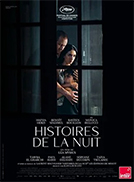
| With | Hafsia Herzi, Benoît Magimel, Bastien Bouillon |
| Runtime | 114 minutes |
| Release | Release date unknown |
| Original title | Histoires De La Nuit |
| Rating | 6/10 |
Nora, Thomas, and their daughter Ida live on an isolated farm with only one neighbor, Cristina, an Italian painter. While everyone is preparing a surprise birthday party for Nora, three men lurk around the house and crash the party, bringing long-buried secrets to the surface…
The review
By Mulder 2026-05-24
From the very first minutes, Léa Mysius makes it clear that this is a slow descent into anxiety, a film where every decoration hanging on the wall resembles less a festive adornment than a warning sign waiting to be understood. Adapted from Laurent Mauvignier’s novel The Birthday Party, the film carries within it the DNA of both psychological film noir and home-invasion thrillers, but Léa Mysius approaches it less as a conventional genre exercise than as an unearthing of buried identities. Watching it often feels like sitting at a family dinner where no one speaks of what is clearly poisoning the atmosphere, yet everyone can sense it with every bite.
Set in a remote rural landscape in western France, the film introduces us to Thomas and Nora Bergogne, played by Bastien Bouillon and Hafsia Herzi, who live with their daughter Ida on an isolated dairy farm, seemingly cut off from the modern world. Yet, in one of the film’s most astute observations, modernity invades even isolation. A seemingly innocent video posted by Ida on social media, showing the family dancing together, becomes the narrative equivalent of unlocking a locked door. The sequence unfolds almost like a cautionary urban legend for the digital age; a harmless moment of joy suddenly turns into a distress flare exposing people who desperately wanted to remain invisible. In an age when entire lives are thoughtlessly documented, Léa Mysius quietly builds tension around a terrifying question: what if being seen were the worst thing that could happen to you? This idea is unsettling precisely because it feels disturbingly relevant.
What follows gradually shifts into the realm of home invasion when mysterious visitors arrive at the farm, led by the unsettling Franck, played by Benoît Magimel, accompanied by Paul Hamy and Alane Delhaye. Rather than rushing toward violence, the film takes pleasure in prolonging the unease. The intruders settle into the house with unsettling confidence, speaking familiarly, moving through private spaces as if they had been invited. The true invasion here is psychological long before it becomes physical. There is a strange cruelty in watching ordinary domestic rituals continue under an invisible threat. The birthday decorations still need to be hung. Meals still need to be prepared. The television still plays cartoons for Ida while the adults exchange increasingly meaningful glances. This creates an atmosphere where every second seems to stretch out endlessly, as if reality itself were waiting for permission to shatter.
The cast proves to be one of the film’s major strengths. Hafsia Herzi portrays Nora with remarkable duality, striking a balance between quiet resilience and the suffocating weight of secrets that threaten to collapse around her. Her performance often relies on subtle shifts in expression rather than explosive moments, conveying the impression of someone who is constantly calculating her survival several steps ahead. Meanwhile, Benoît Magimel seems to have literally stepped out of another film and immediately infuses the screen with electric energy. There is something fascinating about his performance, as Franck rarely behaves like the traditional cinematic monster. On the contrary, he resembles someone who sincerely believes he has unfinished business to settle. Benoît Magimel has developed this extraordinary physical presence over the past few years; he no longer so much enters scenes as he occupies them. His Franck gives the impression of being a storm cloud wearing sunglasses.
Then there is Monica Bellucci, who unexpectedly becomes the emotional heart of the film. Cristina, the artist next door living alone among enormous abstract canvases, could easily have remained a secondary observer, relegated to the margins of the narrative. Instead, she gradually becomes one of its most captivating characters. Some of the film’s richest moments occur during her interactions with the fragile and unstable Bègue, played by Alane Delhaye. Their scenes possess a strange intimacy, verging almost on something melancholic and surprisingly human. A particular irony lingers afterward: while everyone else struggles desperately against the ghosts of their past, Cristina gives the impression of already living alongside hers. Monica Bellucci brings a sad serenity to the character, portraying loneliness not as melodrama, but as a kind of exhaustion accumulated over the years.
Visually, Léa Mysius and cinematographer Paul Guilhaume create a world bathed in icy blues, dense shadows, and an unsettling darkness. The farm itself becomes a prison with open spaces, proving once again that isolation can be far more oppressive than overcrowded cities. Certain images remain etched in the memory: birthday cakes that look almost grotesque under subdued lighting, dark swamps swallowing up silhouettes, and interiors that seem to close in on their occupants. There are moments when the film seems almost suspended between realism and nightmare. It occasionally flirts with visual ideas that border on surrealism, and while not all experiments are perfectly successful, they reveal a filmmaker far more interested in emotional texture than in conventional mechanisms.
The film stumbles when it finally reaches its goal. Its gentle approach creates a tension so carefully sustained that one naturally expects a devastating climax. Unfortunately, several late revelations and narrative twists feel more familiar than shocking. We begin to recognize elements borrowed from classic home-invasion stories, and the film sometimes struggles to transcend these influences. It’s not that the ending falls flat; it simply never reaches the emotional intensity that the build-up promises. The feeling is akin to unwrapping a beautifully wrapped gift only to discover that you already know what’s inside.
Yet, despite its flaws, The Birthday Party remains a captivating and often deeply unsettling experience. It may not reinvent its genre, but Léa Mysius directs with enough confidence and visual precision to elevate material that might otherwise have seemed routine. The film leaves behind a disturbing idea that lingers long after the credits roll: perhaps our pasts never truly disappear, but merely wait patiently for the invitation we accidentally send them. And sometimes, all it takes is a birthday party to bring them back.
The Birthday Party
Directed by Léa Mysius
Based on the novel The Birthday Party by Laurent Mauvignier, published in 2020 by Éditions de minuit
Produced by Jean-Louis Livi
Written by Léa Mysius
Starring Hafsia Herzi, Benoît Magimel, Bastien Bouillon, Monica Bellucci, Tawba El Gharchi, Paul Hamy, Alane Delhaye, Servane Ducorps, Tatia Tsuladze
Music by Florencia Di Concilio
Cinematography: Paul Guilhaume
Edited by Yorgos Lamprinos
Production companies: F Comme Film, Beside Productions, DIVISION, France 3 Cinéma
Distributed by Le Pacte (France)
Release date: May 22, 2026 (Cannes Film Festival), September 16, 2026 (France)
Running time: 114 minutes
Viewed on May 24, 2026, at the Pathe Palace in Paris, Theater 01, Seat B17