

Fatherland
Directed by Paweł Pawlikowski
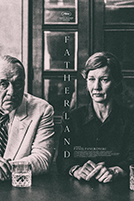
| With | Hanns Zischler, Sandra Hüller, August Diehl, Anna Madeley, Devid Striesow |
| Runtime | 82 minutes |
| Release | Release date unknown |
| Original title | Vaterland |
| Rating | 8/10 |
In 1949, Thomas Mann, winner of the Nobel Prize in Literature, returns to Germany for the first time since the end of the war, accompanied by his daughter Erika, an actress, writer, and rally driver. At the wheel of a black Buick, they embark on a grueling journey through a country they had fled sixteen years earlier, when the Nazi Party had seized power. From Frankfurt, under American occupation, to Weimar, controlled by the Soviets, father and daughter traverse a Germany in ruins, divided in two by the Cold War.
The review
By Mulder 2026-05-22
With Fatherland, Paweł Pawlikowski returns to the emotional and historical terrain that made Ida and Cold War modern classics, but this time, his gaze seems even colder, more introspective, and deeply haunted by the collapse of moral certainties in postwar Europe. Set in 1949, the film follows Nobel Prize-winning writer Thomas Mann and his daughter Erika Mann as they return to a divided Germany after years of exile in the United States. What begins as an official trip to receive the Goethe Prize gradually transforms into a devastating emotional odyssey through the ruins of a country unable to reconcile itself with its own past. Rather than crafting a conventional historical biopic, Paweł Pawlikowski directs a sober chamber piece on exile, guilt, intellectual arrogance, and emotional paralysis, all wrapped up in one of the year’s most visually spellbinding films.
From its beautiful opening sequence, the film establishes a suffocating atmosphere of unresolved grief. In an almost hypnotic scene, Klaus Mann, played with poignant fragility by August Diehl, speaks on the phone with his sister shortly before taking his own life, immediately becoming the ghost who will silently dominate the narrative. His absence hangs over every conversation, every hotel corridor, and every public appearance by his father. What makes Fatherland so powerful is the way it consistently avoids emotional oversimplification. The characters rarely express what they truly feel. Instead, Paweł Pawlikowski builds the drama through pauses, glances, silences, and philosophical conversations that conceal unbearable personal pain beneath intellectual sophistication. The result is a film that feels less like a traditional narrative and more like an emotional exploration of a Europe attempting to rebuild itself while refusing to fully confront its own moral collapse.
At the heart of the film is the extraordinary Sandra Hüller, who delivers yet another stunning performance following Anatomy of a Fall and The Zone of Interest. Her portrayal of Erika Mann is imbued with intelligence, exhaustion, fury, and emotional repression. She is simultaneously her father’s assistant, translator, emotional support, and fiercest critic. Sandra Hüller once again demonstrates an almost unmatched ability to convey entire emotional landscapes through the most subtle gestures. Whether she endures in silence elitist receptions filled with former Nazis feigning innocence, or explodes with rage when Germany’s lingering fascist sympathies become impossible to ignore, she dominates the screen with extraordinary subtlety. One of the film’s greatest achievements is the way it gradually reveals that Erika is not a secondary character orbiting a literary giant, but the emotional and moral heart of the entire story. Her pain becomes the audience’s entry point into a world where intellectual discourse often serves as a shield against genuine emotional confrontation.
Opposite her, Hanns Zischler delivers a memorable performance as Thomas Mann, portraying him as a deeply complex figure, torn between public dignity and private emotional inadequacy. The film never turns Mann into a villain or a saint. On the contrary, it presents him as a brilliant intellectual incapable of understanding the emotional disaster surrounding him. He speaks eloquently about Goethe, morality, culture, and Germany’s future, but struggles deeply to establish intimacy, particularly with his children. The contrast between his public image as Germany’s moral conscience and his private failures as a father provides much of the film’s emotional tension. One of the particularly painful aspects of the narrative is watching Mann cling desperately to the conviction that art and culture can still save civilization, while Erika increasingly views these ideals as abstract luxuries disconnected from reality. Their ideological conflict quietly evolves into something universal: a generational divide between those who still believe in grand cultural ideals and those who have seen history destroy them in real time.
Visually, Fatherland is absolutely breathtaking. Director of photography Łukasz Żal collaborates once again with Paweł Pawlikowski to create austere black-and-white images that seem both timeless and ghostly. The ruined streets of Frankfurt and Weimar resemble emotional graveyards, while the rigid compositions and almost frozen interiors trap the characters in suffocating spaces, laden with the invisible weight of history. Every shot seems meticulously sculpted, without ever appearing artificial. The film’s austere visual beauty constantly contrasts with the moral ugliness lurking beneath the surface of postwar reconstruction. Former Nazis reintegrate into society without batting an eye, ideological propaganda replaces genuine accountability, and public ceremonies attempt to mask collective trauma with a barrage of speeches and music. Certain sequences seem almost surreal in their silent tension, particularly the moments when art and destruction coexist within the same frame, as if Paweł Pawlikowski were wondering whether beauty itself can survive a historical catastrophe without becoming complicit in its own oblivion.
One of the film’s most fascinating aspects is the relevance of its themes today. Although set in 1949 Germany, Fatherland constantly echoes contemporary concerns regarding nationalism, historical denial, political polarization, and the inability of intellectual elites to prevent societies from drifting toward extremism. The divided Germany depicted in the film becomes a disturbing metaphor for modern Europe and, more broadly, for any society struggling to reconcile identity, guilt, and political manipulation. Yet Paweł Pawlikowski never turns the film into a simplistic political allegory. On the contrary, he trusts viewers to recognize the parallels for themselves. This subtlety gives the film extraordinary power. The questions that haunt Fatherland—Can culture stop barbarism? Can nations truly confront their crimes? Does a sense of belonging still exist after moral collapse?—linger long after the final scene ends.
Perhaps most remarkable is the emotional and philosophical complexity that Paweł Pawlikowski manages to condense into a mere eighty minutes. In an era dominated by pompous art-house cinema, Fatherland seems almost radical in its precision and narrative discipline. Every scene counts, every silence carries meaning, and every visual composition deepens the story’s emotional architecture. The film sometimes risks becoming too intellectually dense for viewers unfamiliar with German literary history or postwar politics, but even in its most academic moments, the underlying emotional current remains deeply human. Beneath all the discussions of Goethe, exile, communism, and fascism lies a painfully intimate story between a father and his daughter, unable to truly communicate with one another as they carry between them the emotional corpse of an absent son.
In its final moments, accompanied by the transcendent music of Johann Sebastian Bach, Fatherland achieves something quietly extraordinary. After an entire film dominated by emotional repression, historical trauma, and intellectual debate, Paweł Pawlikowski finally offers a glimpse of a brief moment of tenderness and spiritual liberation. It is not a hopeful ending in the traditional sense, but rather the recognition that art, memory, and human connections can still offer fragile forms of survival, even after civilization has failed in its mission. Beautifully performed, visually flawless, and emotionally moving, Fatherland confirms once again that Paweł Pawlikowski remains one of the great contemporary filmmakers exploring the scars that history leaves on both nations and families.
Fatherland (Vaterland)
Directed by Paweł Pawlikowski
Written by Paweł Pawlikowski, Hendrik Handloegten
Produced by Mario Gianani, Lorenzo Mieli, Ewa Puszczyńska, Jeanne Tremsal, Edward Berger, Dimitri Rassam, Lorenzo Gangarossa
Starring Hanns Zischler, Sandra Hüller, August Diehl, Anna Madeley, Devid Striesow
Cinematography: Łukasz Żal
Editing: Piotr Wójcik, Paweł Pawlikowski
Music: Marcin Masecki
Production companies: Mubi, Our Films, Extreme Emotions Bis, Nine Hours, Chapter2, Circle One
Distribution: Pathé films (France)
Release date: May 14, 2026 (Cannes)
Runtime: 82 minutes
Viewed on May 22, 2026, in Paris at the Pathe Palace, Theater 01, Seat B15