

Colony
Directed by Yeon Sang-ho
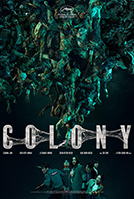
| With | Jun Ji-hyun, Koo Kyo-hwan, Ji Chang-wook, Kim Shin-rok, Shin Hyun-been, Go Soo |
| Runtime | 122 minutes |
| Release | Release date unknown |
| Rating | 8/10 |
In a skyscraper in downtown Seoul, a mysterious infection suddenly spreads. The building is sealed off, and everyone inside is quarantined. At first, the infected crawl around like animals. But little by little, they begin to evolve…
The review
By Mulder 2026-05-27
Ten years after redefining modern zombie cinema with Train to Busan, director and screenwriter Yeon Sang-ho finally returns to the genre that made him one of the most promising names in international horror. And while Colony may not quite reach the emotional perfection of that now-iconic masterpiece, it remains one of the most thrilling and visually inventive zombie films of recent years. Presented as a preview in the Midnight Screenings section of the Cannes Film Festival, the film immediately felt like an adrenaline shot in a lineup often dominated by introspective dramas and slow-paced arthouse films. There was a palpable electricity in the theater during the screening—the kind of collective energy that reminds you why genre cinema remains such a powerful communal experience. Muffled screams, nervous laughter, applause after brutal action sequences—Yeon Sang-ho knows exactly how to orchestrate tension that appeals to the audience, and even when the narrative occasionally ventures into familiar territory, the absolute confidence with which the film is directed keeps it captivating from start to finish.
Set almost entirely inside Seoul’s massive Doongwoori Building—a gigantic vertical labyrinth filled with conference rooms, luxurious offices, shops, escalators, and hidden service corridors—Colony wastes no time plunging the audience into total chaos. Biotechnology professor Kwon Se-jeong, played by the magnetic Jun Ji-hyun, attends a biotechnology conference alongside her ex-husband Han Gyu-seong, played by Go Soo, but the disgraced scientist Seo Young-cheol, portrayed with delightfully unhinged menace by Koo Kyo-hwan, triggers a terrifying viral outbreak inside the tower. What initially appears to be yet another familiar zombie apocalypse gradually reveals a far more intriguing concept: the zombies communicate via a collective mind, sharing their knowledge and evolving together in real time. This unique idea allows Yeon Sang-ho to constantly reinvent the danger throughout the film. The infected don’t just run around blindly; they adapt, devise strategies, coordinate their attacks, and learn human behavior at a frightening speed, creating an atmosphere where survival becomes increasingly impossible as the outbreak drags on.
Visually and technically, the film is often spectacular. Yeon Sang-ho directs several fast-paced action sequences, particularly during the first half as panic spreads through the building like wildfire. The infected move less like traditional zombies and more like grotesque, synchronized organisms, collapsing into violent masses of contorted limbs before reorganizing into coordinated predators. Some sequences truly feel like a nightmare, notably a breathtaking scene in a hallway where dozens of infected bodies merge into what looks like a living wall making its way toward the survivors. Unlike many modern horror blockbusters overloaded with weightless CGI creatures, Colony relies heavily on stunt performers and contortionists, giving the infected a disturbing physical presence that recalls the raw horror of 28 Days Later while retaining its own identity. The practical gore effects, bone-crunching transformations, and bestial body movements create several unforgettable images that linger long after the credits roll.
One of the film’s greatest assets is undoubtedly Jun Ji-hyun, whose long-awaited return to the big screen proves well worth the wait. She commands attention in every scene without ever overdoing it, endowing Se-jeong with an intelligence and emotional restraint that set her apart from the usual archetype of the horror heroine. Rather than succumbing to exaggerated panic, she approaches the apocalypse analytically, constantly observing, calculating, and adapting alongside the audience. There is a quiet melancholy underlying her performance that works wonders, particularly in scenes involving her unresolved relationship with Go Soo’s character. Their chemistry gives the film an emotional backbone that helps counterbalance the relentless carnage. For his part, Ji Chang-wook brings boundless energy to the role of Hyun-seok, a security guard desperately trying to protect his wheelchair-bound sister, played by Kim Shin-rok. The dynamic between these two siblings becomes one of the film’s most human elements, anchoring the spectacle in moments of vulnerability amid the chaos.
What makes Colony particularly interesting is the way it uses its hive mind concept to reflect contemporary fears surrounding artificial intelligence, algorithm-driven behavior, social conformity, and hyperconnectivity. The infected communicate instantly, evolve collectively, and lose all individuality in favor of perfect synchronization, becoming less monsters than biological systems operating under a single terrifying intelligence. Yeon Sang-ho doesn’t always explore these themes with absolute subtlety, but there is something undeniably captivating about the way the film transforms modern anxieties related to technology and communication into physical horror. At times, the infected almost resemble a corrupted digital network brought to life, adapting faster than humans can process information. The film works best when it builds on these ideas while maintaining its brutal momentum, allowing the horror to arise not only from the gore, but also from the terrifying possibility that humanity might be overwhelmed by a collective consciousness devoid of empathy and individuality.
At just over two hours long, the pace occasionally falters in the second half, and some secondary characters remain underdeveloped compared to the emotional depth of Train to Busan. Certain dramatic scenes interrupt the intensity rather than heighten it, and the screenplay sometimes over-explains concepts that were already visually understood. Yet even during these weaker moments, the technical mastery remains impressive. The cinematography constantly finds creative ways to exploit the confined setting, whether through security camera footage, ambushes on crowded escalators, or narrow maintenance tunnels bathed in emergency lighting. The building itself becomes a character, transforming into a gigantic vertical death trap where each floor presents a new variation on the danger. There is also something undeniably satisfying about the resolutely cinematic nature of the experience as a whole. This is a big-budget horror film made with scope, ambition, and confidence, rather than disposable streaming content destined to fade from memory after a weekend.
What ultimately elevates Colony above many recent zombie films is its ability to remain consistently entertaining while attempting to push the genre forward visually and conceptually. It may borrow openly from classics like Dawn of the Dead, Resident Evil, and World War Z, but it remixes these influences with enough style and ferocity that the result is thrilling rather than cynical. Several action sequences are staged with such kinetic precision that one can’t help but admire the craftsmanship behind them, particularly during the large-scale attacks by the infected, where every actor seems caught up in a terrifying and perfectly coordinated choreography. The concept of a hive mind also allows the zombies themselves to evolve visually throughout the film, making the threat increasingly unpredictable rather than repetitive.
Colony may not dethrone Train to Busan as Yeon Sang-ho’s undisputed masterpiece, but it undoubtedly confirms that he remains one of the most technically gifted genre filmmakers working today. Brutal, stylish, wildly entertaining, and brimming with memorable imagery, the film delivers exactly the kind of large-scale midnight horror spectacle audiences crave, while introducing enough fresh ideas to keep the genre alive. At a time when many zombie films seem to run out of steam before they even get started, Colony proves that there is still fresh blood flowing through the veins of the undead.
Colony
Directed by Yeon Sang-ho
Written by Yeon Sang-ho, Choi Gyu-seok
Produced by Yoomin Hailey Yang
Starring Jun Ji-hyun, Koo Kyo-hwan, Ji Chang-wook, Kim Shin-rok, Shin Hyun-been, Go Soo
Cinematography: Bong-Sun Byun
Edited by Mee-Yeon Han
Music by Suk-Won Kim
Production companies: Wow Point, Smilegate
Distributed by Showbox (United States), ARP Sélection (France)
Release dates: May 16, 2026 (Cannes), May 21, 2026 (South Korea), May 27, 2026 (France)
Running time: 122 minutes
Viewed on May 27, 2026 at Gaumont Disney Village, Theater 15, Seat A19