

The Electric Kiss
Directed by Pierre Salvadori
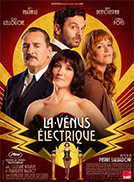
| With | Pio Marmaï, Anaïs Demoustier, Gilles Lellouche, Vimala Pons |
| Runtime | 122 minutes |
| Release | Release date unknown |
| Original title | La Vénus électrique |
| Rating | 7/10 |
Paris, 1928. Antoine Balestro, a young painter in high demand, has been unable to work since his wife’s death, much to the despair of Armand, his gallery owner. One drunken evening, Antoine tries to contact his wife through a psychic. Unbeknownst to him, he is actually speaking with Suzanne, a humble carnival worker who has sneaked into the trailer to steal food. Suzanne proves to be a gifted fraudster, and, quickly aided by Armand, she stages one fake séance after another. Little by little, Antoine regains his inspiration, but for Suzanne, things get complicated as she slowly falls in love with the man she is manipulating...
The review
By Mulder 2026-05-20
Opening the 79th Cannes Film Festival with a romantic period comedy-drama dealing with grief, illusion, artistic torment, and carnival-style deceptions seems, on paper, to be a typically French choice, and Pierre Salvadori fully embraces this tradition with The Electric Kiss a film that constantly oscillates between whimsical farce and melancholic romance. Set in a dreamlike version of 1928 Paris, the film immediately plunges the audience into a traveling carnival populated by broken souls, failed artists, fake mediums, and wounded romantics, all surviving through spectacle and illusion. At the center of this strange world stands Suzanne, magnificently portrayed by Anaïs Demoustier, a woman presented as Venus Electrificata, whose allure lies in electrified kisses sold to lonely men desperate to feel the shock of love. It’s one of those concepts so absurdly theatrical that it could have descended into parody within minutes, but Pierre Salvadori manages to extract a singular emotional sincerity from it. Behind the shimmering lights, velvet curtains, and vaudeville aesthetic lies the portrait of a woman trapped in exploitation, physical pain, and emotional exhaustion, surviving on crumbs while her burned hands silently bear witness to the violence hidden beneath the spectacle.
The true narrative engine kicks into gear when Suzanne is mistaken for a psychic by Antoine, a devastated painter perfectly embodied by Pio Marmaï, who seeks to make contact with his late wife Irène. From there, The Electric Kiss transforms into an elaborate chain of lies, emotional manipulation, and accidental tenderness. Suzanne initially agrees to this charade for the money, especially after Armand, Antoine’s opportunistic art dealer’played with surprising nuance by Gilles Lellouche) realizes that these fake séances miraculously rekindle Antoine’s creative passion. What makes the film more interesting than a simple romantic escapade is the way Pierre Salvadori constantly questions the morality of the illusion itself. Are comforting lies necessarily cruel? Can staging become a form of emotional salvation? The screenplay, based on an original idea by Rebecca Zlotowski and Robin Campillo, constantly blurs the lines between manipulation and compassion. Suzanne technically exploits Antoine’s grief, but many of her actions gradually come to seem less like a deception and more like improvised therapy for a man drowning in guilt and self-destruction. This ambiguity becomes the film’s strongest thematic element, especially as Suzanne begins reading Irène’s diaries and gradually transforms into an emotional extension of the deceased.
What truly elevates the film, however, is the actors’ convincing commitment to striking a balance between absurdity and vulnerability. Anaïs Demoustier delivers one of those performances capable of shifting tone in a matter of seconds, moving from exuberant physical comedy to deeply wounded introspection without ever losing credibility. Certain séances are genuinely hilarious, particularly when Suzanne has to improvise under pressure, half-blinded by theatrical contact lenses, while pretending to channel spirits she barely understands. Yet Anaïs Demoustier never turns Suzanne into a caricature. There is always exhaustion behind her smile, fear behind her improvisations, and ultimately a sincere affection that emerges through the lies. Equally impressive is Pio Marmaï, whose portrayal of Antoine avoids the trap of making grief theatrical or overly romanticized. His Antoine cries constantly, drinks excessively, humiliates himself, clings to ghosts, and desperately seeks absolution, but Pio Marmaï infuses him with enough warmth and sincerity for the audience to understand why Suzanne cannot completely detach herself from this deception. The emotional fragility he brings to the role becomes surprisingly touching, particularly in a cinematic landscape where male vulnerability is still too often reduced to irony or stoicism.
Visually, the film creates a fascinating contradiction. On one hand, the art direction, cinematography, and costumes construct a fanciful and richly stylized version of Paris that often recalls the heightened artificiality of Jean-Pierre Jeunet’s films or even echoes of Baz Luhrmann’s Moulin Rouge!. The carnival itself seems suspended between fairy tale and nightmare, populated by grotesque performers and faded glamour. Julien Poupard’s cinematography bathes the film in warm, golden tones, a soft haze, and theatrical lighting that constantly reinforce the idea that the characters themselves are trapped within a spectacle. On the other hand, some viewers might struggle with the film’s highly artificial aesthetic, especially when combined with a digital sheen that is at times overly polished, giving certain scenes a strangely synthetic look. Yet even when the visual approach becomes excessive, it undeniably contributes to the film’s central obsession with illusion. Nothing here is meant to seem entirely real; everything exists in a liminal space between fantasy, memory, theater, and emotional fabrication.
It is in its increasingly convoluted narrative structure that the film divides opinion the most. As soon as Irène’s diaries begin to introduce lengthy flashbacks to the shared past of Antoine, Irène, and Armand, The Electric Kiss starts juggling multiple emotional timelines, hidden romantic tensions, artistic betrayals, and revelations that sometimes overcomplicate what initially worked best as an intimate tragicomedy. Some flashbacks are truly magnificent, particularly those featuring Vimala Pons, who imbues Irène with a magnetic intelligence and sensuality even though the character is essentially constructed from memories and written fragments. Her presence hovers over the film like a ghost haunting every interaction. Yet the screenplay sometimes becomes too ambitious for its own good, introducing love quadrangles, emotional twists, and multi-layered secrets that dilute the story’s emotional immediacy. There are moments when the pace drags noticeably, particularly in the final third, as Pierre Salvadori struggles to maintain the lighthearted rhythm that initially made the film so charming.
And yet, despite these flaws, there is something undeniably endearing about The Electric Kiss. Perhaps it’s because the film never hides its own absurdity. Pierre Salvadori knows his premise is ridiculous. He understands that fake séances, electrified kisses, and grieving painters could easily become unbearable in less skilled hands. Instead of resisting this absurdity, he dives right in, creating a romantic comedy that unabashedly embraces old-fashioned sincerity. At a time when many modern romances seem terrified of genuine emotion and constantly hide behind cynicism or metatextual humor, there is something refreshing about a film willing to believe in desire, chance, and emotional transformation. Even when the script loses its coherence, the film’s emotional generosity consistently saves it from collapse.
There is also something fascinating about the irony surrounding the film itself. Cannes opening films often have a reputation for being light entertainment aimed at the general public rather than serious artistic statements, and The Electric Kiss almost instantly found itself at the center of this debate. The Electric Kiss is itself an illusion: a film that pretends to be lighter than it actually is, hiding melancholy beneath comedy, grief beneath spectacle, and emotional despair beneath theatrical absurdity. It may not be a masterpiece, and it certainly lacks the narrative precision needed to fully transcend its excesses, but it possesses enough charm, humanity, and emotional eccentricity to remain strangely captivating long after its final scene has faded.
The Electric Kiss
Directed by Pierre Salvadori
Written by Pierre Salvadori, Benjamin Charbit, Benoît Graffin
Story by Robin Campillo, Rebecca Zlotowski
Produced by Philippe Martin
Starring Pio Marmaï, Anaïs Demoustier, Gilles Lellouche, Vimala Pons
Cinematography: Julien Poupard
Edited by Anne-Sophie Bion
Music by Camille Bazbaz
Production companies: Les Films Pelléas, Versus, France 2 Cinéma, Pio & Co, Tovo Films, RTBF, BeTV, Orange
Proximus
Distributed by Diaphana Distribution (France), O'Brother Distribution (Belgium)
Release dates: May 12, 2026 (Cannes), May 12, 2026 (France)
Running time: 122 minutes
Viewed on May 20, 2026, at Gaumont Disney Village, Theater 16, Seat A18