

Passenger
Directed by André Ovredal (2026)
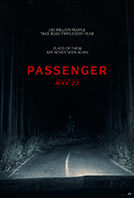
| With | Jacob Scipio, Lou Llobell, Melissa Leo |
| Runtime | 94 minutes |
| Release | 2026-05-22 |
| Rating | 6/10 |
After witnessing a horrific car accident, a young couple realizes they haven’t left the scene without being followed. A demonic presence, the Passenger, joins them on their road trip and turns their adventure into a living nightmare, determined not to stop until it has taken them both.
The review
By Mulder 2026-05-20
There is something inherently unsettling about American highways at night. Perhaps it’s the illusion of freedom that suddenly turns into vulnerability the moment the last gas station disappears in the rearview mirror, or perhaps it’s because horror cinema has conditioned generations of viewers to fear what might be lurking just beyond the reach of their headlights. With Passenger, Norwegian director André Øvredal proves once again that few contemporary genre filmmakers master the mechanics of tension as well as he does, even if the film itself never quite reaches the emotional or mythological heights it desperately hints at. Situated somewhere between The Hitcher, Jeepers Creepers, urban legends whispered around a campfire, and contemporary van life culture, Passenger is ultimately less interested in reinventing horror than in transforming familiar fears into weapons with technical precision. The result is a film that may frustrate viewers seeking originality or deep meaning, but which nonetheless offers enough genuinely unsettling moments to justify the journey.
The screenplay is deceptively simple and, honestly, quite clever in the way it pits modern social fantasies against ancestral fears. Jacob Scipio and Lou Llobell play Tyler and Maddie, a young couple from Brooklyn who abandon conventional life in favor of the increasingly idealized nomadic existence of “van life,” converting a Mercedes Sprinter into a mobile home. Early on, the film subtly suggests that this road trip is already revealing cracks in their relationship long before the supernatural horror arrives. Tyler embraces the philosophy of the open road with almost religious enthusiasm, while Maddie seems caught between her desire for freedom and her longing for stability. This tension becomes the film’s emotional driving force, even if the screenplay by Zachary Donohue and T.W. Burgess explores it only partially. Their nightmare truly begins after they stop at the scene of a macabre accident on a remote road, in the dead of night, unwittingly inviting a demonic entity known only as “The Passenger” to join their journey. The genius of the premise lies in how it transforms a fundamentally commendable act into a fatal mistake. There is something darkly cynical about this concept, and the film uses it to establish the lingering sense that the road itself has become hostile territory.
What immediately elevates *Passenger* above countless interchangeable streaming horror productions is André Øvredal’s craftsmanship. André Øvredal stages fear with an old-school confidence reminiscent of directors who conceive of suspense as a choreography rather than mere deafening noises. Yes, the film uses jump scares, but unlike the lazy “monster-out-of-nowhere” formula that dominates modern horror, these moments are often built through pacing, framing, and a carefully manipulated perspective. An extraordinary sequence set in a gym parking lot becomes a true lesson in spatial disorientation, as Maddie turns around repeatedly only to realize each time that the van has somehow moved further away. The concept is simple, but the execution—thanks to fluid camerawork and mounting panic—makes it one of the film’s standout moments. Another remarkable sequence, involving an outdoor screening of Roman Holiday, transforms the radiant faces of Audrey Hepburn and Gregory Peck into ghostly lights silhouetted against a dark forest, creating images that are at once beautiful, absurd, and deeply unsettling. It is in moments like these that Øvredal reminds the audience why films like The Autopsy of Jane Doe have become cult classics among horror fans.
The atmosphere throughout the film is truly oppressive, and much of the credit goes to cinematographer Federico Verardi, whose work transforms both confined interiors and open landscapes into claustrophobic spaces. The van itself gradually becomes less a vehicle than a haunted room, a prison on wheels where safety seems constantly fleeting. Øvredal skillfully exploits modern automotive technology to turn it into tools of paranoia. A particularly effective sense of dread arises from seeing shadows where there shouldn’t be any, or catching a glimpse of movement through grainy images before the entity suddenly materializes at an incredibly close distance. Even when the film’s mythology begins to falter under critical scrutiny, the sensory experience remains powerful because the direction never loses sight of the primal fear at the heart of the concept: being trapped on a dark road with nowhere to go, with something impossible chasing you.
In terms of acting, Lou Llobell stands out as the film’s emotional anchor. Maddie isn’t written as a stereotypical horror heroine constantly making irrational decisions, and Llobell embodies her with wisdom, relying on a grounded sense of exhaustion rather than exaggerated hysteria. She makes the slow psychological erosion of someone who realizes that reality itself no longer obeys recognizable rules believable. Jacob Scipio brings a quiet warmth to the character of Tyler, though the script sometimes leaves him stuck in repetitive emotional moments. Their chemistry is strong enough that their relationship survives the film’s weakest dialogue, which often over-explains emotions instead of letting them unfold naturally. Then there’s Melissa Leo, who plays Diana, a weathered woman living in a van who possesses knowledge of the cursed roads and the entity haunting them. Leo delivers exactly what the role demands, but the film frustratingly underutilizes her. There is clearly an entire film hidden somewhere in Diana’s past—a film the script only briefly touches upon before reducing her to a mere vehicle for exposition.
Unfortunately, this is where Passenger repeatedly undermines itself. Almost every positive element of the film clashes with a script that never fully commits to its own mythology. The more the narrative tries to explain the Passenger, the weaker the entity becomes. At first, the demon effectively functions as a vague and elusive road nightmare, a folkloric evil that exists simply because the darkness between two destinations has always frightened people. But as the film introduces St. Christopher medals, symbols of vagabonds, road legends, vague Christian mythology, and increasingly detailed “rules,” the mystery begins to crumble under the weight of its own exposition. At times, the Passenger appears as an ancient supernatural force; at others, it seems strangely linked to early 20th-century vagabond culture, without much explanation. Several critics have rightly pointed out that the film’s mythology seems cobbled together from a patchwork of different horror tropes rather than a coherent vision. Worse still, the final confrontation veers heavily into generic supernatural horror territory, abandoning the unsettling ambiguity that initially made the entity so fascinating.
And yet, despite these flaws, Passenger remains strangely captivating from start to finish. This is partly due to André Øvredal’s undeniable flair for spectacle, but also to the way the film effectively taps into modern anxieties surrounding mobility, instability, and freedom of expression. The van life movement has often been portrayed online as a utopian escape from modern pressures, but Passenger quietly deconstructs this fantasy by transforming the endless journey into existential terror. Maddie and Tyler are constantly on the move yet increasingly trapped, physically isolated despite the infinite space surrounding them. An almost ironic commentary lies beneath the horror: in pursuing freedom, they become prisoners of the road itself. The film never explores this idea deeply enough to become truly profound, but the subtext lingers in the background and gives the film a bit more texture than its critics sometimes admit.
Passenger gives the impression of a very good horror filmmaker grappling with a script that only occasionally lives up to his talent. When the film relies on atmosphere, visual inventiveness, and carefully orchestrated dread, it works a treat. When it starts to explain itself, it gets completely bogged down. Horror fans expecting a groundbreaking new monster mythology will likely walk away disappointed, but viewers willing to accept the film as a tense and stylish supernatural road thriller will find plenty to marvel at. It may not join the pantheon of unforgettable horror classics, but it succeeds where many modern genre films fail: it creates moments. Precise, memorable, beautifully constructed moments that remain etched in your memory long after the headlights have faded into the darkness.
Passenger
Directed by André Øvredal
Written by Zachary Donohue, T.W. Burgess
Produced by Walter Hamada, Gary Dauberman
Starring Jacob Scipio, Lou Llobell, Melissa Leo
Cinematography: Federico Verardi
Edited by Martin Bernfeld
Music by Christopher Young
Production companies: 18Hz Productions, Coin Operated
Distributed by Paramount Pictures
Release date: May 20, 2026 (France), May 22, 2026 (United States)
Running time: 94 minutes
Viewed on May 20, 2026 at Gaumont Disney Village, Theater 7, Seat A19