

Star Wars : The Mandalorian and Grogu
Directed by Jon Favreau (2026)
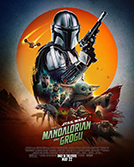
| With | Pedro Pascal, Jeremy Allen White, Sigourney Weaver |
| Runtime | 132 minutes |
| Release | 2026-05-22 |
| Rating | 7/10 |
The fall of the evil Galactic Empire has scattered the Imperial warlords across the galaxy… To protect everything the Rebellion fought for, the fledgling New Republic decides to enlist the help of the legendary Mandalorian bounty hunter Din Djarin and his young apprentice Grogu…
The reviews
By Mulder 2026-05-20
After a seven-year hiatus from movie theaters, Star Wars is finally returning to the big screen with *Star Wars: The Mandalorian and Grogu*, a project that, in a way, embodies all the contradictions currently surrounding the franchise created by George Lucas. Both a sequel to one of Disney+’s most successful series and an attempt to reestablish Star Wars as a cinematic event, the film directed by Jon Favreau constantly oscillates between two identities: that of a nostalgic blockbuster designed for the IMAX experience, and that of a more modest, intimate, character-driven adventure, rooted in television storytelling. This tension ultimately becomes the film’s true personality. From the very first moments, there is an undeniable desire to reconnect with the gritty, Western- and pulp-inspired spirit of the original trilogy. The grimy planets, smoky cantinas, bizarre alien creatures, worn armor, and rain-soaked neon streets all seem deeply rooted in that tactile atmosphere that brought the early Star Wars films to life. Unlike many recent blockbusters in the franchise, obsessed with sterile digital perfection, this film embraces texture, imperfection, and atmosphere. Every corridor feels lived-in, every alien market seems to harbor decades of unseen stories, and for the first time in years, the galaxy feels truly vast again, rather than reduced to a collection of green-screen corridors and corporate mythology management.
What continues to make this branch of the franchise—The Mandalorian—work so well is its simplicity. While the Skywalker saga has often collapsed under the weight of prophecies, lineages, and endless exposition of the universe, Jon Favreau has the wisdom to focus the emotional core almost entirely on the bond between Din Djarin and Grogu. This relationship remains the beating heart of the film and the main reason audiences become emotionally invested in what is otherwise a fairly straightforward tale of rescue and pursuit. Pedro Pascal, though he spends most of the film hidden behind beskar armor and an electronically altered voice, once again manages to breathe humanity into Din Djarin through subtle body language and a restrained vocal performance. The character continues to embody the archetype of the silent gunslinger popularized by Clint Eastwood, but beneath that stoicism lies a deeply exhausted surrogate father, terrified of letting down the child he has adopted. Grogu, for his part, transcends the mere status of a mascot here. The film wisely grants him agency, emotional responsibility, and even goes so far as to make him, at times, the main character. A surprisingly tender emotional thread runs through the entire film, centered on Grogu as he gradually realizes that one day, he might outlive the man who protects him, and although the script never fully explores the tragic implications of this idea, this underlying emotional current quietly persists beneath the spectacle.
The plot itself is intentionally simple, almost aggressively so. Din Djarin now works alongside the New Republic to track down the remnants of the fallen Empire across the Outer Rim. A mission assigned by Colonel Ward, played by Sigourney Weaver, sends him and Grogu to rescue Rotta the Hutt, voiced by Jeremy Allen White, the son of the infamous Jabba the Hutt. Rotta, however, turns out to be a far cry from his father’s grotesque criminal legacy. Reimagined as a reluctant gladiator desperately trying to escape his family’s shadow, the character becomes one of the film’s strangest yet most interesting additions. The idea of a Hutt rejecting dynastic expectations cleverly mirrors the franchise itself, which is attempting to move away from its endless obsession with the Skywalkers. Unfortunately, the screenplay by Jon Favreau, Dave Filoni, and Noah Kloor often struggles to explore these ideas beyond superficial dialogue. Several conversations are repeated almost word for word, and many secondary characters feel less like fully realized personalities and more like mere vehicles for exposition. This is particularly frustrating with Sigourney Weaver, whose commanding screen presence immediately elevates every scene she appears in, but the film surprisingly gives her little to do beyond assigning missions and looking disappointed by Mando’s increasingly chaotic operations.
Where the film undeniably succeeds is in its pure execution as an adventure film. Star Wars: The Mandalorian and Grogu often feels like a loving hybrid of old morning serials, spaghetti westerns, Amblin family adventures, and classic monster movies. One moment, Din Djarin is making his way through the remnants of the Empire atop snow-capped mountains in a sequence reminiscent of vintage James Bond films, and the next, Grogu is wandering through swamps, hiding from monstrous predators, as if it were a clip from a 1980s Steven Spielberg production. The film makes far greater use of puppetry and animatronics than many expected, and this choice lends the film immense charm. Grogu remains one of the most expressive practical creations in modern cinema, with every tilt of the head, every blink of the eye, and every small gesture conveying genuine emotion. In an era dominated by lifeless CGI sidekicks, her physical presence becomes one of the film’s greatest assets. There’s even a surprisingly delightful sequence featuring Grogu and a group of Anzellans that channels the pure energy of Jim Henson and seems almost completely disconnected from modern blockbuster cinema.
Yet the film is not without major flaws. Despite its cinematic scale, it often genuinely feels like it’s made up of several episodes of a TV series stitched together into a single feature film. The pacing can become repetitive, with action sequences sometimes following one another without enough thematic or emotional build-up to justify their length. Some viewers will no doubt miss the lyrical grandeur traditionally associated with Star Wars cinema. The stakes here are intentionally more modest and personal, but this restraint also means the story sometimes lacks urgency. There are moments when the film seems poised to explore fascinating political ideas involving the fractured New Republic and the lingering Imperial influence, only to ultimately abandon them in favor of another monster attack or chase scene. The screenplay consistently prioritizes pacing over complexity, making the film entertaining but at times emotionally superficial. Ironically, the film’s strongest scenes are often the quietest: Grogu tending to a wounded Din Djarin, Mando silently watching his adopted son sleep by a campfire, or those small moments where the armored bounty hunter clumsily tries to act like a parent while clearly having no idea what he’s doing.
Visually, Jon Favreau delivers truly spectacular imagery, even if the film is sometimes marred by that over-processed digital opacity that plagues modern franchise filmmaking. Certain sequences, particularly the gladiator arena featuring Rotta the Hutt and the third act set in the swamps, are teeming with inventively designed creatures and a chaotic energy that wonderfully evoke the old school. The decision to prioritize practical effects as much as possible gives the film a tactile richness that is lacking in many recent blockbusters. At the same time, some action scenes suffer from an overreliance on CGI environments that sometimes flatten the visual depth. Yet even when the effects become overwhelming, the film’s atmosphere remains strong enough to hold the viewer’s interest. All of this is complemented by a phenomenal new score by Ludwig Göransson, whose music once again blends Western motifs, synth-heavy experimentation, and classic orchestral heroism to create something that feels intimately tied to The Mandalorian’s identity rather than simply recycling John Williams’s nostalgia.
One of the most fascinating aspects of the film is the way it consciously distances itself from the increasingly exhausting obsession with mythology that has dominated the discourse around Star Wars for decades. There are, of course, nods, cameos, and references for longtime fans, but unlike many recent productions, the film rarely lingers on worshipping its own continuity. Instead, it focuses almost entirely on adventure, emotion, and pacing. This makes the film pleasantly accessible, even for an audience that hasn’t seen all the Disney+ spin-off series. In many ways, The Mandalorian and Grogu resembles the kind of standalone sci-fi and fantasy adventure that Hollywood used to produce regularly before all the franchises became obsessed with world-building and setting up sequels. The film understands that not all Star Wars stories need to revolve around a galactic destiny or hereditary lineages. Sometimes, it’s enough simply to watch a weary bounty hunter and his adopted child survive one dangerous situation after another while slowly learning what family means.
Star Wars: The Mandalorian and Grogu may not reinvent Star Wars, nor does it fully justify its move from streaming TV to the big screen, but it achieves something arguably more important right now: reminding audiences why this universe was so endearing in the first place. Behind the explosions, monsters, aerial battles, and nostalgic imagery lies a surprisingly sincere story about loneliness, parenthood, responsibility, and emotional bonds. The film may at times seem rough around the edges, uneven, and a bit light on drama, but it is also charming, sincere, and genuinely entertaining in a way that many recent films in the franchise have forgotten. In an era when blockbusters often confuse scale with emotion, and myth with storytelling, Jon Favreau offers us a Star Wars adventure that simply seeks to entertain, amuse, and, at times, touch the heart. That may seem modest for one of cinema’s biggest franchises, but after years of bloated mythology and controversial spectacles, modesty may be exactly what this galaxy far, far away needed.
Star Wars: The Mandalorian and Grogu
Directed by Jon Favreau
Written by Jon Favreau, Dave Filoni, Noah Kloor
Based on Characters by George Lucas
Produced by Kathleen Kennedy, Jon Favreau, Dave Filoni, Ian Bryce
Starring Pedro Pascal, Jeremy Allen White, Sigourney Weaver
Cinematography: David Klein
Edited by Rachel Goodlett Katz, Dylan Firshein
Music by Ludwig Göransson
Production companies: Lucasfilm Ltd., Fairview Entertainment
Distributed by Walt Disney Studios Motion Pictures (United States)
Release date: May 20, 2026 (FRance), May 22, 2026 (United States)
Running time: 132 minutes
Viewed on May 18, 2026 at Pathé Beaugrenelle, Dolby Cinema Theater seat B19
By Sabine 2026-05-19
The Star Wars saga returns to theaters seven years after the last movie, The Rise of Skywalker in 2019, which concluded the Skywalker saga. A new adventure begins with the Mandalorian, a formidable bounty hunter, and his son, the adorable Baby Yoda, Grogu. The stakes are high for the saga, with this transition from the small screen to the big screen. Director Jon Favreau remains at the helm, surrounded by the same team in production, screenplay, special effects, visual effects, music, and more. The film can be enjoyed without having watched the three seasons of The Mandalorian series.
The film offers a unique storyline. The Empire is no more, but Imperial warlords still sow terror across the galaxy. The fledgling New Republic fights to protect the gains of the Rebellion. At the head of this resistance is Colonel Ward, played by Sigourney Weaver. She calls upon the legendary Mandalorian bounty hunter Din Djarin, once again portrayed by Pedro Pascal, and his young apprentice, Grogu, who possesses the Force. Sigourney Weaver brings not only her talent and charisma but also the imaginative world of the Alien saga. Pedro Pascal reprises his role from the series. The strength of this character lies in his voice and his body language, as he is mostly masked. Part of this performance is due to the talent of Brendan Wayne, John Wayne's grandson. He embodies this masked vigilante and gives him his presence and presence. Alongside him, stuntman Lateef Crowder performs the more complex stunts and fight scenes. Jonny Croyne is very convincing in the role of the villain, Lord Janu. Martin Scorsese lends his voice to an animated character, the monkey.
The plot centers on the father-son relationship and learning to survive in a hostile environment, with a moving development midway through the film. However, the story lacks the power of mythology and a strong sense of stakes. The script doesn't live up to my expectations for this saga. The success of a film often hinges on the credibility of its villains. It must be said that the Hutts are particularly repulsive, but they weren't designed to move, to fight. These scenes simply don't work. It's a pity because the other monsters—the aquatic creatures, those in the arena—and their fight scenes are well done.
On screen, the Star Wars universe is fully present. Indeed, the film relies on the work of technicians steeped in the history and language of the franchise, true experts in their field. This is also due to Jon Favreau's direction. He was determined to ground the film in reality, whether for the characters, the battles, or the sets. The saga's iconic ships seem weathered by time. Jon Favreau (Iron Man) successfully combines new technologies with traditional craftsmanship (puppetry, animatronics, stop-motion animation) which allows the Star Wars universe to be fully recreated. The animatronic Grogu is a perfect example. With his cute face, small eyes, and little sounds, it's impossible to resist the charm of this character, just as it is for the Anzellans, those small, wrinkled creatures with large, dark eyes.
The film is grounded in real locations, always with the aim of evoking emotion. Viewers will find familiar landmarks and references, with snowy landscapes and hyperspace. Each planet has its own distinct atmosphere: the seaside for the rebellion, the jungle for the Hutts, the rocky desert of The Mandalorian. The visual universe of the planet Shakari is inspired by Blade Runner. Similarly, the bar fight scene draws its inspiration from John Woo's iconic Korean action film Hard Boiled.
Ludwig Göransson's (Oppenheimer, Sinners) music carries the film. A two-time Emmy Award winner for his work on the series, he composed a multitude of themes for the film's sequences, ranging from a recorder solo to a human choir, a symphony orchestra, a brass band, and an 80s-style synth track. With a larger orchestra, expanding from 70 to around 100 musicians, and a 64-member choir, the music transcends the big screen in its scale and resonance. Despite production values worthy of the saga, the film lacks dramaturgy and emotional depth. A shame, because a talented team was here.
Star Wars: The Mandalorian and Grogu
Directed by Jon Favreau
Written by Jon Favreau, Dave Filoni, Noah Kloor
Based on Characters by George Lucas
Produced by Kathleen Kennedy, Jon Favreau, Dave Filoni, Ian Bryce
Starring Pedro Pascal, Jeremy Allen White, Sigourney Weaver
Cinematography: David Klein
Edited by Rachel Goodlett Katz, Dylan Firshein
Music by Ludwig Göransson
Production companies: Lucasfilm Ltd., Fairview Entertainment
Distributed by Walt Disney Studios Motion Pictures (United States)
Release date: May 20, 2026 (France), May 22, 2026 (United States)
Running time: 132 minutes
Viewed on May 18, 2026 at Pathé Beaugrenelle, Dolby Cinema Theater