

Marty, Life Is Short
Directed by Lawrence Kasdan (2026)
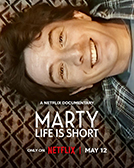
| With | Martin Short, Steve Martin, John Mulaney, Eugene Levy, Andrea Martin, Paul Shaffer, Catherine O'Hara, Deborah Divine, Peter Aykroyd, Jayne Eastwood, Joe Flaherty, Tom Hanks, David Letterman, Laurie MacDonald, Conan O'Brien, Walter F. Parkes, Gilda Radner, Charles Short, Oliver Short, Steven Spielberg, Dave Thomas, Rita Wilson |
| Runtime | 99 minutes |
| Release | 2026-05-12 |
| Rating | 8/10 |
In this documentary, Martin Short reflects on a life filled with joy through iconic clips, interviews, and never-before-seen footage featuring numerous stars.
The review
By Mulder 2026-05-14
With Marty, Life Is Short, Lawrence Kasdan offers much more than a simple, traditional documentary chronicling Martin Short’s career; he paints a warm, intimate, and often deeply moving portrait of a comedian who has made laughter both an art form and a survival instinct. The film is being released at a time when documentaries about comedy legends have almost become a genre unto themselves, but this one immediately stands out because it focuses less on proving that Martin Short is a legend and more on understanding why his humor seems so inseparable from generosity, sorrow, friendship, and a refusal to let life harden him. Through rare home movies, archival footage, new interviews, and Lawrence Kasdan’s affectionate gaze, the documentary paints a portrait of a man who has spent decades transforming every room, every set, every scene, every dinner, and every family gathering into a place where joy becomes contagious.
What makes the film particularly touching is the way it connects Martin Short’s frenetic comic energy to the personal losses that shaped him from a young age. The loss of his brother David Short when he was a child, followed by his mother Olive Short and his father Charles Short before he even reached adulthood, could have led to bitterness or withdrawal, but the documentary suggests that the opposite happened: Martin Short chose performance, laughter, and human connection as a way to keep the people he loved alive within him. This idea is further reinforced by the presence of his late wife, Nancy Dolman, whose importance to the film cannot be overstated. She is not treated as merely a tragic chapter or a secondary character, but as an artist, a partner, a mother, and the emotional center of his life. Home videos of their wedding, their children, and their gatherings with friends give the documentary its soul, revealing a private world full of teasing, tenderness, music, absurdity, and the kind of domestic happiness that seems almost cinematic in itself.
His professional journey is treated with affection, even if it sometimes moves too quickly. From the legendary Toronto production of Godspell with Eugene Levy, Gilda Radner, Andrea Martin, Victor Garber, and Paul Shaffer, to Second City Television, Saturday Night Live, Three Amigos, Father of the Bride, Broadway, Primetime Glick, and Only Murders in the Building, the documentary traces an extraordinary career built on risk rather than calculation. Martin Short has always been an artist who thinks big, whether in the role of Ed Grimley, Jiminy Glick, or one of his many eccentric characters on stage, and the film understands that his humor works because he’s never shy. He may have experienced failure, and he is amusingly honest about the number of projects that did not achieve the commercial success he had hoped for, but what stands out is the portrait of an artist who prioritizes the joy of creation over the cold arithmetic of success.
The most powerful moments aren’t necessarily the defining milestones of his career, but those where the film opens the door to Martin Short’s private circle. Steve Martin, Tom Hanks, Rita Wilson, Steven Spielberg, Ron Howard, John Mulaney, Catherine O’Hara, and Eugene Levy don’t simply appear as celebrity testimonials; they give the impression of belonging to an extended family of the heart. An unforgettable anecdote, featuring Steven Spielberg filming Tom Hanks and Martin Short reenacting Butch Cassidy and the Kid in the roles of Forrest Gump and Ed Grimley, perfectly captures the spirit of the documentary: celebrities, certainly, but above all friends engaging in antics because Martin Short has created the conditions conducive to the flourishing of the ridiculous. In these home movies, celebrity fades into the background, leaving room only for playfulness, affection, and the rare sight of adults who haven’t forgotten how to be silly.
Yet, Marty, Life Is Short is not without its limits. Lawrence Kasdan clearly loves his subject, and this affection lends the film a certain warmth, but it also prevents it from delving deeper into analysis. Certain periods of Martin Short’s film career, particularly the commercial flops and the shifting public reception of his most controversial characters, deserved a deeper analysis. The documentary briefly acknowledges that his style may be too intense for some viewers, but it rarely dwells on this tension. There is a fascinating film hidden within this one, explaining why Martin Short’s comedy can be both adored and divisive, why characters like Jiminy Glick provoke such strong reactions, and how a comedian so beloved by his peers has sometimes struggled to find the ideal cinematic vehicle. The film touches on these ideas but often moves on before fully exploring them.
Yet this gentleness is also part of the documentary’s charm. This is neither an investigative biography nor a ruthless deconstruction; it is a celebration crafted by a friend who understands that Martin Short’s true success may not lie in any single role, award, or iconic character, but in the life he has built around the art of making others feel welcome. The film’s emotional thesis is simple yet compelling: movies fade, reviews come and go, box office numbers lose their meaning, but the laughter shared around a table, in a lakeside home, on a stage, or in front of a camera can become a form of memory. In this sense, Marty, Life Is Short is as much about friendship and grief as it is about comedy.
In the end, what remains is the image of Martin Short, not only as a comedy genius, but also as someone who has made joy a discipline. The documentary may have a conventional structure, and it may leave fans wanting more, hoping for a longer and more comprehensive version, but its emotional impact is undeniable. It reminds us that behind the extravagant hairstyle, the exuberant voices, the frenetic body language, and the perfectly timed absurdity lies an artist who understands that comedy is not an escape from life’s pain, but one of the most human ways to respond to it. Marty, Life Is Short is funny, tender, nostalgic, and profoundly simple. This documentary is a loving tribute to a man who seems to have spent his life proving that the best way to survive loss is to keep inviting people to the party.
Marty, Life Is Short
Directed by Lawrence Kasdan
Produced by Sara Bernstein, Blair Foster, Lawrence Kasdan, Meredith Kaulfers, Madhura Scott, Christopher St. John, Justin Wilkes
Starring Martin Short, Steve Martin, John Mulaney, Eugene Levy, Andrea Martin, Paul Shaffer, Catherine O'Hara, Deborah Divine, Peter Aykroyd, Jayne Eastwood, Joe Flaherty, Tom Hanks, David Letterman, Laurie MacDonald, Conan O'Brien, Walter F. Parkes, Gilda Radner, Charles Short, Oliver Short, Steven Spielberg, Dave Thomas, Rita Wilson
Edited by Sierra Neal
Music by James Newton Howard, Xander Rodzinski
Production companies: Imagine Documentaries
Distributed by Netflix
Release dates: May 12, 2026 (France, United States)
Running time: 99 minutes
Viewed on May 14, 2026 on Netflix