

Pour Le Plaisir
Directed by Reem Kherici
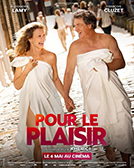
| With | Alexandra Lamy, François Cluzet, Mitty Hazanavicius, Reem Kherici, Delphine Baril, Camille Aumont Carnel, Kyan Khojandi, François-Xavier Demaison, Bowie Ricci |
| Runtime | 89 minutes |
| Release | Release date unknown |
| Rating | 6/10 |
What if we told you about the invention of the century? A couple, a truth that shatters everything. Fanny and Tom have been happily married for 20 years. But one day, a secret comes to light: Fanny has never had an orgasm. Tom, an engineer, decides to take on a daring challenge: to create the object that will revolutionize female pleasure. Together, they embark on this quest—as wild as it is moving—that will transform their relationship. How far will they go? Far, very far.
The review
By Mulder 2026-05-09
With Pour le plaisir, director and co-screenwriter Reem Kherici attempts something relatively rare in mainstream French comedy: addressing female pleasure head-on without resorting to either cheap vulgarity or overt activism. Loosely inspired by the true story of Michael Lenke and Brigitte Lenke, the creators of the famous Womanizer, the film transforms this German success story into a French marital chronicle centered on a couple married for twenty years who suddenly discover an intimate secret capable of upending their entire balance. On paper, the project was intriguing, particularly because it tackled a subject still surprisingly underrepresented in mainstream French cinema: the female orgasm within a stable, loving couple. And one must credit Reem Kherici with a certain boldness in her desire to tackle this theme with gentleness, humor, and modesty, where many would have opted for either heavy-handed provocation or a weighty psychological drama.
The film’s true driving force obviously lies in the duo formed by Alexandra Lamy and François Cluzet, two extremely popular figures in French cinema who are playing here on familiar ground. Alexandra Lamy brings that luminous spontaneity we’ve known her for over the years, with a sincere ability to make her character immediately endearing, while François Cluzet embodies a man whose ego has been wounded but who is never caricaturally macho. The film works best, in fact, when it focuses on this rather touching idea of a man who, after absorbing the shock of discovering he has never given his wife an orgasm, sincerely decides to understand and help rather than run away or hold a lasting grudge. There is something quite tender and even almost old-school about this way of portraying a couple in their fifties who continue to communicate, experiment, and try to save their connection. You get the sense that Reem Kherici wanted above all to tell a love story rather than a story about the sexual revolution, and that is probably what keeps the film from sinking into raunchy comedy.
Where Pour le plaisir becomes weaker is in its direction and, above all, in its writing. Despite a potentially explosive subject, the film remains constantly within an extremely well-defined comfort zone. Many situations seem written to elicit a polite smile rather than a genuine laugh, with a succession of gags revolving around sex toy prototypes, family misunderstandings, or awkward conversations that feel more like certain Sunday-night TV shows than the rhythm of a true cinematic comedy. This impression is reinforced by a very polished, extremely bright, almost sanitized visual style that sometimes strips the narrative—despite its focus on desire and pleasure—of any organic or sensual dimension. One understands the intention to maintain modesty, especially coming from a director who has explained that she grew up in a conservative environment, but this restraint sometimes ends up emotionally neutralizing the film rather than lending it elegance.
And yet, despite its obvious limitations, Pour le plaisir also possesses something quite endearing in its desire to normalize certain conversations that remain taboo. There are several scenes where the film hits the right note, particularly when it addresses the silence that can exist in some couples for decades regarding female pleasure, or the way some women pretend to satisfy their partner to protect his ego. Without becoming a didactic film, the feature quietly offers interesting reflections on sex education, on listening within a couple, and on the historical misunderstanding of the female body. A scene highlighting the fact that the clitoris was long absent from anatomical representations leaves a more lasting impression than certain gags that were supposedly meant to be the film’s comedic highlights. This is where we sense the potential of a subject that might have benefited from being handled with even greater subtlety or dramatic ambition.
What often saves the film from boredom is the actors’ sincere energy. Even when certain lines seem overly scripted or artificially lighthearted, Alexandra Lamy and François Cluzet give the impression of deeply believing in their relationship. Their chemistry works best in the quieter scenes, away from the comedic set-up. You almost sense two actors trying to bring emotional truth to a comedic structure that sometimes feels too contrived. Several viewers who saw the film at preview screenings have also highlighted this rather rare blend of accessible humor and intimate subject matter, and it’s true that the film at least succeeds in sparking a discussion. In an era when many French comedies seek above all to provoke or pile on punchlines, Pour le plaisir instead tries to defuse awkwardness with kindness. This is undoubtedly its greatest strength.
It remains difficult, however, to ignore that the film sorely lacks visual and narrative originality. On several occasions, one gets the sense of watching a daring subject constantly being reduced to an extremely safe, mainstream form. The secondary characters are often reduced to archetypes, some dialogue lacks naturalness, and the direction never truly finds the cinematic flair capable of transcending this story—despite it being inspired by a genuine industrial and societal revolution centered on female pleasure. It’s easy to imagine that a more incisive director could have drawn from this material either a biting satire on male-female relationships or a much more emotional marital chronicle. Reem Kherici, on the contrary, chooses the path of comfort and maximum accessibility, which makes the film enjoyable at times but rarely memorable.
What remains interesting, ultimately, is the film’s reception itself. During its preview tour, many viewers noted that they had never seen a mainstream French comedy address female pleasure so directly with such lightheartedness. And that is likely where the true significance of Pour le plaisir lies. Not in its total artistic success—which it never quite achieves—but in its ability to normalize certain discussions still shrouded in embarrassment or silence. The film doesn’t revolutionize either the French romantic comedy or cinema about sexuality, but it modestly contributes to shifting the public’s perspective on topics long considered uncomfortable.
Pour le plaisir resembles its own concept: a work full of good intentions, sincerely eager to do good, but which sometimes struggles to find the right rhythm and intensity to provoke a genuine emotional or comic impact. The film is enjoyable to watch thanks to its lead duo and its subject matter—rarely treated with such tenderness in mainstream French cinema—but it also leaves the impression of a potential that is only partially realized. A comedy that is endearing at times, even useful at times, but too tame to be truly memorable.
Pour le plaisir
Directed by Reem Kherici
Written by Reem Kherici, Gari Kikoïne, David Solal
Produced by Philippe Rousselet, Elsa Leeb, David Solal
Starring Alexandra Lamy, François Cluzet, Mitty Hazanavicius, Reem Kherici, Delphine Baril, Camille Aumont Carnel, Kyan Khojandi, François-Xavier Demaison, Bowie Ricci
Cinematography: Dominique Fausset
Edited by Samuel Danesi
Music by Laurent Aknin
Production companies: Vendôme Films, Baxtory, TF1 Group
Distributed by Studio TF1 (France)
Release dates: May 6, 2026 (France)
Running time: 89 minutes
Viewed on May 8, 2026 at Gaumont Disney Village, Theater 14, Seat A19