

Fuze
Directed by David Mackenzie (2026)
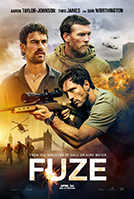
| With | Aaron Taylor-Johnson, Theo James, Gugu Mbatha-Raw, Sam Worthington |
| Runtime | 96 minutes |
| Release | 2026-04-24 |
| Rating | 7/10 |
The discovery of an unexploded World War II bomb at a London construction site triggers a massive evacuation—the perfect opportunity for a heist.
The review
By Mulder 2026-05-09
Fuze, directed by David Mackenzie, is the kind of understated, gritty thriller that seems tailor-made for an audience that still longs for those mid-budget action films once made for movie theaters rather than for algorithms. Its premise works right from the start: an unexploded World War II bomb is discovered beneath a London construction site, triggering a massive evacuation and requiring the intervention of Major Will Tranter, played by Aaron Taylor-Johnson, to assess and neutralize the threat. At the same time, Chief Inspector Zuzana, played by Gugu Mbatha-Raw, manages the police operation from a high-tech control room, while a gang of criminals led by Karalis, played by Theo James, and X, played by Sam Worthington, takes advantage of the deserted streets and the security cordon to carry out a carefully planned bank heist. It’s a delightfully simple idea on paper, almost old-school in its straightforwardness, and the best thing about *Fuze* is the way it confidently captures the thrill of watching professionals under pressure, whether they’re trying to save lives, steal diamonds, or survive the fallout of a plan that may have been doomed from the start.
The film’s opening is undoubtedly its strongest part, as director David Mackenzie knows how to turn the procedural into suspense. The bomb isn’t merely a plot device; it becomes a physical, almost mythical presence, a buried relic of history threatening to tear modern London apart. There is something quietly fascinating about the contrast between the bureaucratic efficiency of the evacuation, the military precision of the bomb squad, and the criminal opportunism unfolding underground. Aaron Taylor-Johnson imbues Major Will Tranter with a tense, focused intensity, suggesting a man who has spent too much time facing danger to waste words explaining himself. His stillness contrasts sharply with the film’s constant movement, and even when the script merely hints at his trauma or past, Aaron Taylor-Johnson manages to suggest more than the dialogue provides. The film is less interested in confession than in action, less in psychology than in function, which makes him seem less like a fully developed character than a dangerous tool used under the exact conditions for which he was designed.
This is where Fuze becomes more playful: in its refusal to remain a simple bomb-defusing thriller. Ben Hopkins’ screenplay constantly shifts form, moving from a civic emergency to a heist film, from a heist film to a betrayal thriller, and finally heading toward something more akin to a moral conundrum about loyalty, trust, and the question of who can be considered a hero when everyone has blood on their hands. This constant transformation is both the film’s strength and its weakness. On the one hand, the narrative rarely allows the viewer to settle in comfortably enough to anticipate each twist; on the other, the film sometimes moves so quickly from one twist to the next that the emotional impact of these reversals is diminished. It’s entertaining to be caught off guard, but it’s more satisfying when the people at the heart of the machine matter as much as the machine itself. Here, the plot is often sharper than the characterization, and one sometimes gets the impression that director David Mackenzie and screenwriter Ben Hopkins are more enthusiastic about the architecture of the heist than its human cost.
The cast goes a long way toward keeping the film engaging, even when the characters remain sketchily drawn. Gugu Mbatha-Raw brings intelligence and authority to the role of Chief Inspector Zuzana, though the part too often confines her to shots of screens, orders, and reaction shots, whereas the film would have benefited from giving her more initiative amid the unfolding chaos. Theo James is one of the film’s most dynamic assets in the role of Karalis, bringing an elusive and slightly arrogant energy to a criminal who seems constantly to be recalculating the odds in his favor. Sam Worthington, as X, is more low-key and somewhat underutilized, but his austere physical presence lends the criminal side of the story a raw force that contrasts nicely with Theo James’s sharper opportunism. Elham Ehsas also plays an important role as Rahim, whose family’s relocation during the evacuation provides the film with one of its most grounded storylines, even if the script perhaps waits too long to fully reveal how it fits into the bigger picture.
What makes *Fuze* enjoyable is its craftsmanship. Director David Mackenzie has always been a master of stark visuals and tense environments, whether in *Starred Up*, *Hell or High Water*, or *Relay*, and here he proves once again that he knows how to create tension through geography, editing, and character behavior. The film shifts between the site of the explosion, the police command center, and the bank heist with a liveliness that keeps the story moving even as plausibility begins to stretch. Giles Nuttgens’ cinematography lends London a luminous, realistic clarity rather than a noir-style glamour, making the danger strangely visible rather than hidden. Tony Doogan’s score is more uneven, at times relying too heavily on generic electronic beats, but as the action intensifies, the sound design and pacing do create the distinct impression that multiple clocks are ticking simultaneously. There are moments when a drill, a safe, a traffic light, or the silence surrounding the bomb convey more tension than any line of dialogue could.
The problem is that Fuze is almost too effective for its own good. Running about ninety minutes, the film moves forward with admirable urgency, but one also gets the impression that an additional fifteen or twenty minutes could have deepened the stakes. Major Will Tranter’s potential trauma, Commissioner Zuzana’s authority under institutional pressure, Karalis’s motivations, X’s loyalty, and Rahim’s family history all contain enough material for a richer drama. Instead, the film prefers to save key revelations for late structural twists, including a finale that reframes earlier events but also risks feeling tacked-on. The coda is meant to serve as a final detonation—the moment when the audience realizes what the film was really about—but it also exposes the lack of emotional groundwork laid earlier. The twist may be clever, but cleverness doesn’t always equate to catharsis.
Nevertheless, it’s a real pleasure to see a film like Fuze: compact, confident, unpretentious, and convinced that genre cinema doesn’t have to apologize for wanting to entertain. It may not reach the emotional or thematic depth of Hell or High Water, where David Mackenzie fused crime, despair, and social critique with far greater elegance, but it possesses enough of that technical intelligence to remain captivating. The film is at its best when it embraces its pulp instincts: tough guys making bad choices, professionals trying to control uncontrollable situations, loyalties cracking under pressure, and a city momentarily emptied of its inhabitants so that buried stories and plots can rise to the surface. It’s not a great thriller, and it’s certainly not the major work David Mackenzie has proven capable of, but it’s an incisive, watchable, and at times exhilarating exercise in genre.
Fuze ultimately feels like a film with a formidable fuse, a powerful spark, and a slightly uneven explosion. Its first act promises something truly special, its middle section offers a satisfying tangle of complications, and its ending both intrigues and frustrates by attempting to retroactively add emotional weight to a story that has largely treated its characters as pawns on a chessboard. Yet, as a professional, fast-paced crime thriller, it mostly works. Aaron Taylor-Johnson, Gugu Mbatha-Raw, Theo James, Sam Worthington, and Elham Ehsas lend the film enough presence to compensate for some of its narrative shortcuts, while David Mackenzie maintains the tension at a level high enough to make the journey worthwhile.
Fuze
Directed by David Mackenzie
Written by Ben Hopkins
Produced by Sebastien Raybaud, Callum Christopher Grant, David Mackenzie, Gillian Berrie
Starring Aaron Taylor-Johnson, Theo James, Gugu Mbatha-Raw, Sam Worthington
Cinematography: Giles Nuttgens
Edited by Matt Mayer
Music by Tony Doogan
Production companies: Anton, Sigma Films
Distributed by Saban Films, Roadside Attractions (United States), SND (France)
Release dates: September 5, 2025 (TIFF), April 24, 2026 (United States), May 6, 2026 (France)
Running time: 96 minutes
Viewed on May 8, 2026 at Gaumont Disney Village, Theater 7, Seat C19