

Mortal Kombat II
Directed by Simon McQuoid (2026)
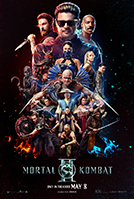
| With | Karl Urban, Adeline Rudolph, Jessica McNamee, Josh Lawson, Ludi Lin, Mehcad Brooks, Tati Gabrielle, Lewis Tan, Damon Herriman, Chin Han, Tadanobu Asano, Joe Taslim, Hiroyuki Sanada |
| Runtime | 116 minutes |
| Release | 2026-05-08 |
| Rating | 7/10 |
The fan-favorite champions—now joined by Johnny Cage himself—face off in an ultimate, no-holds-barred tournament to try to overthrow the reign of Shao Kahn, a tyrant who threatens the very existence of Earthrealm and its inhabitants.
The review
By Mulder 2026-05-06
There is something almost ritualistic about Mortal Kombat: even before it became a film franchise, it was that arcade machine that drew players into the dark corners of hotels, shopping malls, and arcades, demanding coins, reflexes, and a somewhat unhealthy fascination with forbidden violence. Anyone who grew up learning secret button combinations from older players will understand why this saga still holds such a special place in pop culture. The first Mortal Kombat reboot in 2021, directed by Simon McQuoid, got the iconography right but faltered when it came to the very promise of its own title, offering fatalities, familiar warriors, and splatters of blood, while somehow pushing the tournament itself to the sidelines. Mortal Kombat II arrives almost like an apology written in blood on the screen: this time, the tournament is definitely here, the fights come one after another at a breakneck pace, the tone is lighter, and the film no longer pretends that the audience came for a delicate mythology or a Shakespearean tragedy. It knows that people want warriors, kingdoms, over-the-top dialogue, smashing impacts, and the glorious absurdity of hearing “Finish Him!” echo in the collective memory of several generations of gamers.
Jeremy Slater’s screenplay picks up with the champions of Earthrealm preparing for the battle that should have defined the previous film, while the tyrannical ruler of Outworld, Shao Kahn—portrayed with imposing physical menace by Martyn Ford—threatens to tip the balance of power through conquest, sorcery, and a handy cosmic amulet. Among the returning fighters are Lewis Tan as Cole Young, now wisely sidelined from the spotlight after the first film’s clumsy attempt to make him the audience’s gateway into this universe; Ludi Lin as Liu Kang; Jessica McNamee as Sonya Blade; Mehcad Brooks as Jax Briggs, and Tadanobu Asano as Lord Raiden. Alongside them, the sequel introduces two characters who immediately give the film a more assertive personality: Karl Urban as Johnny Cage, the fading action star whose ego, insecurity, and sarcastic disbelief provide a much-needed touch of levity, and Adeline Rudolph as Kitana, whose tragic connection to Outworld brings the film what comes closest to emotional gravity. The result remains chaotic, over-the-top, and at times breathless, but it’s also much closer to what a Mortal Kombat movie should be.
The great pleasure of Mortal Kombat II lies in the way it openly embraces fan service without seeming the least bit embarrassed about it. Johnny Cage is treated less as a traditional hero and more as a living bridge between the audience and the madness on screen—a Hollywood tough guy on the decline clearly inspired by the old myth surrounding Jean-Claude Van Damme, plunged into a universe of gods, demons, revenants, assassins, and monsters. Karl Urban embodies him with just the right amount of self-deprecation to keep the character from becoming unbearable, even if the film sometimes uses him more as a comic relief than as the true protagonist promised by the marketing campaign. The biggest surprise is that Kitana becomes the emotional backbone of the film, with Adeline Rudolph bringing elegance, anger, and vulnerability to a role that could easily have been reduced to a costume, weapons, and a mythological universe. Her conflict with Shao Kahn, her connection to Sindel, played by Ana Thu Nguyen, and her complex relationship with Jade, played by Tati Gabrielle, give the film a more powerful tragic dimension than expected, even when the script rushes through these elements to move on to the next fight.
This is also where the film reveals its greatest contradiction: Mortal Kombat II finally gives fans the tournament they’ve been waiting for, but it constantly interrupts it with too many side quests, resurrections, political intrigues, and detours aimed at expanding the franchise’s universe. The mythology created by Ed Boon and John Tobia has always been gloriously over-the-top, but cinema demands a sense of pacing, coherence, and focus that the film only partially manages to maintain. The presence of Quan Chi, played by Damon Herriman, allows for the return of dead characters such as Kano, once again portrayed by Josh Lawson, and while this is undeniably entertaining—since Josh Lawson remains one of the film’s most reliable comic assets—it also weakens the impact of death in a saga entirely built around deadly combat. When anyone can come back thanks to necromancy, Netherrealm magic, or the logic of the sequel, fatalities become spectacular punctuation marks rather than dramatic events. It’s great for the applause, less great for the stakes.
Visually, the film is at its best when Simon McQuoid lets the fights breathe. There are arenas and sets clearly designed to evoke immediate recognition among players, including images of temples, the energy of acid pits, and side-scrolling compositions that mimic the two-dimensional brutality of the original game. Some fights have real personality, particularly those involving Johnny Cage, Kitana, Liu Kang, Baraka (played by CJ Bloomfield), and Shao Kahn, whose hammer blows give the film a welcome sense of weight. Yet the action isn’t always as precise as it should be. The choreography is more inventive than in the previous film, but it sometimes lacks the crisp martial rhythm of Paul W. S. Anderson’s 1995 Mortal Kombat, a film that featured far less blood but often more physical clarity. The heavy reliance on digital blood also remains an issue: CGI blood sprays may embellish an impact, but they rarely let the viewer feel it. For a franchise obsessed with broken, torn, and dismembered bodies, the tactile quality of the violence matters more than the quantity of red pixels.
It would be dishonest, however, to deny the film’s effectiveness as mainstream entertainment. Mortal Kombat II isn’t a sophisticated blockbuster, but it’s often enjoyable to watch, especially with the right audience. It has the energy of a fan screening where people expect iconic moves, absurd dialogue, and extravagant finishing moves more than carefully crafted narrative arcs. The cameo nods, familiar faces, famous attacks, grotesque weapons, and in-jokes speak directly to gamers who have spent years memorizing fatalities and debating their favorite fighters. There’s even a certain honesty in the film’s no-frills structure: people fight, someone explains why they have to fight, then they fight again. In another franchise, this would come across as laziness. Here, it almost seems intentional. The problem is that the film sometimes confuses nostalgia with storytelling, as if showing something familiar were enough to make it significant.
Compared to the 2021 reboot, however, this sequel is undeniably a step forward. It sets aside the least compelling element of the previous film, restores the tournament structure, gives the saga a stronger sense of entertainment, and introduces characters who seem truly essential to the identity of Mortal Kombat. Karl Urban may not always perfectly match the classic image of Johnny Cage, but he brings confidence and comic tension to the film. Adeline Rudolph is even more important: she brings grace and intensity to Kitana and proves that this universe can convey emotion when the script allows it. Martyn Ford makes Shao Kahn a brutal and imposing antagonist, while Josh Lawson once again steals the show whenever Kano is allowed to infect the room with his vulgar charm. The film remains too cluttered, too focused on exposition, and too reliant on the mechanics of future sequels, but it is also more grandiose, bloodier, funnier, and more confident than its predecessor.
Mortal Kombat II is therefore not a flawless victory, but it is finally a recognizable victory for the franchise on screen. It remains stuck between adaptation and cinema, between giving fans exactly what they want and daring to become something more than a high-end live-action cutscene. Yet, despite its muddled narrative, uneven effects, and chaotic structure, it delivers the essential thrills: brutal fights, a genuine mythology, iconic characters, fatalities that delight the audience, and just enough self-deprecation to keep the experience from collapsing under the weight of its own tradition. As a film, it is limited; as a Mortal Kombat experience, it is often exactly what it needed to be
Mortal Kombat II
Directed by Simon McQuoid
Written by Jeremy Slater
Based on Mortal Kombat by Ed Boon, John Tobias
Produced by Todd Garner, James Wan, Toby Emmerich, E. Bennett Walsh, Simon McQuoid
Starring Karl Urban, Adeline Rudolph, Jessica McNamee, Josh Lawson, Ludi Lin, Mehcad Brooks, Tati Gabrielle, Lewis Tan, Damon Herriman, Chin Han, Tadanobu Asano, Joe Taslim, Hiroyuki Sanada
Cinematography: Stephen F. Windon
Edited by Stuart Levy
Music by Benjamin Wallfisch
Production companies: New Line Cinema, Atomic Monster, Broken Road Productions, Fireside Films
Distributed by Warner Bros. Pictures
Release dates: April 27, 2026 (TCL Chinese Theater), May 6, 2026 (France), May 8, 2026 (United States)
Running time: 116 minutes
Viewed on May 6, 2026 at Gaumont Disney Village, Theater 11, IMAX seat E19