

Tuner
Directed by Daniel Roher (2026)
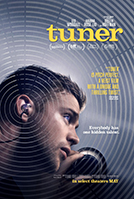
| With | Leo Woodall, Havana Rose Liu, Lior Raz, Tovah Feldshuh, Jean Reno et Dustin Hoffman |
| Runtime | 107 minutes |
| Release | 2026-05-22 |
| Rating | 8/10 |
Blessed with exceptional hearing, a young piano tuner sees his life turned upside down when his talent catches the attention of criminals who drag him into a series of increasingly risky burglaries. Against his will, he becomes entangled in a dangerous spiral that could cost him far more than his freedom.
The review
By Mulder 2026-04-29
There is something quietly disarming about the film Tuner, the kind of movie that takes you by surprise with a deceptively simple premise before revealing itself to be a surprisingly complex character study, cloaked in the conventions of the crime thriller. For his feature film debut, Daniel Roher seeks not so much to reinvent the genre as to revisit it with an extraordinary sensitivity to rhythm, tone, and, above all, sound. The story of Niki White, portrayed with remarkable restraint and magnetism by Leo Woodall, revolves around a contradiction that becomes the beating heart of the film: a man whose greatest limitation (hyperacusis, an extreme sensitivity to sound) becomes his most dangerous asset. What begins as a quiet portrait of a piano tuner navigating the noise of New York gradually transforms into something far more unstable, where every faint click of a safe mechanism feels as charged as a ticking time bomb.
The film’s opening sequences are arguably its most charming, drawing on a kind of lived intimacy reminiscent of classic character-driven dramas. Niki’s relationship with his mentor Harry Horowitz, portrayed with warmth and natural charisma by Dustin Hoffman, gives the film an emotional anchor that resonates long after Hoffman exits the scene. Their dynamic part mentorship, part surrogate father-son bond is filled with small, human moments: the banter in the van between missions, shared meals, and a mutual understanding rooted not in words but in a shared reverence for music. One gets the sense that these scenes could stand entirely on their own, almost as a film in their own right, while remaining captivating. This is also where Tuner feels most authentic, capturing the little-known art of piano tuning with a surprising reverence that elevates the profession beyond a mere narrative device.
What makes Niki so compelling as a protagonist is precisely his contradiction. Leo Woodall portrays him as a man caught between two worlds: withdrawn yet competent, emotionally reserved yet deeply empathetic. There is an almost painful stillness in his performance, as if every sound he hears resonates within him before he allows himself to react. This stillness becomes crucial as soon as the film introduces its central plot twist: the discovery that his hyper-refined hearing can be used to pick locks. It’s a concept that could easily feel gimmicky, but the film Tuner anchors it in physicality and tension, transforming every lock-picking sequence into a kind of perverse musical performance. The clinks and slides of metal pins become the notes of a composition that only Niki can interpret, and in these moments, the film finds a unique cinematic language where sound design becomes storytelling.
The transition into the world of crime is handled with a deliberate, almost nonchalant inevitability. Enter Uri, played with a disarming mix of charm and menace by Lior Raz, who embodies the film’s moral gray area. Uri is not a caricatured villain; he acts according to a twisted logic that lends his actions a disturbing rationality, making Niki’s descent feel less like a fall and more like a slow drift. What is particularly effective is the way Tuner presents this shift not as a sudden moral collapse, but as a series of small compromises, each justified by necessity foremost among them Harry’s mounting medical bills. It is through these choices that the film quietly explores a familiar yet powerful idea: just how easily good intentions can pave the way for irreversible consequences.
Running parallel to this darker trajectory is the film’s romantic thread, embodied by Havana Rose Liu as Ruthie, a gifted composition student who represents both what Niki has lost and what he might still regain. Their relationship is one of the film’s most delicate balances, blending tenderness with underlying tension as Niki’s double life inevitably begins to intrude on their bond. Liu brings a grounded sincerity to the character of Ruthie, avoiding the trap of reducing her to a mere narrative function, even if the screenplay occasionally relies on familiar romantic clichés. Together, their scenes offer a necessary counterpoint to the film’s escalating stakes, reminding us that at its core, Tuner is as much about desire and identity as it is about crime.
Technically, the film is at its peak when it fully embraces its sonic perspective. The sound design, arguably the film’s most distinctive element, does not merely accompany the narrative; it immerses the audience in Niki’s subjective experience. Moments of deafening noise starkly contrast with near-total silence, creating a sensory back-and-forth that mirrors her inner state. Combined with Will Bates’s jazz-infused score, the result is a film whose use of sound feels almost tactile, where every auditory shift carries emotional weight. It’s a bold choice that pays off, particularly in the heist sequences, where tension is built less through action than through what we hear—or don’t hear.
That said, Tuner isn’t without its missteps. As the narrative moves toward its third act, the film begins to rely more heavily on familiar genre conventions, introducing coincidences and plot devices that slightly undermine the organic flow established earlier. The shift in tone toward a more conventional thriller, while effective at raising the stakes, sometimes clashes with the nuanced character work that defines the first two-thirds. This is where the film seems most torn, caught between its desire to offer a momentum that appeals to a mainstream audience and its more introspective ambitions. Yet even in these moments, the strength of the performances particularly Leo Woodall’s prevents the film from losing its footing entirely.
What ultimately elevates Tuner above the predictability of its narrative is its sincerity. There is an undeniable affection for its characters and their struggles, a sense that Daniel Roher is less interested in the mechanics of the heist than in the emotional resonance of the choices that lead to it. The film may follow a familiar path, but it travels it with enough style, heart, and technical finesse to make the journey worthwhile. It may not be a symphony, but it’s far from mere background noise: it’s a carefully composed work that knows when to amplify and when to pull back.
Tuner
Directed by Daniel Roher
Written by Daniel Roher, Robert Ramsey
Produced by JoAnne Sellar, Lila Yacoub, Teddy Schwarzman, Michael Heimler
Starring Leo Woodall, Havana Rose Liu, Lior Raz, Tovah Feldshuh, Jean Reno, Dustin Hoffman
Cinematography: Lowell A. Meyer
Edited by Greg O'Bryant
Music by Will Bates
Production companies: Black Bear Pictures, Elevation Pictures, English Breakfast Productions
Distributed by Black Bear Pictures (United States), Metropolitan FilmExport (France)
Release dates: August 30, 2025 (Telluride), May 22, 2026 (United States), May 27, 2026 (France)
Running time: 107 minutes
Viewed on April 29, 2026, at the Metropolitan FilmExport theater