

The Devil Wears Prada 2
Directed by David Frankel (2026)
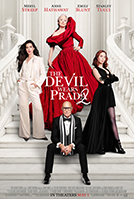
| With | Meryl Streep, Anne Hathaway, Emily Blunt, Justin Theroux, Kenneth Branagh, Stanley Tucci |
| Runtime | 119 minutes |
| Release | 2026-05-01 |
| Rating | 10/10 |
Miranda, Andy, Emily, and Nigel return to the ruthless and glamorous world of Runway magazine and the streets of New York, where elegance is a formidable weapon.
The reviews
By Mulder 2026-04-29
Twenty years after the first film became a pop culture phenomenon almost by accident before evolving into a timeless classic, The Devil Wears Prada 2 achieves something rarer than nostalgia: it justifies its own existence. Rather than merely lazily dusting off old cult lines and iconic looks, director David Frankel and screenwriter Aline Brosh McKenna understand that time itself must be the true subject of this sequel. The world that once crowned glossy magazines as arbiters of good taste has fractured into algorithms, vanity metrics, and fleeting trends. This shift lends this return to the catwalks a genuine dramatic dimension. What was once a sparkling comedy about ambition has now become a more incisive portrait of relevance, legacy, and survival in industries that reinvent themselves every quarter. The result is elegant, intelligent, and memorable entertainment that remembers why audiences fell in love with it the first time, while refusing to settle for mere imitation.
At the center stands Meryl Streep, once again perfect in the role of Miranda Priestly. She doesn’t merely reprise the role; she deepens it. Her larger-than-life character is still terrifyingly precise, still capable of freezing a room with a pause rather than a shout, but age has introduced more subtle cracks in the marble. The film skillfully places her at the pinnacle of power just as the ground is shifting beneath her feet, and Streep exploits this contradiction to perfection. A particularly revealing detail is that her original wig was reportedly reworked to have less volume and a sleeker shape—a visual metaphor for a woman shedding her softness to remain formidable. This is exactly the kind of costume psychology this film understands. Miranda remains a tyrant of taste, but she is now confronted with obsolescence, and Meryl Streep embodies this inner conflict with magnificent control.
While Miranda embodies mythology, Anne Hathaway brings emotional intelligence, and once again her natural grace fills the screen. Andy Sachs returns older, more composed, and no longer dazzled by proximity to power. Anne Hathaway intelligently resists the temptation to make Andy cynical; on the contrary, she imbues her with hard-won confidence. The screenplay acknowledges that adulthood is not simply a matter of success and time, but the accumulation of compromises. Andy’s new orbit around Miranda bears the traces of unfinished business, and Anne Hathaway excels at portraying someone who has matured while remaining vulnerable to the old gravitational forces. Her chemistry with Meryl Streep remains exquisite because it relies less on confrontation than on recognition. They understand each other now, perhaps more than either would care to admit, and every scene between them resonates with history.
The film’s secret weapon, however, might well be Emily Blunt. Elevated from mistreated assistant to influential figure, Emily Charlton’s character becomes the most delightful evolution in this sequel. Emily Blunt embodies her with the same sense of biting irony as before, but her sarcasm now hides a strategy. She knows how institutions work, having survived one herself. Every time she enters the scene, the film picks up speed, becoming more caustic and funnier. Stanley Tucci, for his part, slips back into the role of Nigel Kipling with natural grace, bringing warmth and wit to the film without ever falling into sentimentality. His presence reminds us that style, in this universe, has never been solely about clothing; it was also about discernment, loyalty, and chosen family. The returning quartet feels less like a reunion gimmick and more like artists picking up where they left off.
What truly elevates this sequel is its updated satire of media culture. In 2006, prestige came through magazine covers and editorial control. In 2026, authority is diffuse, performative, and constantly monetized. The screenplay brilliantly exploits this evolution, showing how modern industries champion disruption while yearning for the legitimacy of yesteryear. Some journalists might cringe at recognizing themselves, and rightly so: the film includes layoffs, brand repositioning, hollow corporate jargon, and the strange requirement that every profession must now stage itself online. Yet it never lapses into moralizing. It wraps anxiety in haute couture and a zany rhythm, which is exactly the right approach. The original lambasted fashion snobbery; this sequel broadens the target to an entire economy based on appearance.
Visually, the production is sumptuous without excess. Costume designer Molly Rogers approaches the wardrobe not as a parade of brands, but as an architecture of the characters. Andy’s mature aesthetic,
women’s wear, Miranda’s disciplined uniforms, and Emily’s bolder silhouettes all tell a story. The sequences in Milan are particularly enchanting—so much so that Anne Hathaway came just to watch Meryl Streep film at the Galleria, as she considered it one of the most beautiful shots in the production. This admiration shines through on screen. These scenes possess the grandeur, elegance, and confidence of old Hollywood, without ever losing sight of the people behind the costumes. Even the soundtrack, blending familiar pop references with more recent touches—including a contribution and appearance by Lady Gaga—gives the film a rhythm that feels contemporary rather than desperate.
What is most surprising is the film’s tenderness. Beneath the barbs and fabulous fabrics lies a story about professional identity in one’s forties: who are you when what defined you begins to fade? This question affects Miranda, Andy, Nigel, and Emily in different ways. The screenplay suggests repeatedly that reinvention is glamorous in theory and brutal in practice. It also understands that competence can be seductive, that toxic work environments often masquerade as meritocracies, and that some relationships survive because they’re too complicated to end cleanly. These reflections give the comedy an unexpected resonance.
The Devil Wears Prada 2 isn’t better than the original, and it doesn’t need to be. It is wiser, more mature, and more incisive in some respects, and impressively honest about the impact of time on people and institutions. Rare are the sequels to cult films that return with such style, wit, and substance. It delivers mainstream entertainment while authentically addressing aging, ambition, and relevance in the modern world. Miranda may still wear Prada, but now she also carries history.
The Devil Wears Prada 2
Directed by David Frankel
Written by Aline Brosh McKenna
Based on Characters by Lauren Weisberger
Produced by Wendy Finerman
Starring Meryl Streep, Anne Hathaway, Emily Blunt, Justin Theroux, Kenneth Branagh, Stanley Tucci
Cinematography: Florian Ballhaus
Edited by Andrew Marcus
Music by Theodore Shapiro
Production company: Wendy Finerman Productions
Distributed by 20th Century Studios
Release dates: April 20, 2026 (Lincoln Center, Manhattan), April 28, 2026 (France), May 1, 2026 (United States)
Running time: 119 minutes
Viewed on April 27, 2026 at Publicis Cinemas, Theater 1
By Cookie 2026-04-29
It is with a mix of interest and curiosity that we discover, twenty years later, the sequel to *The Devil Wears Prada*. What can we expect? It’s not always easy for a sequel to live up to the original or match its spirit.
In this installment, we rediscover the excitement of the world of fashion, elegance, luxury, and intrigue.
The characters have evolved over time, particularly Andy Sachs, played by Anne Hathaway, who has gained confidence while retaining her innocence and noble spirit. By a twist of fate, she finds herself once again having to work closely with her former boss, Miranda Priestly, editor-in-chief of Runway magazine, played with ease by Meryl Streep. This is no easy task, as Miranda is cold and unapproachable, with a sharp tongue. Now in the role of editorial director, Andy patiently hopes to influence and change Miranda’s fiery temperament.
Stanley Tucci, in the role of Nigel, is as impeccable as ever as the assistant, indispensable for defusing tensions, though his calm and professionalism are often put to the test. As for Emily, played by Emily Blunt, she is exquisite in her role as the schemer. In this more aggressive sequel, closer to reality, director David Frankel’s vision highlights the media’s drift away from ethical journalism, the dictates of revenue, the demands of advertisers, and the profound changes brought about within the newspaper’s organization and editorial department. The twists and intrigues multiply, and the tension and suspense never let up throughout the film.
The music is omnipresent and perfectly harmonious, dynamic, particularly when it accompanies Andy’s steps through the streets of New York, and during parties and fashion shows. The direction is meticulous and impeccable, featuring sumptuous sets, the beauty of haute couture garments, and magnificent Italian landscapes. There is no shortage of moments of relaxation and laughter despite the dark situations, bringing a sense of lightness. We can’t help but smile when Miranda goes to her company’s cafeteria for a business meeting but doesn’t know where it is in the building—a place she’s obviously unfamiliar with given her status and standing.
We can say that this sequel is a success; viewers will rediscover the glamour of fashion and the sense of escape with pleasure and enthusiasm. The casting is excellent; it was a wise choice to bring back the same actors and actresses. The twenty years seem to have flown by and haven’t left a single wrinkle. The film’s runtime is satisfying—there’s no downtime—and we might even find ourselves thinking about and imagining a sequel soon, given how close we feel to these endearing characters. Without a doubt, The Devil Wears Prada 2 is an entertaining and devilishly effective film.
The Devil Wears Prada 2
Directed by David Frankel
Written by Aline Brosh McKenna
Based on Characters by Lauren Weisberger
Produced by Wendy Finerman
Starring Meryl Streep, Anne Hathaway, Emily Blunt, Justin Theroux, Kenneth Branagh, Stanley Tucci
Cinematography: Florian Ballhaus
Edited by Andrew Marcus
Music by Theodore Shapiro
Production company: Wendy Finerman Productions
Distributed by 20th Century Studios (United States), The Walt Disney Company France (France)
Release dates: April 20, 2026 (Lincoln Center, Manhattan), April 28, 2026 (France), May 1, 2026 (United States)
Running time: 119 minutes
Viewed on April 27, 2026 at Publicis Cinemas, Theater 1