

Michael
Directed by Antoine Fuqua (2026)
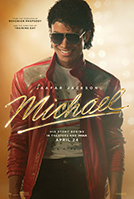
| With | Jaafar Jackson, Nia Long, Laura Harrier, Juliano Krue Valdi, Miles Teller, Colman Domingo |
| Runtime | 127 minutes |
| Release | 2026-04-24 |
| Rating | 9/10 |
Michael paints a cinematic portrait of the life of one of the most influential artists of our time. The film tells the story of Michael Jackson beyond his music, from the discovery of his extraordinary talent as the leader of the Jackson 5 to his evolution into a visionary artist whose creative ambition fueled a relentless quest to become the world’s greatest performer. Highlighting his life offstage and his most iconic performances from his early solo career, the film offers audiences a front-row seat to discover Michael Jackson like never before. This is where his story begins.
The reviews
By Mulder 2026-04-22
“Michael” isn't just another biopic churned out by a major studio, but an attempt to bring to life one of the most mythologized figures of the modern era. Few artists have left such an indelible mark on global culture as Michael Jackson: a child prodigy, a chart-topping innovator, a fashion icon, a tabloid obsession, and a figure of equal parts devotion and controversy. Director Antoine Fuqua and screenwriter John Logan wisely realized that a single film could not contain all of this; this first chapter therefore focuses on his rise from the steel town of Gary, Indiana, to the imperial heights of the Bad era. The result is an undeniably captivating film, lavishly staged and emotionally accessible, which often thrills the viewer in the moment, even if it hesitates whenever deeper complexity comes knocking at the door. It is a portrait more concerned with preserving the feeling than dissecting the contradiction, yet the narrative nonetheless demonstrates considerable skill and sensitivity.
Jaafar Jackson’s performance could easily have descended into imitation but instead becomes something more nuanced. He possesses the soft voice, the delicate posture, the measured gestures, but what is most impressive is the way he conveys the dual identity at the heart of Michael Jackson’s public image: a shy, almost childlike reserve in private life, then a volcanic magnetism as soon as the music begins. In the rehearsal rooms, he seems withdrawn and cautious, speaking as if trying not to disturb the atmosphere around him; on stage, his body suddenly tenses, his eyes blaze, and the room belongs to him. It’s a transformation difficult to make believable because the audience knows the original so intimately, but Jaafar Jackson pulls it off time and again. Equally remarkable is Juliano Valdi, who embodies the young Michael with a blend of innocence and burden that lends the early scenes genuine emotional intensity. In his eyes, we can already glimpse a child learning that talent can be both a gift and a curse.
While many musical biopics rely on editing as a shortcut, Michael often transforms the musical reenactment into a dramatic language in its own right. The Jackson 5’s breakthrough, the moonwalk at Motown 25, the rise of Off the Wall, the Thriller phenomenon—the result of precision engineering—and the closing spectacle of the Bad era are staged with enough energy to remind viewers why this artist once seemed less like a celebrity than a force of nature. In several sequences, the film skillfully recreates the sensation of collective wonder: the trembling security barriers, the tearful fans, the jostling cameramen, strangers moving in unison to the beat of the music. There is a particularly effective moment where a quiet backstage corridor erupts into deafening hysteria the moment he appears, illustrating more clearly than any dialogue the pressure of becoming a global icon. Even skeptics of the genre might find themselves smiling despite their resistance. The songs still work, the moves still captivate, and the film knows when to let that truth speak for itself.
Yet the screenplay repeatedly prioritizes accessibility over depth. John Logan structures the drama around the conflict with Joe Jackson, and Colman Domingo imbues the patriarch with strength, menace, and, at times, flashes of wounded pride. He is convincing as the architect of discipline who confuses fear with love and control with protection. However, the writing often reduces him to a mere central obstacle rather than a fully explored man, shaped by poverty, ambition, and generational wounds. This same simplification affects the entire family. Nia Long brings grace and serenity to the role of Katherine Jackson, but she is given too few memorable scenes. The brothers parade across the screen like satellites of Michael’s rise. Key creative collaborators appear, make their contributions, and then disappear. The world surrounding the star is constantly present but rarely inhabited. For a story rooted in family dynamics and artistic partnership, too many relationships remain sketchy.
The film also hints at psychological depth without fully committing to it. We see the obsession with Peter Pan, the nostalgia for childhood preserved in toys and animals, the sensitivity to criticism about appearance, the inability to establish ordinary trust. These are not insignificant details; they are potential avenues for understanding a person who has spent her adulthood rebuilding what fame stole from her childhood. But each thread is briefly introduced before the narrative rushes toward the next iconic event. A consultation for a rhinoplasty, a solitary evening with exotic animals, a moment of silent unease in a crowded mansion. Each of these elements hints at a drama richer than the one the film is willing to explore. We come away with the sense that Michael understands these wounds existed, but fears that dwelling on them might disrupt the celebratory tone he has chosen to maintain.
To its credit, the production quality rarely falters. The costumes, makeup, and sets meticulously recreate decades of pop-cultural memory without too often veering into parody. The sound design is powerful, particularly in the theater settings where bass lines and screams create an atmosphere akin to that of a concert. Antoine Fuqua directs with professionalism and energy, but not always with the stylistic boldness required for a subject whose artistic genius revolutionized the grammar of music videos and live performances. Some dance scenes are cut too abruptly when they should be allowed to stretch out and let the movement speak for itself. Some confrontations are staged effectively, whereas they should feel dangerous or intimate. The film is beautiful throughout, but only occasionally transcendent.
What ultimately makes the film Michael a success is not that it reveals everything, but that it reminds the audience of what made this phenomenon impossible to ignore. It may soften the edges, compress the truths, and avoid some of the most difficult terrain, but it nonetheless captures the strange loneliness of being worshipped, the brutal cost of a childhood turned into a commodity, and the unmatched electric energy of an artist capable of stopping the world when he steps onto the stage. This isn’t the final word on Michael Jackson, and the film doesn’t claim to be one if you look closely. It’s a polished, emotionally accessible, and mainstream first movement of a far more chaotic symphony. Thanks in large part to Jaafar Jackson’s surprisingly masterful performance, the film rises above clichés more often than it falls into them.
Michael
Directed by Antoine Fuqua
Written by John Logan
Produced by Graham King, John Branca, John McClain
Starring Jaafar Jackson, Nia Long, Laura Harrier, Juliano Krue Valdi, Miles Teller, Colman Domingo
Cinematography : Dion Beebe
Edited by John Ottman, Harry Yoon
Music by Lior Rosner
Production companies : Lionsgate Films, GK Films
Distributed by Lionsgate Films (United States) Universal Pictures International France (France)
Release dates : April 10, 2026 (Berlin), April 22, 2026 (France), April 24, 2026 (United States)
Running time : 127 minutes
Seen on April 22, 2026, at Gaumont Disney Village, IMAX Theater, Seat F18
By Sabine 2026-04-21
Michael is a skillfully crafted biopic, centered on his rise to fame, stringing together hit after hit, to introduce his music to a new generation and to relive the best decades, from the 70s to the 90s, for older generations like myself. As expected, the power of the songs sweeps everything away, including the narrative.
Following Michael Jackson The Musical's success of, this biopic is coming to the big screen. It was conceived by John Branca, the singer's former lawyer and executor. Co-producer Graham King knows the job, having produced Ali with Will Smith, Scorsese's The Aviator about Howard Hughes, and Bohemian Rhapsody about Freddie Mercury. Graham King enlisted John Logan, the screenwriter of The Aviator, to write the screenplay. Logan wisely focuses on the most pivotal years. He recounts the metamorphosis of a hypersensitive little boy into a complete artist who writes, composes, sings, and dances, and then into an international star. He begins with the Jackson 5's early days in 1967, when they started performing from their hometown of Gary, Indiana. He traces the emancipation of a son, and an artist.
The film is structured around the songs. Each song, each performance, aims to show Michael progressing on his own path. Between these musical and theatrical moments, the intimate narrative focuses on the relationship between Michael Jackson and his father, who physically and psychologically abused him. Throughout the film, contextual elements are provided to the viewer, subtly, sometimes too subtly. Relational difficulties, loneliness, and his refuge in cinema are alluded to, but the suffering is glossed over. Sexuality is never talked about. The film delivers a positive and joyful narrative about the life of an artist whose motto was to always aim higher. And the power of the songs overwhelms the story. The film ends with the album Bad, featuring the legendary 1988 Wembley concert, before the move to Neverland and the sexual abuse accusations. Musically, the period covers the Jackson 5 and the solo albums Off The Wall, Thriller, Bad, produced by Quincy Jones, one of the greatest music producers of the 20th century.
The film's strength lies in the enduring power of its songs and the breathtaking performance of Jaafar Jackson, son of Jermaine, Michael's nephew. He is believable both in his acting and in the choreography. It was a true challenge that required two years of training, as Michael Jackson was an extraordinary dancer with unique moves like the Moonwalk, his twisting turns, and his defiance of gravity as he danced on his toes. Juliano Valdi is equally convincing as the young Michael. "The more successful the villain, the more successful the film," Hitchcock famously said. This is certainly true of this biopic, thanks to Colman Domingo's portrayal of Joseph, Michael's violent, manipulative, and complex father. While the mother, bodyguard, and lawyer John Branca are present, the brothers have only minor roles, and Janet Jackson does not appear in the film. As a reminder, the family consisted of nine children: Rebbie, Jackie, Tito, Jermaine, La Toya, Marlon, Michael, Randy, and Janet. Only Michael and Janet had true solo careers.
Director Antoine Fuqua (Training Day, The Equalizer) places the viewer right next to the artist, in the best seat at a concert, to showcase just how extraordinary a showman Michael Jackson was. The sound quality is captivating. It works perfectly. Michael Jackson revolutionized the music video concept by creating veritable short films. The film incorporates footage from iconic videos like "Beat It" and "Thriller." The recreations are meticulous, never artificial or dated. This is undoubtedly due to the fact that for the family scenes, the crew was able to film in historical locations, such as the house in Encino, California, and use authentic objects like the Grammy Awards. The singer's unique style is on full display, with his famous sequined glove, cropped tuxedo pants, glittery socks, and patent leather loafers. Notably, the chimpanzee Bubble was digitally recreated. It's obvious, but isn't this process preferable to the animal suffering inherent in filming a fictional story? Everyone will have their own opinion.
Michael
Directed by Antoine Fuqua
Written by John Logan
Produced by Graham King, John Branca, John McClain
Starring Jaafar Jackson, Nia Long, Laura Harrier, Juliano Krue Valdi, Miles Teller, Colman Domingo
Cinematography : Dion Beebe
Edited by John Ottman, Harry Yoon
Music by Lior Rosner
Production companies : Lionsgate Films, GK Films
Distributed by Lionsgate Films (United States) Universal Pictures International France (France)
Release dates : April 10, 2026 (Berlin), April 22, 2026 (France), April 24, 2026 (United States)
Running time : 127 minutes
Seen April 13, 2026 at Rex, Paris