

The Yeti
Directed by Gene Gallerano, William Pisciotta (2026)
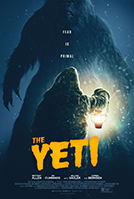
| With | Brittany Allen, Eric Nelsen, Jim Cummings, William Sadler, Corbin Bernsen |
| Runtime | 93 minutes |
| Release | 2026-04-04 |
| Rating | 7/10 |
Oil tycoon Merriell Sunday Sr. and renowned adventurer Hollis Bannister disappear without a trace. Their last known location is northern Alaska. Ellie Bannister and Merriell Sunday Jr. set out in search of their missing fathers...
The review
By Mulder 2026-03-30
There is something inherently appealing about a film like The Yeti, especially when it is driven by the obvious affection that Gene Gallerano and William Pisciotta have for a bygone era of monster movies. From its very first frames, the film positions itself as both a tribute and an experience, transporting the audience to 1947 Alaska through a visual language that deliberately echoes mid-20th-century genre cinema. Watching it, one couldn’t help but feel as though one had stumbled upon a forgotten reel, unearthed from dusty archives with its newsreel aesthetic, stylized lighting, and that particular blend of sincerity and pulp storytelling that defined the golden age of monster movies. Yet, as much as the film succeeds in recreating this atmosphere, it reveals the delicate balance between homage and reinvention, which doesn’t always work in its favor.
At the heart of the story lies a classic expedition plot, triggered by the disappearance of oil tycoon Merriel Sunday Sr., played with gravitas by Corbin Bernsen, alongside legendary explorer Hollis Bannister, portrayed by William Sadler. The rescue mission led by Merriel Sunday Jr., played by Eric Nelsen, brings together a group of specialists whose composition seems almost archetypal: the war-scarred veteran, the scientist, the explosives expert, and, above all, Ellie Bannister, played by Brittany Allen, who emerges as the film’s emotional anchor. It is through Ellie that the story finds its most compelling dimension, particularly in her strained relationship with her father and her inner struggle between intellectual detachment and lived experience. There is a quiet, almost melancholic depth to her character that suggests a far more introspective film lurking beneath the surface of this monster movie.
What strikes us most while watching is how often The Yeti seems less interested in the eponymous monster than in the psychological burden of its characters. The film devotes a great deal of time to exploring trauma—war memories, family tensions, personal insecurities—and while this ambition is commendable, it creates a tonal dissonance that’s hard to ignore. One moment, the film invites us into intimate, almost theatrical exchanges around a campfire; the next, it abruptly shifts into bursts of visceral horror. This duality can be intriguing, but here, we sometimes get the impression that two films are vying for supremacy. I found myself admiring the intent while simultaneously wishing for a clearer narrative focus.
And then there is the creature itself—the Yeti, or rather that elusive presence haunting the edges of the frame. Gene Gallerano and William Pisciotta make a deliberate decision not to reveal the monster, favoring suggestion over revelation—a technique perfected by classics such as Jaws. In theory, this is the right approach, especially given the impressive practical effects that are eventually unveiled. When the creature appears, it exudes a tangible, almost tactile quality that digital effects rarely manage to achieve. However, the film’s restraint sometimes borders on frustration. For a film that promises a confrontation with a mythical beast, the Yeti often feels like a secondary character in its own story, a shadow rather than an imminent threat.
This choice is further complicated by the film’s pacing, which is undeniably its most controversial aspect. There is a deliberate slowness to the progression, a lingering quality that allows the scenes to breathe but also risks draining them of their urgency. We vividly remember checking our watches halfway through, not out of boredom, but out of surprise at how little progress the story had made. The snowy landscapes, though visually striking, sometimes feel more like static backdrops than active participants in the story, lacking the oppressive hostility one might expect from such a unforgiving environment.
Yet it would be unfair to overlook the film’s undeniable strengths. The commitment to practical special effects is not only admirable—it is essential to the film’s identity. In an era dominated by digital spectacle, seeing a creature come to life through artisanal craftsmanship lends a certain authenticity that enriches the visual experience. Similarly, the actors’ performances elevate a script that could easily have descended into caricature. Jim Cummings brings a subtle intensity to the character of Booker, while Linc Hand adds a touch of silent menace to that of Coates. Even in moments when the dialogue feels overly expository, the actors manage to ground their characters in something believable.
What makes The Yeti particularly fascinating is its ambition to fuse the aesthetics of classic B-movies with the thematic concerns of contemporary horror. It aims to be both a nostalgic throwback and a modern character study, a pulp monster adventure and a reflection on trauma and legacy. This ambition is both its greatest strength and its most significant limitation. We catch glimpses here of the makings of a truly remarkable film, but they are often diluted by an overly sprawling narrative and an uncertainty about what the film ultimately wants to be.
The Yeti is less a terrifying creature film than a curious hybrid, a film that prioritizes atmosphere and characters over pure spectacle. It may frustrate viewers expecting a relentless horror film, but it offers enough craftsmanship and sincerity to deserve attention, particularly from those who appreciate the history and evolution of the genre. One cannot shake the feeling of having seen something both admirable and incomplete, a film that aspires to greatness but settles for a level just below it, like a distant silhouette moving through the snow, never fully revealing itself.
The Yeti
Written and directed by Gene Gallerano, William Pisciotta
Produced by Johnathan Brownlee, Ross Meyerson
Starring Brittany Allen, Eric Nelsen, Jim Cummings, William Sadler, Corbin Bernsen
Cinematography: Joel Froome
Edited by Christina Bennett Lind
Music by John Hunter
Production companies: Torfoot Entertainment Group, Hardscrabble Film Company
Distributed by Well Go USA Entertainment (United States)
Release dates: April 3, 2026 (Beyond Fest), April 4, 2026 (United States)
Running time: 93 minutes
Viewed on March 30, 2025 (press screener)