

The Drama
Directed by Kristoffer Borgli (2026)
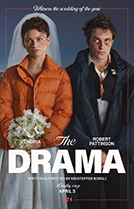
| With | Zendaya, Robert Pattinson, Mamoudou Athie, Alana Haim, Hailey Gates, Zoë Winters |
| Runtime | 105 minutes |
| Release | 2026-04-03 |
| Rating | 7/10 |
Un couple comblé voit son bonheur mis à l’épreuve lorsqu’un rebondissement inattendu vient tout bouleverser à une semaine de son mariage.
The review
By Mulder 2026-04-01
There’s something almost deceptively charming about *The Drama*, the kind of film that draws you in with the reassuring tropes of a romantic comedy before quietly pulling the rug out from under you. Directed by Kristoffer Borgli, this unsettling and unpredictable film begins as a classic love story: a boy meets a girl, awkward charm turns into affection, wedding bells loom on the horizon… Yet, from the very first minutes, an underlying sense of unease suggests that something is amiss beneath that smooth surface. Through the story of Charlie and Emma, played by Robert Pattinson and Zendaya, Borgli doesn’t just create a relationship drama, but offers a deeply provocative exploration of intimacy, truth, and the fragile illusions we build around the people we love. This isn’t simply a film that asks whether love can survive a revelation; it questions the very notion that love ever truly rests on solid ground.
What makes The Drama particularly fascinating is the speed with which it dismantles its own premise. The first act unfolds with disarming naturalism, capturing the rhythm of a modern relationship with almost documentary-like precision. The dialogue flows seamlessly, the chemistry feels organic, and the presence of their closest friends, Mike and Rachel—played by Mamoudou Athie and Alana Haim—adds texture and credibility to this seemingly idyllic bubble. Yet, during a seemingly innocuous dinner conversation, a simple confession shatters this reality, transforming the film into something far more abrasive and psychologically unstable. Kristoffer Borgli’s decision to place this narrative rupture so early on is crucial: rather than building up to a twist, he forces both his characters and his audience to live with its consequences, prolonging the unease until it becomes almost unbearable.
From that moment on, The Drama becomes a study in emotional disintegration, and it is here that Robert Pattinson delivers one of the most captivating performances of his career. His Charlie is not a romantic hero, but a man slowly crumbling under the weight of a truth he cannot process. Pattinson draws on his now-iconic ability to embody a nervous, fractured masculinity, transforming Charlie into a tangle of contradictions—empathetic yet selfish, rational yet absurdly impulsive. There is something almost painfully human in the way he shifts from denial to justification and then to paranoia, as if he were trying to negotiate with his own conscience in real time. His performance is often tinged with dark comedy, yet never loses sight of the character’s genuine emotional breakdown.
Opposite him, Zendaya delivers a performance of remarkable restraint and complexity. Emma is, in many ways, the film’s most enigmatic figure—a character who exists simultaneously as victim, suspect, and emotional anchor. Zendaya avoids the trap of over-explaining her character, instead letting ambiguity define her. Her stillness becomes as expressive as Pattinson’s volatility, and the tension between the two performances creates a dynamic that is both intimate and deeply unsettling. What is particularly striking is the way Zendaya subtly reshapes the audience’s perception of Emma without ever explicitly altering her behavior; it is our understanding that changes, not necessarily her, and this distinction lies at the heart of the film’s brilliance.
Surrounding them, Alana Haim and Mamoudou Athie serve as both mirrors and catalysts. Haim, in particular, is electrifying as Rachel, embodying a kind of moral absolutism that is as fascinating as it is unsettling. She infuses the film with explosive energy, her reactions often reflecting what some viewers might feel but would hesitate to admit. Athie, on the other hand, brings a calmer, more measured presence, attempting to serve as a mediator in a fundamentally intractable situation. Their dynamic adds a new dimension to the film’s exploration of judgment and empathy, illustrating just how quickly personal relationships can fracture when confronted with uncomfortable truths.
Stylistically, Kristoffer Borgli reinforces this emotional instability through a fragmented, almost intrusive approach to editing and sound. Abrupt cuts, fleeting images, and disorienting flashbacks blur the line between memory, imagination, and reality, plunging the audience into the very heart of Charlie’s disintegrating psyche. At times, the film seems to actively resist any sense of coherence, looping conversations and revisiting emotional moments in a way that reflects the cyclical nature of real-life conflicts. While this repetition sometimes risks stagnation, it also serves a deliberate purpose: to trap the viewer in the same mental space as its characters, where resolution seems perpetually out of reach.
Yet, despite all its boldness, The Drama is not without flaws. There are moments when the screenplay relies too heavily on provocation, when the central premise seems designed more to shock than to fully explore its thematic implications. Kristoffer Borgli tackles complex sociocultural issues—such as violence, perception, and moral relativism—without always committing to dissecting them in a meaningful way. This creates a tension between depth and superficial provocation, leaving certain ideas seeming underdeveloped even as they linger uncomfortably in the background. The film’s third act, in particular, revolves around its central dilemma without necessarily advancing it, suggesting a filmmaker more interested in asking questions than answering them.
And yet, perhaps that is precisely where the interest lies. The Drama draws its strength from its refusal to provide clarity or comfort. It is less concerned with offering a resolution than with laying bare the fragile architecture of human connections. What happens when the person you love no longer matches the image you have formed of them? Can empathy coexist with disgust? And above all, do we ever truly know someone? Borgli offers no answers, but he forces us to confront these questions in a way that is both deeply unsettling and strangely captivating.
By the film’s end, what lingers is not the shock of its central revelation, but the quiet, unsettling realization that love itself may rest on selective blindness. The Drama is not an easy film to accept; it is chaotic, divisive, and at times frustrating, but it is undeniably bold. Carried by the remarkable performances of Robert Pattinson and Zendaya, and driven by Kristoffer Borgli’s desire to push boundaries, it stands out as one of the most provocative explorations of relationships in recent years. Whether you find it profound or problematic will likely depend on your tolerance for discomfort, but one thing is certain: it’s a film that refuses to be forgotten.
The Drama
Written and directed by Kristoffer Borgli
Produced by Ari Aster, Lars Knudsen, Tyler Campellone
Starring Zendaya, Robert Pattinson, Mamoudou Athie, Alana Haim, Hailey Gates, Zoë Winters
Cinematography : Arseni Khachaturan
Edited by Joshua Raymond Lee
Music by Daniel Pemberton
Production company : Square Peg
Distributed by A24 (United States), Metropolitan FilmExport (France)
Release dates : March 17, 2026 (Los Angeles), April 1, 2026 (France), April 3, 2026 (United States)
Running time : 105 minutes
Viewed on April 1, 2026 at Gaumont Disney Village, Theater 8, Seat A20