

The Mortuary Assistant
Directed by Jeremiah Kipp (2026)
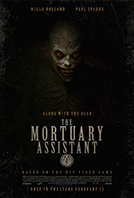
| With | Willa Holland, Paul Sparks |
| Runtime | 91 minutes |
| Release | 2026-02-13 |
| Rating | 7/10 |
Rebecca Owens spends her first night on the job at the River Fields morgue. Soon, the corpses awaken from their long slumber and turn on her...
The review
By Mulder 2026-03-18
Adapting a horror video game for the big screen has always been a delicate task, and The Mortuary Assistant is yet another example of how difficult it is to strike the right balance. Directed by Jeremiah Kipp and written by Tracee Beebe in collaboration with the game’s creator, Brian Clarke, the film attempts to translate the claustrophobic dread of this 2022 indie hit into a cinematic experience rooted in atmosphere, psychological trauma, and ritual horror. The result is neither the disaster that often befalls video game adaptations nor the breakthrough some might have hoped for, but rather a strangely captivating supernatural thriller—uneven, yet often effective—that relies heavily on atmosphere, acting, and a sinister sense of inevitability. While the film sometimes struggles with its pacing and exposition, it still manages to create a suffocating atmosphere that lingers longer than expected, particularly for viewers willing to embrace its slow and methodical approach to fear.
The story follows Rebecca Owens, portrayed with remarkable commitment by Willa Holland, a recovering addict who has just completed her training as a morgue assistant under the supervision of the enigmatic Raymond Delver, played by Paul Sparks. From the opening embalming sequence, the film makes it clear that it aims to make the audience uncomfortable, not through cheap tricks, but through the unsettling normality of death itself. The clinical precision of the procedure, the cold lighting, and the eerie silence of the morgue immediately set the tone, evoking the kind of realistic horror that films like The Autopsy of Jane Doe have made so effective. I found myself unexpectedly absorbed by these opening scenes, not because they are shocking, but because they seem disturbingly realistic, as if the film wanted to remind us that true horror often lies in the routine rather than the supernatural.
Once Rebecca is called back to work for an unexpected night shift, the film ventures into more familiar territory, but with an interesting twist: instead of rushing toward jump scares, Jeremiah Kipp chooses to let the tension build slowly, almost stubbornly. The morgue becomes less of a setting and more of a psychological trap, a place where reality begins to fracture under the weight of Rebecca’s past trauma, her guilt, and the possibility that a demonic entity has chosen her as its next host. The idea that morticians might secretly be aware of the existence of supernatural forces, revealing the truth only once a newcomer has proven their devotion, is one of the film’s most intriguing concepts, and it lends the story a strange professional logic that gives the horror a strangely procedural feel. This is where the film is at its strongest, blending the mundane and the occult in a way that makes every hallway, every drawer, and every flickering light feel menacing.
However, the film is not without flaws, and many of them stem from the very source material it attempts to honor. Since the original game relies on repetition, puzzles, and player interaction, the screenplay sometimes feels trapped in a structure that doesn’t fully translate to film. Long explanatory sequences, cryptic instructions, and ritualistic rules can slow the pace, and there are moments when the narrative becomes deliberately confusing in order to mimic the game’s disorientation. At times, it feels as though the film wanted the audience to feel as lost as Rebecca, which is an interesting idea in theory, but which, in practice, sometimes creates distance rather than tension. We wouldn’t call this a failure, however; rather, it feels like a film constantly walking a tightrope between staying true to its source material and the need to function as a standalone story.
What ultimately makes the film captivating is Willa Holland’s performance, which carries the story almost entirely on its own. She manages to make Rebecca believable even as the script plunges her into increasingly surreal situations, and her portrayal of a woman trying to stay sober while facing real demons gives the film an emotional anchor that prevents it from becoming just another possession story. Paul Sparks, for his part, brings a unsettling ambiguity to the character of Raymond Delver, whom he portrays as a man who seems to know far more than he lets on, without ever fully revealing his motivations. Their dynamic, often expressed through phone conversations and brief encounters, reinforces the film’s sense of isolation, as if Rebecca had been left alone not only with the dead, but also with truths she wasn’t meant to understand.
Visually, the film deserves more credit than it may receive at first glance. The art direction recreates the morgue with impressive attention to detail, featuring cold metal, cracked tiles, and dark corridors that seem to stretch endlessly into the darkness. Cinematographer Kevin Duggin uses shadows and muted colors to create a constant sense of unease, while the special effects, supervised by Norman Cabrera, give the bodies and demonic apparitions a tactile realism that is often lacking in digital horror. Some of the most effective moments are also the simplest: a corpse that seems to move when no one is looking, a silhouette standing silently in the background, a phone ringing in the middle of the night with no one on the other end. These are scares that rely not on volume, but on anticipation, and when the film relies on them, it works surprisingly well.
It is in its mythology that the film loses some of its power, as this becomes increasingly dense as the story progresses. The rules of possession, the sigils, the rituals, and the history of the demons are presented in a way that can feel rushed, as if the film were trying to cram the entire universe of a video game into a limited runtime. This sometimes breaks the tension just as it should be reaching its peak, and the final act, though visually striking, doesn’t always deliver the emotional satisfaction it seems to promise. Yet even here, the film never becomes boring, as the atmosphere remains so heavy that the sense of terror never completely fades. It’s the kind of horror that relies more on build-up than on shock, wearing the viewer down rather than startling them.
The Mortuary Assistant isn’t the definitive video game adaptation, nor the terrifying masterpiece some fans might have hoped for, but it’s far from the lifeless stylistic exercise it could have been. Thanks to Jeremiah Kipp’s direction, Willa Holland’s committed performance, and the production team’s solid visual work, the film manages to create a dark and oppressive experience that lingers in the mind, even when the narrative falters. It is an imperfect but sincere attempt to transpose an interactive nightmare into a cinematic one, and while it doesn’t always succeed, it displays enough ambition and atmosphere to make the journey worthwhile.
The Mortuary Assistant
Directed by Jeremiah Kipp
Written by Tracee Beebe, Brian Clarke
Based on The Mortuary Assistant by DreadXP
Produced by Patrick Ewald, Cole Payn
Starring Willa Holland, Paul Sparks
Cinematography: Kevin Duggin
Edited by Don Money
Music by Jeffery Alan Jones
Production companies: Epic Pictures Group, Creativity Capital
Distributed by Seismic Releasing / Epic Pictures (United States)
Release date: February 13, 2026 (United States), March 26, 2026 (Shudder)
Running time: 91 minutes
Viewed on March 18, 2026 (Press screener)