

Good Luck Have Fun Don't Die
Directed by Gore Verbinski (2026)
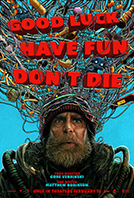
| With | Sam Rockwell, Haley Lu Richardson, Michael Peña, Zazie Beetz, Asim Chaudhry, Juno Temple |
| Runtime | 134 minutes |
| Release | 2026-02-13 |
| Rating | 8/10 |
One evening, in a seedy Los Angeles diner, a strange, scruffy man walks in holding a detonator and claims to have come from the future. This is supposedly the 117th time he’s traveled back in time to prevent an apocalypse triggered by AI and save a humanity brainwashed by screens. His ultimate strategy: recruit the restaurant’s customers to form a team capable of saving the world. If this group—as unlikely as it is ill-prepared—succeeds, then humanity might still have a chance… Or maybe not. Who knows ?
The review
By Mulder 2026-03-20
There’s something almost perversely refreshing about seeing Gore Verbinski make his return to cinema with a film so unruly, so provocative, and so determined to spit in the face of smooth, sanitized algorithmic entertainment. Good Luck, Have Fun, Don’t Die opens with a premise that sounds like a joke told by a sci-fi junkie after drinking too much coffee: a nameless man from the future, portrayed with wild desperation by Sam Rockwell, bursts into a Los Angeles restaurant and announces that the world is coming to an end because humanity has surrendered to screens, distraction, and artificial intelligence. Yet the film quickly reveals that this chaos is not a meaningless provocation. What makes this opening so successful is the way Gore Verbinski stages it as a collision between an apocalyptic sermon, a black comedy, and a study of off-the-wall characters. The customers stare at him, half-bored, half-annoyed, more offended by the interruption of their scrolling than by the threat of extinction, and this joke sets the tone for the entire film: the end of the world is no longer a dramatic event, but simply yet another notification vying for our attention. It’s a wild, funny, and slightly depressing introduction, and even when the film subsequently loses its coherence, it never quite loses that initial sting. You can sense that Gore Verbinski is making a film out of frustration, not to follow a trend; this isn’t a slick studio warning about AI, but a loud, ugly, and strangely moving panic attack about a society that has confused convenience with meaning.
This tone would collapse instantly without Sam Rockwell, and the film knows it. He doesn’t embody a conventional action hero, nor even an eccentric sci-fi messenger in the classic sense, but something far more unstable and captivating: a man who has repeated the same mission so many times that urgency, exhaustion, contempt, and hope have melted into a single, restless personality. Sam Rockwell gives the role a jerky rhythm that keeps the character suspended between prophet, con artist, traumatized survivor, and deeply irritating eccentric, and that is exactly why it works. Another actor might have pushed the performance toward a shrill parody or an overly serious melodrama, but Sam Rockwell makes this nameless time traveler seem like the last human being still capable of embarrassment, panic, and moral outrage in a world that has numbed itself into passive surrender. There’s also an inspired contradiction in seeing such a naturally magnetic performer embody a character who often looks ridiculous, talks too much, and treats his potential allies with surprising impatience. This contradiction becomes the film’s emotional engine. He needs people, but he hardly believes in them anymore. He tries to save humanity while giving the impression that he’s already found it guilty. In the hands of another filmmaker, this could have devolved into a hollow “cell phones are evil” diatribe, but Sam Rockwell infuses enough pain and absurdity into every outburst that the film’s hysteria feels authentic rather than contrived.
The supporting cast is less well-served, but several performances still leave a lasting impression because the screenplay, despite all its excesses, understands that technology only becomes frightening when it invades humanity’s most intimate wounds. Juno Temple is the most striking example of this. Her character, Susan, is not simply a grieving mother caught up in a science-fiction plot; she embodies a world so morally broken that grief itself has become a commercial opportunity. Her story, which deals with the grotesque commodification of grief, is undoubtedly the film’s darkest and most haunting thread, and Juno Temple portrays it with a trembling disbelief that prevents the satire from becoming trite. Haley Lu Richardson, for her part, imbues Ingrid with a wounded sincerity that the film desperately needs. The character could have come across as an eccentric dystopian sketch, but Haley Lu Richardson anchors her in pain rather than fantasy. She brings one of the film’s rare moments of genuine tenderness, especially as the story begins to suggest that resistance to synthetic comfort is not heroic in the glamorous sense of the word, but rather solitary, humiliating, and exhausting. Michael Peña and Zazie Beetz are convincing as educators watching young people sink into a screen-fueled automatism, even if their characters seem more schematic than fully developed, while performers such as Asim Chaudhry, Daniel Barnett, Georgia Goodman, Dominique Maher, Tom Taylor, Artie Wilkinson-Hunt, and Cassiel Eatock-Winnik all contribute to the impression that this world is teeming with victims of technological seduction, even if the film fails to give them all equal weight.
What strikes one most about this film, however, is not simply its anti-AI stance, but the specific ugliness of its imagination. Matthew Robinson’s screenplay does not envision artificial intelligence as an elegant takeover by machines, in the classic mold of James Cameron’s nightmarish logic, nor as the cool digital omnipotence of the many post-Matrix imitators. On the contrary, it imagines the collapse as something kitschy, pathetic, compulsive, and commercially optimized. This is the film’s best and most intelligent idea. The apocalypse does not arrive here with grandeur; it arrives disguised as comfort, personalization, convenience, gamification, endless stimulation, and emotional outsourcing. In this sense, the film’s disorder is almost an integral part of its method. The structure constantly interrupts the narrative momentum with flashbacks that often resemble mini-dystopian fables, and while this episodic approach can certainly undermine the momentum of the central mission, it also reveals a filmmaker and screenwriter attempting to catalog every nook and cranny of the cultural decay that now passes for normal life. At times, this produces truly powerful sequences, especially when the satire tackles themes like education, grief, virtual escapism, and social numbness. At other times, it becomes crude, repetitive, or too smug in its own bitterness. The film sometimes confuses accusation with depth, and some of its observations on youth culture and device addiction are more general than they should be. But even there, there is something invigorating about its lack of concern for appearing trendy. In an era when so many genre films are designed to feel seamless, Gore Verbinski seems almost determined to leave splinters in the audience’s hands.
This same refusal to polish the edges is also the source of the film’s most obvious weaknesses. At over two hours, Good Luck, Have Fun, Don’t Die undeniably drags on, and the second half in particular begins to suffer under the weight of the sheer number of ideas, tonal shifts, grotesque settings, and digressions into world-building that it attempts to juggle. There are moments when the film feels less like a carefully calibrated narrative and more like a desperate brainstorming session projected directly onto the screen, and not all the bizarre imagery or dramatic escalations find their place. Some action sequences seem to drag on, certain visual inventions border on the ridiculous without offering sufficient payoff, and more than one subplot feels like the raw material for a separate, sharper, and more devastating film. Yet to dismiss this excess would be to ignore what makes the film memorable. Gore Verbinski has always been a filmmaker drawn to elastic imagery, tonal instability, and sequences that oscillate between spectacle and feverish nightmare, and this film—perhaps more openly than anything he has directed in recent years—feels like the work of a director using the genre to express his disgust, anxiety, and genuine grief in the face of a dwindling sense of reality. That is why even the weakest moments remain interesting. The film may be overloaded, but it is never empty. It may be raw, but it is not artificial. It may waver, but it never feels manufactured. In a strange way, the film’s very human imperfections become its strongest argument against the slick falseness it attacks.
Good Luck, Have Fun, Don’t Die isn’t a flawless comeback for Gore Verbinski, but it’s a fiercely alive one, and that’s what matters. It’s a film that leaps, stumbles, rages, goes too far, surprises, and, at times, touches on something truly haunting. His vision of AI focuses less on killer software than on the spiritual laziness that drives people to surrender their memories, their grief, their attention, their privacy, and even their imagination to systems designed to mimic life while draining it of its substance. This theme gives the film its enduring power, especially as Sam Rockwell, Juno Temple, and Haley Lu Richardson continually unearth fragments of wounded humanity amid all the noise. For every scene that feels too long or too eager to hammer home a point, there’s another that reminds you just how rare it has become to see an American genre film from a studio that’s this angry, this strange, and this willing to risk ridicule to say something sincere. It doesn’t reinvent dystopian science fiction, and it certainly doesn’t always master its own ambitions, but it has guts, personality, and that kind of frayed conviction that can’t be faked.
Good Luck, Have Fun, Don’t Die
Directed by Gore Verbinski
Written by Matthew Robinson
Produced by Gore Verbinski, Robert Kulzer, Erwin Stoff, Oly Obst, Denise Chamian
Starring Sam Rockwell, Haley Lu Richardson, Michael Peña, Zazie Beetz, Asim Chaudhry, Juno Temple
Cinematography: James Whitaker
Edited by Craig Wood
Music by Geoff Zanelli
Production companies: Constantin Film, Blind Wink Productions, 3 Arts Entertainment
Distributed by Briarcliff Entertainment (United States), Metropolitan FilmExport (France)
Release dates: September 24, 2025 (Fantastic Fest), February 13, 2026 (United States), April 15, 2026 (France)
Running time: 134 minutes
Viewed on March 15, 2026 (VOD)