

Project Hail Mary
Directed by Phil Lord, Christopher Miller (2026)
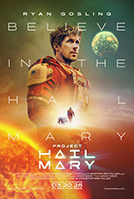
| With | Ryan Gosling, Sandra Hüller, James Ortiz, Lionel Boyce |
| Runtime | 156 minutes |
| Release | 2026-03-20 |
| Rating | 10/10 |
Ryland Grace, a science professor, wakes up alone aboard a spaceship, light-years away from Earth, with no memory of his identity or why he is on board. Little by little, his memory returns, and he realizes the stakes of his mission: to solve the mystery of the mysterious substance causing the Sun’s extinction. To try to save humanity, he’ll have to draw on his scientific knowledge and unconventional ideas… But an unexpected friendship might just help him face this mission without having to do it alone.
The review
By Mulder 2026-03-18
The film adaptation of Andy Weir’s novel always generates high expectations, especially after the massive success of The Martian. With Project Hail Mary, directors Phil Lord and Christopher Miller strike the perfect balance between rigorous science fiction, mainstream spectacle, and a deeply human story. The result is a film that is both familiar and surprisingly sincere, a spectacular blockbuster that dares to believe that intelligence, curiosity, and cooperation may well remain humanity’s most powerful tools. Written by Drew Goddard, who once again translates Andy Weir’s complex scientific concepts into accessible cinema, the film adheres to the same fundamental philosophy as its predecessor: survival does not depend on strength, but on knowledge, patience, and the ability to solve problems step by step. In an era dominated by cynical disaster movies, this optimistic approach seems almost radical, and that alone gives the film a unique emotional resonance that sets it apart from most contemporary science fiction productions.
The story follows Ryland Grace, portrayed with remarkable warmth and vulnerability by Ryan Gosling, a middle school science teacher who wakes up alone aboard a spaceship, light-years from Earth, with no memory of how he got there. The first act, built around his gradual rediscovery of the mission through fragmented flashbacks, is both intriguing and surprisingly funny, allowing Gosling to draw on his natural blend of awkward charm and understated humor. Unlike the typical space hero, Grace is neither a trained astronaut nor an intrepid adventurer, but an ordinary scientist who would rather be in a classroom than in a spacesuit. This choice gives the film an immediate emotional grounding, as the stakes—the slow death of the Sun caused by an alien microorganism known as the Astrophage—are of cosmic proportions, while the protagonist remains deeply human. The scenes on Earth, particularly those featuring Eva Stratt, the ice-cold project leader portrayed with steely intensity by Sandra Hüller, bring a welcome sense of urgency and moral ambiguity, reminding us that saving the world often requires impossible decisions and uncomfortable compromises.
Once the film fully plunges into deep space, however, Project Hail Mary reveals its true identity, shifting from a survival story to something far more unexpected: a film about friendship across the universe. The arrival of Rocky, the alien engineer brought to life by James Ortiz’s puppetry and voice, transforms the film into a strangely touching exploration of communication, cooperation, and loneliness. The relationship between Grace and Rocky is the emotional heart of the story, and it works far better than one might expect. Watching two completely different species slowly learn to understand each other through mathematics, physics, and improvised translation devices becomes one of the film’s greatest pleasures. This is also where Phil Lord and Christopher Miller’s sensibility shines brightest, blending humor and sincerity in a way that recalls their best work, without ever losing sight of the larger stakes.
Visually, the film fully embraces its blockbuster ambitions, with cinematography that captures both the terrifying emptiness and the breathtaking beauty of space. The artistic design of the spaceship, the alien technology, and the distant star systems gives the film a tangible, almost old-school sci-fi atmosphere, as if it were in the tradition of 2001: A Space Odyssey, Interstellar, or Close Encounters of the Third Kind. Yet, despite its scale, the film never forgets that its true strength lies in its characters rather than its special effects. Even during the most spectacular sequences, the focus remains on Grace’s reactions—her fear, her curiosity, and her growing sense of responsibility. This emotional grounding prevents the film from sinking into empty spectacle, a pitfall that many modern blockbusters struggle to avoid.
That said, the film isn’t without its flaws, and its greatest strength sometimes becomes a weakness. The frequent flashbacks can slow the pace, and the screenplay sometimes feels overloaded with exposition as it attempts to explain complex scientific concepts while remaining entertaining. The tone also wavers at times, shifting from high-stakes drama to lighthearted comedy in a way that won’t necessarily appeal to everyone. Some viewers will find the humor a bit too self-aware, and the film’s emphasis on optimism may seem almost naive in a genre that often thrives on darker themes. There are also moments, particularly in the final act, where the story seems reluctant to end, offering multiple emotional resolutions before finally settling on its conclusion. Yet even when the film stumbles, its sincerity makes it hard to dislike, as it genuinely seeks to inspire rather than impress.
What ultimately makes Project Hail Mary memorable is Ryan Gosling’s performance, which carries the film through long sequences almost entirely on its own. He manages to strike a balance between comedy, fear, intelligence, and vulnerability in a way that makes Grace a real character rather than a typical movie hero. His chemistry with Rocky is surprisingly moving, and their friendship becomes the film’s strongest theme: survival isn’t just a matter of science, but also of connection. In a story where the fate of multiple worlds hinges on equations and experiments, the most important discovery turns out to be empathy. This message, as simple as it may seem, gives the film a warmth that is lacking in many modern sci-fi epics.
Project Hail Mary may not reach the philosophical depth of Interstellar or the raw tension of Gravity, but it achieves something just as difficult: creating a big-budget space adventure that inspires hope without being childish, that moves us without being manipulative, and that is intelligent without being cold. It’s a film about problem-solving, friendship, and the tenacious belief that humans—and perhaps even aliens—can work together to solve what seems impossible. In a cinematic landscape often dominated by franchise formulas and cynical remakes, that alone makes it worth seeing.
Project Hail Mary
Directed by Phil Lord, Christopher Miller
Written by Drew Goddard
Based on Project Hail Mary by Andy Weir
Produced by Amy Pascal, Ryan Gosling, Phil Lord, Christopher Miller, Aditya Sood, Rachel O'Connor, Andy Weir
Starring Ryan Gosling, Sandra Hüller, James Ortiz, Lionel Boyce
Cinematography: Greig Fraser
Edited by Joel Negron
Music by Daniel Pemberton
Production companies: Pascal Pictures, Open Invite Films, Waypoint Entertainment, Lord Miller Productions
Distributed by Amazon MGM Studios (United States), Sony Pictures Releasing France (France)
Release dates: March 9, 2026 (Empire Leicester Square), March 18, 2026 (France), March 20, 2026 (United States)
Running time: 156 minutes
Viewed on March 18, 2026 at Gaumont Disney Village, Theater 11, Seat E18