

Whistle
Directed by Corin Hardy (2026)
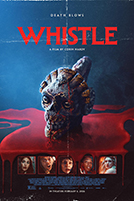
| With | Dafne Keen, Sophie Nélisse, Sky Yang, Jhaleil Swaby, Ali Skovbye, Percy Hynes White, Michelle Fairley, Nick Frost |
| Runtime | 100 minutes |
| Release | 2026-02-06 |
| Rating | 7/10 |
A group of high school students stumble upon a forgotten artifact: an Aztec Death Whistle. They discover that blowing it releases a terrifying sound capable of summoning their future deaths to hunt them down. As the number of victims rises, the teenagers must break the chain of death before the whistle's final echo seals their fate.
The review
By Mulder 2026-03-05
With Whistle, director Corin Hardy delivers a film that is a true love letter to the supernatural slasher films of the late 90s and early 2000s, those horror stories set in high schools where cursed objects, doomed teenagers, and inventive deaths coexist. Written by Owen Egerton, the film never hides its influences, openly embracing the legacy of films such as Final Destination, Urban Legend, and even A Nightmare on Elm Street, while trying to forge its own identity with a clever central idea: an ancient Aztec whistle that not only kills those who hear it, but also summons the exact death that fate had already reserved for them, only much earlier. It's a premise that instantly stimulates the imagination, and from the opening scene, the film sets a tone that is both playful and morbid, as if it knows full well that the audience has seen this kind of story before, but is willing to go along with it anyway.
The story follows Chrysanthemum Willet, played by Dafne Keen (Logan, His Dark Materials), a troubled teenager who arrives in a dreary industrial town after experiencing a personal tragedy. She is assigned the locker of a student who died a few months earlier, where she discovers a mysterious whistle, an object that seems harmless at first glance but quickly turns out to be the worst thing you could find in a horror movie. Alongside her cousin Rel, played by Sky Yang, and a group of classmates including Ellie (Sophie Nélisse), Grace (Ali Skovbye), and Dean (Jhaleil Swaby), Chrys finds herself entangled in a curse that turns their future deaths into an immediate threat. The film wastes no time explaining its rules, and once the whistle blows, the story moves forward with almost mechanical efficiency, each character forced to confront the horrifying vision of how they are destined to die. This concept, halfway between fatalism and the supernatural logic of horror films, is undoubtedly the film's strongest idea, allowing Corin Hardy to stage a series of deaths that are often grotesque, sometimes absurd, but almost always memorable.
What makes the film more captivating than many similar productions is the fact that it attempts, at least in part, to anchor its horror in emotional stakes. The relationship between Chrys and Ellie, played with surprising sincerity by Dafne Keen and Sophie Nélisse, gives the story a fragile center that prevents it from becoming pure spectacle. Their chemistry seems natural, and the decision to place a queer romance at the heart of a genre that often relies on clichés adds a welcome modern touch without turning the film into a militant work. Around them, the supporting roles correspond to recognizable archetypes, but the performances, particularly those of Sky Yang and Ali Skovbye, give these roles enough warmth that the audience cares, at least a little, about who will survive the curse.
Whistle is first and foremost a horror film, and it's in its key scenes that it really comes to life. Corin Hardy clearly takes pleasure in staging elaborate, sometimes extravagant death sequences, and the film's best moments are those where the supernatural rules allow for something visually unexpected, such as a car crash in a bedroom or a body crushed by an invisible machine. These scenes often combine practical effects and digital enhancements in a way that recalls the excess of 1990s genre cinema, and even when the CGI becomes visible, the sheer inventiveness of the situations makes them entertaining. It feels like the film understands exactly what the audience came for, and it rarely hesitates to show blood, broken bones, and twisted bodies with a certain mischievous enthusiasm.
However, the film is not without its flaws, and most of them stem from the script. Owen Egerton builds an intriguing mythology around the whistle, but the rules sometimes seem inconsistent, and several subplots feel more like distractions than essential elements. The film also suffers from a difficult pace in its middle section, where the investigation into the curse slows down the momentum without adding much depth. At times, we would have preferred the story to choose to be either a pure, fast-paced slasher or a deeper reflection on mortality, rather than trying to strike a balance between the two without fully committing to either direction.
However, it would be unfair to deny the film's undeniable charm. There's something refreshing about a horror film that openly embraces its influences instead of pretending to reinvent the genre. The references to classic filmmakers, the deliberately stylized high school setting, and even the slightly exaggerated dialogue all contribute to the impression that Corin Hardy wanted to recreate the atmosphere of the films he grew up with. In this sense, Whistle is less a groundbreaking horror film than a nostalgic one, reminiscent of a time when teen slashers were unapologetically gory, slightly ridiculous, and proud of it.
Another element worth praising is the visual atmosphere. The industrial town setting, the fall festival sequence, and the dark school hallways give the film a distinct personality, aided by Björn Charpentier's cinematography, which often bathes the story in cold colors and smoky textures. Combined with a surprisingly energetic soundtrack, the result is a film that feels visually richer than many productions of similar scope. Even when the script falters, the direction keeps things interesting, proving once again that Corin Hardy has a real talent for creating atmosphere, even in a story that sometimes feels too familiar.
Whistle may not become a cult classic on par with the films it references, but it succeeds in being exactly what it sets out to be: a brutal, entertaining, slightly old-fashioned supernatural slasher with just enough heart to make the carnage meaningful. Thanks to committed performances, a solid central concept, and several genuinely inventive death sequences, the film manages to rise above its predictable structure and deliver a horror experience that is both nostalgic and fun, even if it never completely escapes the shadow of its inspirations.
Whistle
Directed by Corin Hardy
Written by Owen Egerton
Produced by David Gross, Whitney Brown, Macdara Kelleher, John Keville
Starring Dafne Keen, Sophie Nélisse, Sky Yang, Jhaleil Swaby, Ali Skovbye, Percy Hynes White, Michelle Fairley, Nick Frost
Cinematography: Björn Charpentier
Edited by Nicholas Emerson
Music by Doomphonic
Production companies: No Trace Camping, Wild Atlantic Pictures
Distributed by Independent Film Company (United States), Metropolitan Filmexport (France)
Release dates: September 25, 2025 (Fantastic Fest), February 6, 2026 (United States), March 18, 2026 (France)
Running time: 100 minutes
Viewed on March 5, 2026 on VOD