

The Strangers – Chapter 3
Directed by Renny Harlin (2026)
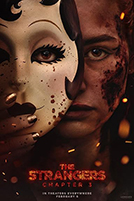
| With | Madelaine Petsch, Gabriel Basso, Ema Horvath, Richard Brake, Rachel Shenton, George Young, Ella Bruccoleri |
| Runtime | 91 minutes |
| Release | 2026-02-06 |
| Rating | 4/10 |
In the series' most brutal chapter, Maya collides with the masked killers and finds the only way out of the nightmare...is in.
The review
By Mulder 2026-03-07
With The Strangers: Chapter 3, Renny Harlin finally brings to a close a trilogy whose very existence has often seemed difficult to justify, and this final chapter unfortunately confirms all the weaknesses that have accumulated since the beginning of this ambitious but misguided project. Conceived as an expansion of the minimalist concept imagined by Bryan Bertino in 2008, this new saga aimed to explore the mythology of the masked killers while following the evolution of its heroine, Maya, played by Madelaine Petsch. On paper, the idea seemed interesting: transforming a brutal and stripped-down home invasion into a broader narrative about trauma, violence, and the contamination of evil. In reality, this third installment feels more like a forced, almost contractual conclusion that attempts too late to connect narrative elements that remained superficial throughout two entire films, without ever recapturing the visceral tension that was the strength of the original material.
The film picks up immediately after the events of the previous chapter, with Maya wounded and hunted in the woods around the small town of Venus, Oregon, while the two survivors of the trio of killers, played by Gabriel Basso and Ella Bruccoleri, continue their hunt with mechanical determination. Very quickly, Renny Harlin and screenwriters Alan R. Cohen and Alan Freedland multiply the flashbacks to explain the origin of the Strangers, their childhood, their relationship with the town, and even their connection to the sheriff played by Richard Brake. This is where the film undoubtedly makes its biggest mistake: by trying to explain everything, it destroys the mystery that made these antagonists truly disturbing. In Bryan Bertino's film, the terror came from the fact that the killers had no reason. Here, they have a story, a logic, almost an organization, and this desire to add depth paradoxically ends up making the whole thing much more mundane, almost administrative.
One of the most interesting narrative threads is based on the idea that Maya could herself become a Stranger, forced to replace the missing Pin-Up Girl. This theme, which evokes the contamination of trauma and the transformation of the victim into the perpetrator, could have given the film a real psychological dimension. Madelaine Petsch does her best to give weight to this development, playing her character with credible physical and emotional exhaustion, as if each scene were an extension of the hell she has been through since the first film. But the script refuses to follow through on this idea, preferring to return to a classic structure of predictable chases, kidnappings, and confrontations, as if the film never dared to choose between brutal slasher and character study.
Renny Harlin's direction, despite his past ability to deliver solid action films, oscillates here between technical competence and an obvious lack of inspiration. A few sequences work, particularly in the church and abandoned sawmill settings, where the atmosphere briefly regains an interesting tension, but the whole remains surprisingly flat for a film that is supposed to conclude an entire trilogy. The numerous scenes of violence lack impact, often cut too early or drowned out by confusing editing and unconvincing digital effects, giving the impression that the film is constantly hesitating between wanting to shock and wanting to remain tame.
The addition of new characters, such as Maya's sister played by Rachel Shenton, accompanied by George Young and Miles Yekinni, seems primarily intended to increase the number of victims rather than enrich the narrative. Their presence adds almost no emotional stakes, and their fate seems predetermined from the moment they are introduced. This lack of attachment to the characters is indicative of a larger problem: after three films, the trilogy has still failed to build a real connection between the viewer and its heroine, which makes the moments that are supposed to be dramatic surprisingly cold.
The further the film progresses, the more we feel that this conclusion seeks to give meaning to a story that perhaps didn't need it. The revelations about the town, the sheriff's role, and the killers' origins should bring a tragic or disturbing dimension, but they seem to mainly highlight the inconsistencies in the script. How can a small community cover up so many crimes without consequences? Why do the killers constantly leave Maya alive when they eliminate everyone else without hesitation? These questions remain unanswered, and the feeling of repetition ultimately replaces any tension.
The final act, however, attempts to create an emotional climax around the final confrontation between Maya and Gabriel Basso's character, with the idea that the line between victim and executioner could disappear. Again, the concept is interesting, but the execution remains too predictable to produce a real shock. We sense that the film wants to reach a dark and disturbing conclusion, but in the end it settles for a fairly conventional ending, which feels more like relief than real catharsis.
In the end, The Strangers: Chapter 3 isn't a total disaster, but it perfectly symbolizes the limitations of this trilogy: a strong initial idea, stretched out over three films without ever finding the right direction. Despite Madelaine Petsch's obvious commitment and a few visually successful moments, the film suffers from an overly explanatory script, a lack of tension, and an absence of clear identity. This final chapter concludes the story without any real sparkle, leaving the impression of a missed opportunity rather than a memorable finale.
The Strangers – Chapter 3
Directed by Renny Harlin
Written by Alan R. Cohen, Alan Freedland
Based on Characters by Bryan Bertino
Produced by Courtney Solomon, Mark Canton, Christopher Milburn, Gary Raskin, Alastair Birlingham, Charlie Dombek
Starring Madelaine Petsch, Gabriel Basso, Ema Horvath, Richard Brake, Rachel Shenton, George Young, Ella Bruccoleri
Cinematography: José David Montero
Edited by Kate Hickey
Music by Justin Burnett, Òscar Senén
Production company: Fifth Element Productions
Distributed by Lionsgate (United States)
Release dates: January 15, 2026 (Los Angeles), February 6, 2026 (United States)
Running time: 91 minutes
Viewed on March 7, 2026 (VOD)