

The Bride !
Directed by Maggie Gyllenhaal (2026)
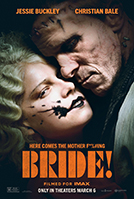
| With | Jessie Buckley, Christian Bale, Peter Sarsgaard, Annette Bening, Jake Gyllenhaal, Penélope Cruz |
| Runtime | 126 minutes |
| Release | 2026-03-06 |
| Rating | 7/10 |
Consumed by loneliness, Frank travels to Chicago in the 1930s and asks Dr. Euphronious, a visionary scientist, to create him a companion. Together, they resurrect a young woman who had been murdered, and the bride comes back to life! But what follows exceeds anything they could have imagined: murders, possessions, an outlaw couple caught up in a radical and unbridled social movement, and a passionate and tumultuous love story !
The review
By Mulder 2026-03-04
With the film The Bride!, Maggie Gyllenhaal doesn't just revisit a myth; she tears it apart, reconfigures it, and infuses it with a violent electric shock. Set in the smoky, feverish Chicago of the 1930s, the film begins as a reinterpretation of Mary Shelley's legacy, but quickly transforms into something much more radical: an outlaw gothic romance, a feminist awakening, and a love letter to cinema itself. The premise is deceptively simple: Frank, a lonely monster masterfully played by Christian Bale, enlists the visionary Dr. Euphronious to create a companion, and together they resurrect a murdered young woman who becomes the Bride, played by Jessie Buckley. But what unfolds next is anything but conventional. From the very first images, you sense that this is a filmmaker who thinks big, without fear of excess, contradiction, or provocation. This is not a glossy horror film, polished to appeal to awards season; it is fierce, funny, sensual, sometimes chaotic, and couldn't care less about pleasing everyone. At a time when many big-budget studio films seem calculated down to the last millimeter, The Bride! feels alive, restless, impulsive, gloriously untamed. It is undoubtedly one of the best films of the year, and some of its images will remain etched in your memory for a long time to come.
What sets this film apart most is its decision to give voice and presence to a character who, in James Whale's 1935 classic, appeared for only a few minutes. As Maggie Gyllenhaal herself explains, she was struck by the fact that the Bride had become a lasting cultural icon despite her silence and near-total absence. Here, the Bride is no longer an accessory to male loneliness; she is the axis around which the story revolves. The transformation of Ida, a weary woman surviving in a brutal world, into a mythical and electrifying bride is one of the film's most daring moves. The dark substance staining her lips, her dazzling white hair, and her bright orange dress designed by Sandy Powell help create an image that is both a nod to the past and the icon of something entirely new. This is a film about autonomy, about the violence of imposed narratives, about what happens when a resurrected woman refuses the script written for her. Thematically, it oscillates between body horror, romantic tragedy, and social rebellion, evoking everything from Bonnie and Clyde to the feverish theatricality of modern gothic pop, while always filtering these influences through a singular and authoritative gaze.
At the center of this storm is Jessie Buckley, who delivers one of the most unbridled performances of her career. Seeing her embody the bride while navigating awards season for Hamnet reminds us of the astonishing range of her talent. Here, she throws herself into the role with reckless abandon—wild, sensual, unpredictable, but deeply human. The camera, directed by Lawrence Sher, adores her, often capturing her in close-ups that seem almost provocative in their intimacy. There is something electric about the way she moves: at once a punk-rock singer, a tragic heroine, and a revolutionary prophet. She is funny, wild, vulnerable, and terrifying in the space of a single scene. But above all, beneath the theatricality, Jessie Buckley never loses sight of the emotional heart of the character. The Bride's thirst for truth, love, and identity is palpable. She wants it all, and Jessie Buckley makes you believe she deserves it.
At her side, Christian Bale plays a Frank who is both imposing and heartbreakingly tender. Avoiding the caricature of a simplistic parody, Christian Bale draws inspiration from the lineage of Boris Karloff while anchoring his performance in a deeply human vulnerability. This Frank has lived for over a century; he is tired, introspective, overwhelmed by guilt. There is a quiet intelligence in his gaze, a desire that makes his brutality all the more tragic. Christian Bale captures the paradox of a creature capable of immense violence who chooses restraint, and this tension is magnetic. His chemistry with Jessie Buckley is explosive: it's not the orderly symmetry of classic Hollywood romances, but a volatile dance between two beings who don't know if their love will save or destroy them. Their relationship, founded on a lie but fueled by a genuine connection, gives the film its tragic character. When it falters, it hurts.
The supporting roles add layers of complexity and tonal contrast. Dr. Euphronious, played by Annette Bening, is both a visionary scientist and a romantic idealist, a woman whose iconoclasm mirrors that of her creation. Peter Sarsgaard brings a weary ambiguity to Inspector Wiles, while Penélope Cruz infuses Myrna with lively intelligence and warmth, subtly challenging the male-dominated world of investigation that surrounds her. The film becomes something of a family affair with the presence of Jake Gyllenhaal and Peter Sarsgaard, reinforcing the feeling that this is not simply a studio commission, but a deeply personal project for Maggie Gyllenhaal. Behind the camera, the craftsmanship is equally bold: Karen Murphy's art direction evokes a Chicago that is both historical and mythical; Hildur Guðnadóttir's score, which blends orchestral romanticism with punk textures, vibrates with rebellious energy. When the frame widens during moments of supernatural intensity, the effect is visceral rather than decorative.
If the film has weaknesses, they lie in its abundance. The script sometimes juggles more thematic threads than it can weave together coherently. Subplots flare up and then fizzle out, and some ideas seem more powerful in conception than in execution. Yet these imperfections are inseparable from the film's ambition. Like its protagonists, The Bride! refuses moderation. While other recent gothic spectacles seemed hesitant to fully embrace their own madness, Maggie Gyllenhaal dives headfirst into hers. The result is uneven but exhilarating: a film that would rather risk ridicule than settle for safety. Its body horror, social commentary, romantic melodrama, and outlaw fantasy don't always align perfectly, but raw energy propels it forward.
The Bride! is a rare studio film: one that feels like it was written, that is singular and resolutely personal. It is messy, as great love stories often are: upsetting, contradictory, excessive. Some viewers will undoubtedly resist its shifts in tone and gothic extravagance; others will come away electrified. Our media outlet is among the latter. In a cinematic landscape increasingly dominated by algorithm-friendly fluidity, this film dares to disturb, provoke, and demand emotional abandonment. It believes in the transformative power of the theatrical experience, of sitting in the dark and letting yourself be overwhelmed by something wild. For this alone, and for the fierce performances of Jessie Buckley and Christian Bale, as well as Maggie Gyllenhaal's fearless vision, The Bride! deserves to be seen in the cinema.
The Bride !
Written and Directed by Maggie Gyllenhaal
Based on Frankenstein by Mary Shelley
Produced by Maggie Gyllenhaal, Emma Tillinger Koskoff, Talia Kleinhendler, Osnat Handelsman-Keren
Starring Jessie Buckley, Christian Bale, Peter Sarsgaard, Annette Bening, Jake Gyllenhaal, Penélope Cruz
Cinematography: Lawrence Sher
Edited by Dylan Tichenor
Music by Hildur Guðnadóttir
Production companies: First Love Films, In the Current Company
Distributed by Warner Bros. Pictures
Release dates: February 26, 2026 (Leicester Square), March 4, 2026 (France), March 6, 2026 (United States)
Running time: 126 minutes
Seen on March 2, 2026 at the Elysées Lincoln cinema