

Affection, Affection
Directed by Alexia Walther, Maxime Matray
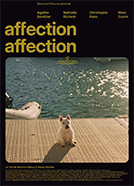
| With | Agathe Bonitzer, Nathalie Richard, Christophe Paou, Marc Susini |
| Runtime | 99 minutes |
| Release | Release date unknown |
| Rating | 7/10 |
On the French Riviera, a teenager disappears on her birthday. Géraldine, a municipal employee, decides to take on the role of detective. No one saw anything, but everyone has an opinion, and Géraldine struggles not to get overwhelmed by the gossip, theories, and beliefs of others. And the unexpected return of her mother doesn't make her task any easier. As everyone knows, small towns are full of petty crimes...
The review
By Cookie 2026-04-01
From the very first minutes of Affection, Affection, there is a kind of almost gentle disorientation, as if the film were inviting us to set aside our viewer reflexes and embrace a more fluid, more uncertain experience. Alexia Walther and Maxime Matray have created a unique work here, one that reads less like a traditional narrative and more like a structured meandering, a treasure hunt where every element seems deliberately off-kilter. On this French Riviera, strangely stripped of its usual bustle, the disappearance of a teenage girl serves more as a starting point than as a true narrative driving force. Very quickly, the investigation shifts toward something else—a more fluid terrain where hypotheses replace certainties, and where the truth fragments as it circulates among the characters.
In this deliberately off-kilter setup, Agathe Bonitzer portrays a restrained, almost withdrawn Géraldine who observes more than she acts. Far from the usual figures of the crime thriller, her character becomes a focal point, a witness open to the stories of others. The film then takes a mischievous delight in subverting the genre’s conventions, rejecting any linear progression in favor of a freer, almost playful structure. One is sometimes reminded of certain films by Éric Rohmer or Jacques Rivette, in this way of letting situations breathe and prioritizing detours over conclusions, yet without ever falling into mere imitation. Here, everything seems designed to slightly disorient the viewer, but never completely, as if the film were seeking a fragile balance between disorientation and fascination.
Visually, Pauline Sicard’s cinematography plays an essential role in this sense of diffuse strangeness. The settings of the Var region, filmed out of season, take on an almost unreal dimension, between deserted beaches, empty parking lots, and silent buildings. This choice of open yet uninhabited spaces reinforces the impression of a world in limbo, where something seems constantly on the verge of happening without ever materializing. The cinematography favors wide shots, allowing the characters to blend into their surroundings, as if they were becoming an extension of them. This visual approach perfectly accompanies Géraldine’s inner journey, as her bearings seem to gradually dissolve into this uncertain reality.
The film also stands out for its very distinctive tone, constantly oscillating between subtle humor and a sense of latent unease. Certain situations border on the burlesque, particularly through a cast of secondary characters whose behavior is sometimes bewildering but never caricatured. Every exchange, every anecdote seems to contribute to enriching a deliberately vague narrative fabric. Micha Vanony’s music, with its delicate and almost fragile tones, envelops the whole in a hushed atmosphere, like a continuous breath accompanying this narrative drift. Nothing is emphasized, everything is suggested, which gives the film a very particular, almost elusive texture.
Beneath this apparent lightness, however, Affection, Affection explores deeply intimate themes, notably those of parenthood, loss, and memory. The disappearance that opens the film echoes a more intimate, more buried absence—that of a mother whose shadow looms over the entire narrative. The title itself, through its repetition, evokes this duality between attachment and pain, between presence and disappearance. The relationships between the characters are fragmented, often implicit, and give way to numerous silences, like so many spaces to be filled by the viewer.
The cast, which blends seasoned actors like Nathalie Richard, Christophe Paou, and Marc Susini with more spontaneous faces, contributes to this sense of constant dissonance. The performances fall into slightly different registers, creating a form of unstable harmony that perfectly matches the film’s universe. The dialogues, often elliptical, function more as echoes than as genuine explanatory exchanges, reinforcing this impression of a narrative that builds through successive touches rather than through assertion.
However, this formal freedom, which is the source of the film’s richness in its first part, can also be its limitation. As the narrative progresses, the lack of a more defined structure can generate a certain weariness, as if the film sometimes struggles to renew its own approach. The 1 hour and 41-minute runtime then becomes slightly noticeable, and one can imagine that a tighter format would have allowed the film to retain all the power of this vision without diminishing its impact.
Despite this, Affection, Affection remains a rare cinematic experience, one that fully embraces its penchant for ambiguity and uncertainty. Where many films seek to explain and resolve, Alexia Walther and Maxime Matray choose instead to open up possibilities and leave room for interpretation. The viewer is not guided, but invited to feel, to interpret, to accept not understanding everything. And this is undoubtedly where the film’s true success lies: in its ability to create a lasting impression, made up of sensations rather than certainties.
Affection, Affection
Directed by Alexia Walther, Maxime Matray
Produced by Emmanuel Chaumet
Starring Agathe Bonitzer, Nathalie Richard, Christophe Paou, Marc Susini
Cinematography: Pauline Sicard
Edited by Jeanne Sarfati
Music by Micha Vanony
Production companies: Ecce Films
Distributed by UFO Distribution (France)
Release dates: April 15, 2026 (France)
Running time: 99 minutes
Seen on March 4, 2026 at the Club de l'Etoile