

Primavera
Directed by Damiano Michieletto
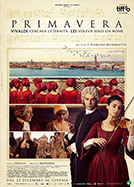
| With | Tecla Insolia, Michele Riondino, Andrea Pennacchi, Fabrizia Sacchi, Valentina Bellè, Stefano Accorsi |
| Runtime | 111 minutes |
| Release | Release date unknown |
| Rating | 8/10 |
In the early 18th century, the Ospedale della Pietà in Venice took in young orphan girls and trained them in music. Hidden from the public, often masked or behind a grille, the orchestra of young girls performed for the institution's wealthy patrons. Cecilia, 20, excelled as a violinist. Until the day a new music teacher, Antonio Vivaldi, arrived and turned her life and that of the Ospedale upside down.
The review
By Cookie 2026-03-01
It is with a curiosity tinged with suspicion that we discover Primavera, Damiano Michieletto’s debut feature film, as its title evokes the gentleness of renewal while the film draws us into a far darker and more oppressive reality. Behind this epic set in 18th-century Venice, the filmmaker does not merely paint a portrait of Antonio Vivaldi, but chooses above all to shed light on the fragile fate of a young orphan navigating a world where talent alone is not enough to guarantee freedom. Inspired by Tiziano Scarpa’s novel *Stabat Mater*, the narrative oscillates between formal beauty and inner tension, offering an elegant work that is, at times, restrained in its emotional outbursts.
At the heart of the film, the character of Cecilia stands out powerfully, carried by Tecla Insolia’s intense performance. This young violin prodigy accurately embodies a soul in search of affection and emancipation, torn between her artistic aspirations and an imposed future. Her gaze, often laden with silence, conveys the full depth of her confinement. Her journey is moving in its universality—that of a talent trapped within a rigid system, where personal expression seems constantly stifled. Cecilia plays with passion, yet appears deprived of the chance to live fully, an idea that runs delicately through the film.
The arrival of Michele Riondino in the role of Antonio Vivaldi adds an interesting nuance. Far from the flamboyant image of the composer, he is presented here as a more fragile man, almost withdrawn, torn between his creative desire and his limitations in the face of the system’s constraints. The relationship between teacher and student, marked by respect and restraint, develops with finesse, without ever falling into dramatic excess. This approach lends a certain elegance, even if it can sometimes leave the viewer wanting more, as emotions remain restrained.
Visually, the film is a true success. Daria D'Antonio’s cinematography elevates every shot, recreating a Venice that is both sumptuous and oppressive. The play of light, shadows, and sets give the film a remarkable pictorial quality. The costumes designed by Maria Rita Barbera and Gala Calderone reinforce this immersion in an era where refinement coexists with a form of social confinement. Every image seems carefully crafted, giving the film an aesthetic akin to a living painting.
Music naturally plays an essential role, without ever imposing itself excessively. It accompanies the narrative with subtlety, supporting the emotions without overwhelming them. The compositions inspired by Antonio Vivaldi, enriched by those of Fabio Massimo Capogrosso, convey the characters’ inner tensions and their desire for freedom. Certain musical scenes, particularly the confrontations between students, perfectly illustrate music as a space for expression and rivalry.
The film also addresses a more social and political dimension through the workings of the Ospedale della Pietà, revealing a system where young women are both trained and constrained. The characters portrayed by Fabrizia Sacchi and Andrea Pennacchi highlight the strict rules of this world, while Stefano Accorsi, in the role of Cecilia’s fiancé, embodies a more direct authority, underscoring the weight of social conventions and expectations.
Despite all its qualities, Primavera leaves a slightly mixed impression. The film captivates with its beauty and atmosphere, but at times remains emotionally reserved. Everything is controlled, polished—almost too much so—which can give the sense of a work that doesn’t fully dare to break free. We follow the story with interest, without always being completely moved.
Ultimately, Primavera is an elegant film, carried by refined direction and spot-on performances. It offers an immersion into a rich yet constrained world, where music becomes an essential means of expression. A sensitive work that captivates with its aesthetics and atmosphere, while maintaining a certain emotional distance.
Primavera
Directed by Damiano Michieletto
Written by Ludovica Rampoldi
Based on Stabat Mater by Tiziano Scarpa
Produced by Carlotta Calori, Nicola Giuliano, Marc Missonnier, Francesca Cima, Viola Prestieri
Starring Tecla Insolia, Michele Riondino, Andrea Pennacchi, Fabrizia Sacchi, Valentina Bellè, Stefano Accorsi
Cinematography: Daria D'Antonio
Edited by Walter Fasano
Music by Fabio Massimo Capogrosso
Production companies: Warner Bros. Entertainment (Italy), Indigo Film, Moana Films
Distributed by Diaphana Distribution (France)
Release dates: September 6, 2025 (TIFF), April 29, 2026 (France)
Running time: 111 minutes
Seen on February 11, 2026 at Club Marbeuf