

The Testament of Ann Lee
Directed by Mona Fastvold (2026)
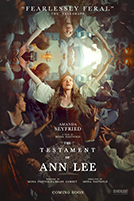
| With | Amanda Seyfried, Thomasin McKenzie, Lewis Pullman, Stacy Martin, Tim Blake Nelson, Christopher Abbott |
| Runtime | 137 minutes |
| Release | 2026-12-25 |
| Rating | 7/10 |
The fascinating and incredible true story of Ann Lee, founder of the religious cult known as the Shakers. This passionate prophetess, who preached gender equality and social justice, was adored by her followers.
The review
By Mulder 2026-02-28
There are films that reconstruct history, and then there are those that attempt to bring it back to life, to make it sweat, tremble, and even sing again. The Testament of Ann Lee clearly belongs to the latter category: a resolutely strange, sometimes disturbing, often exhilarating religious epic that approaches faith in a way that most films avoid, that is, up close, without a smirk, without taking the comfortable distance of saying to oneself, “These people are weird, aren't they?” Mona Fastvold doesn't treat the Shakers as a museum label or a joke about minimalist furniture; she treats them as human beings clinging to something that keeps them alive. The result is a musical where the body becomes the instrument, where devotion resonates as a breath, foot-stomping, and collective momentum, and where ecstasy becomes its own language.
At the center of it all is Amanda Seyfried, who delivers a masterful performance that not only carries the film, but haunts it. She embodies Ann Lee with an authenticity that never veers into vanity and a conviction that never sinks into caricature, even when the story flirts with the fine line between prophet and cult leader. The film wisely leaves room for ambiguity: the question of whether she is touched by God or broken by life hangs over each chapter, and Amanda Seyfried doesn't give us the answer, she embodies it. Her physicality is crucial; she can move with wild freedom, then return to an almost terrifying calm, and this contrast makes the character both saintly and stubbornly human. The repeated births and repeated losses are not used as cheap tragic fuel; they seem to be the molten core around which her doctrine hardens, and it is difficult not to interpret her gospel of celibacy as an attempt to regain control in a world where women's bodies are treated as public property.
Formally, Mona Fastvold and co-writer Brady Corbet construct the film as a true “testament” in the literal sense: chaptered, narrated, mythical, and at times exasperating in its refusal to smooth things over for the audience. The narration (guided by Thomasin McKenzie) gives the story a fairy-tale structure, but the images and sound constantly attempt to escape this structure, as if the story itself were rebelling against being neatly summarized. Visually, the film is tactilely dense, filmed with a pictorial rigor that makes certain shots feel as if they are lit from within, with chiaroscuro doing half the emotional work before anyone speaks. This is the kind of period film that doesn't want the past to be accessible; it wants it to be other, alien, and intense, governed by different laws, and that's exactly why it works when the cult turns into a physical spectacle.
It is in this spectacle that the film becomes something that one doesn't so much watch as endure and surrender to. Celia Rowlson-Hall's choreography is not decorative; it is theology. Bodies rise, hands beat chests, arms stretch upward as if trying to bring the sky closer, and the result is hypnotic, sometimes frightening, and strangely transporting. There is a constant tension in the film's body language: the Shakers forbid sex, but the cult is charged with sublimated desire, as if the body were trying to speak the only language it has been ordered to forget. This is where the film becomes truly provocative: devotion as purification and displacement, ecstasy as freedom and constraint. This is also where Daniel Blumberg's work takes on its full meaning: the hymns and choral textures do not seek to imitate the catchy melodies of Broadway, but rather to create a trance, repeating phrases until they become heartbeats; and when a touch of modernity cuts through the score, it can be seen as a deliberate break, reminding us that this is not a static reconstruction, but a confrontation with time.
The supporting roles provide the film with a world to fight against, which is important because the film is as obsessed with the community as it is with its central character. Lewis Pullman brings down-to-earth loyalty as the brother, a presence that makes faith feel like a physical force: supportive, unshakeable, and quietly sacrificial. Christopher Abbott is perfect as the husband whose face alone is enough to convey the film's darkest comedy: the dawning horror of realizing that the woman he married has constructed a theology in which he is, spiritually speaking, the problem. This friction is one of the most striking elements of the film, as it is not just a marital conflict, but an ideology clashing with appetite, and the film refuses to make things easy for either side. Furthermore, the broader narrative arc from England to America, from suspicion to persecution, from utopia to backlash, echoes the creators' ongoing fascination with the ambition and cost of building a world within a hostile world, but filtered through a very different kind of monument: not architecture, but belief.
This film tests the viewer's endurance. The first part is very dynamic: the music comes across like an eruption, the scenes of worship are electrifying, the historical brutality is visceral. Then, once the community arrives on American soil, the narrative can begin to feel more mannered and repetitive, as if the structure is tightening in the same order that Ann Lee tries to impose on chaos. This may be partly intentional, but intention is not always synonymous with momentum, and there are passages where the film admires its own artistry a little longer than necessary. Yet even when it slows down, it never becomes complacent: the respect shown to its believers is genuine, the images remain striking, and the entire project possesses that rare ambitious quality that allows us to sense that the filmmakers are staking their reputations on the idea that audiences can accept something strange, rigorous, and spiritually ambiguous.
Ultimately, what stands out most in The Testament of Ann Lee is that it doesn't ask us to join the Shakers, but to take their inner life seriously. It finds joy in the strangest beliefs without turning that joy into a joke, and it identifies the human needs that lie behind the doctrine: grief, action, desire, community, the desperate desire to bring order to a world on fire. It's not a perfect film, and its drift in the second half may leave some viewers exhausted rather than exhilarated, but as a cinematic work, the film is unique, courageous, and unforgettable.
The Testament of Ann Lee
Directed by Mona Fastvold
Written by Mona Fastvold, Brady Corbet
Produced by Andrew Morrison, Joshua Horsfield, Viktória Petrányi, Mona Fastvold, Brady Corbet, Gregory Jankilevitsch, Klaudia Śmieja-Rostworowska, Lillian LaSalle, Mark Lampert
Starring Amanda Seyfried, Thomasin McKenzie, Lewis Pullman, Stacy Martin, Tim Blake Nelson, Christopher Abbott
Cinematography: William Rexer
Edited by Sofía Subercaseaux
Music by Daniel Blumberg
Production companies: Annapurna Pictures, Kaplan Morrison, Intake Films, Mid March Media, FirstGen
Mizzel Media, Yintai Entertainment, ArtClass Films, Carte Blanche, Parable
Distributed by Searchlight Pictures (Etats-Unis), The Walt Disney Company France (France)
Release dates: September 1, 2025 (Venice), December 25, 2025 (United States), March 11, 2026 (France)
Running time: 137 minutes
Seen on January 21, 2026 at The Walt Disney Company headquarters